From Task Capture to Workflow: How Humanoid Robots Learn a Factory Job
Recording the operators who already do the work, then turning it into a deploy-ready humanoid workflow. Here's how Motion's Field Deployment Engineers and the AI Workflow Builder get a robot running your tasks.
Motion1 Inc. ·
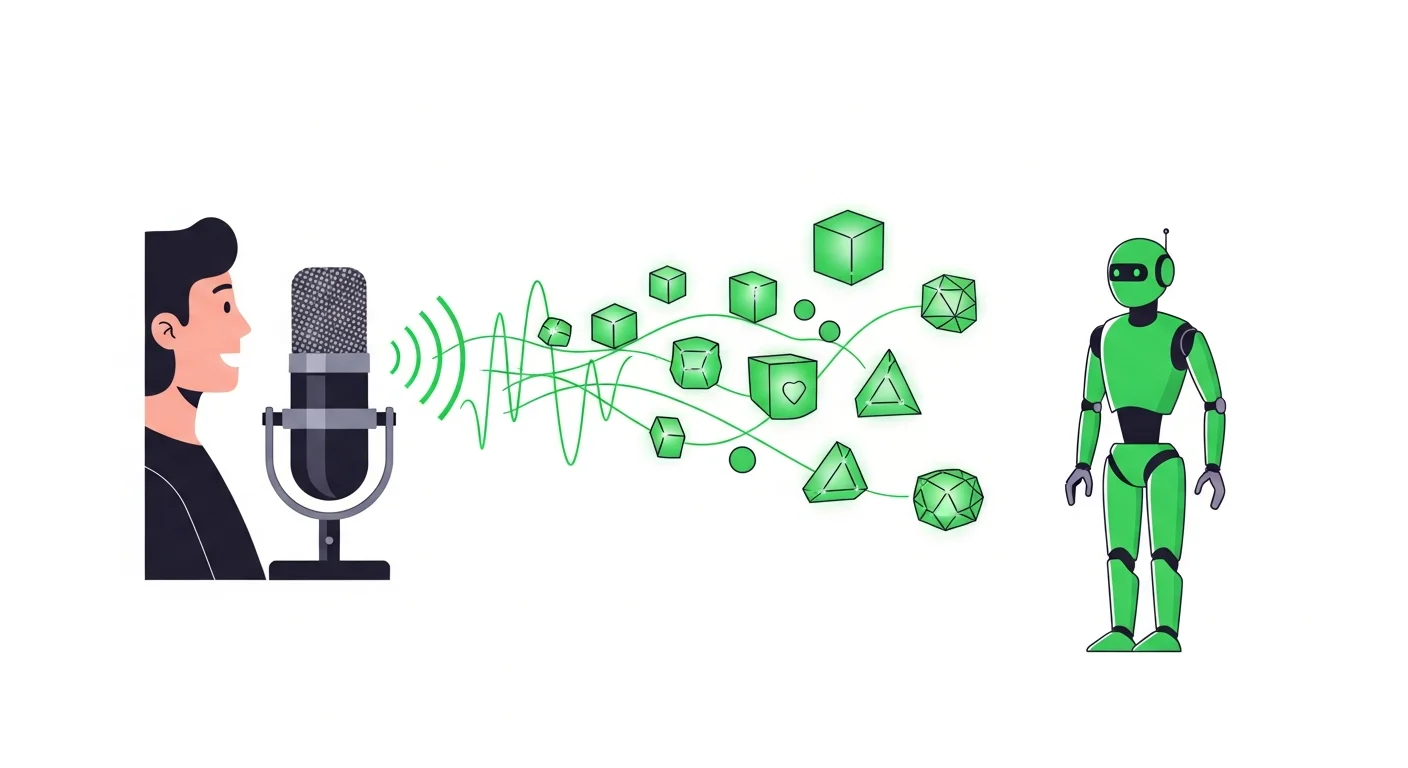
The End of Robot Programming as We Know It
For as long as robots have existed in industry, making them do useful work has required specialised programming. Whether the language was proprietary - like the teach pendants used for industrial arms - or general-purpose like Python and C++, the fundamental constraint was the same: a human with deep technical knowledge had to manually specify every aspect of the robot's behaviour, from high-level task logic down to individual joint trajectories.
Physical AI breaks that constraint. Once a model can watch a task being done and infer the intent behind the motion, specifying behaviour shifts from writing code to showing the work.
This constraint shaped the entire economics of robotics. It meant that every deployment required expensive engineering talent. It meant that every new task required a new programming effort. It meant that the people who understood the work - the operations managers and line workers - were separated from the people who could program the robots by a translation layer of consultants and engineers that added cost, time, and miscommunication at every stage.
Egocentric task capture is the technology that dissolves this constraint. An operations manager shows what needs to be done - recorded from their own point of view as they do it, alongside a spoken account of the steps: pick products from the conveyor, inspect for defects, pack into boxes of six, seal and palletise. Field Deployment Engineers turn that capture into a deployment-ready workflow in the AI Workflow Builder. No engineering hire on the manufacturer's side. No robotics degree. No months of iteration on the factory floor.
The implications extend far beyond convenience. This model fundamentally changes who can deploy robots, how fast they can be deployed, and at what cost. It is to robotics what the spreadsheet was to financial modelling, what the web browser was to information access, and what the smartphone was to personal computing: a technology that moves a powerful capability from specialists to everyone.
Inside the Pipeline
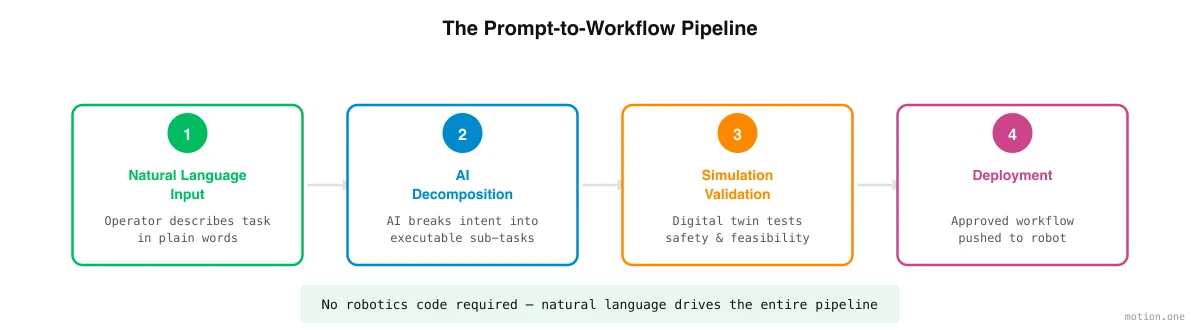
The apparent simplicity of showing a task and receiving a working workflow conceals a sophisticated pipeline of AI agents working in concert. Understanding what happens behind the scenes is useful for evaluating the maturity and reliability of different deployment platforms.
The pipeline begins with task decomposition. A specialised AI agent parses the captured task - the recordings and the operator's account of the steps - and breaks it into discrete manipulation steps. "Package products into boxes" becomes a sequence of atomic actions: approach the conveyor, identify the product, grip with appropriate force, transport to the box, orient correctly, place, release, repeat until the box is full, seal the box, transport to the pallet, and stack according to the defined pattern. This decomposition must account for the order of operations, the dependencies between steps, and the decision points where the robot must choose between alternative actions.
Next, a scene generation agent creates a three-dimensional simulation of the real environment. Using photographs and video of the actual factory - captured with ordinary cameras - the agent reconstructs the geometry, identifies key objects (conveyors, boxes, products, pallets), and assigns realistic physics properties (mass, friction, deformability) to each element. The result is a digital twin specific to the manufacturer's facility.
A policy training agent then takes over, using reinforcement learning and on-site teleoperation data to train the humanoid to execute each step within the simulation. The robot practises thousands of iterations per hour, receiving rewards for successful task completion and penalties for failures. Through this process, it develops a control policy - a mapping from sensory input to motor output - that achieves the target accuracy for each step.
A deployment agent validates the trained policy through a battery of tests, handles the sim-to-real transfer process, and manages the handoff to physical hardware with real-time monitoring during initial operation.
Finally, an orchestration agent coordinates across multiple humanoids when the task requires robot-to-robot collaboration or when multiple units are working on related tasks in the same facility.
What Task Capture Changes
The shift from programming to task capture is not just a change of tooling. It fundamentally restructures the relationship between the people who understand the work and the robots that perform it.
In the traditional model, the operations manager knows what needs to be done, but cannot communicate it directly to the robot. They must explain it to a robotics engineer, who interprets it (with inevitable loss of nuance and context), translates it into code (with inevitable assumptions and simplifications), and iterates (with inevitable misalignment between what was requested and what was delivered). This telephone game adds months of time, tens of thousands of dollars in cost, and a persistent gap between intent and implementation.
In the task capture model, the operations manager conveys the work the way they already know it: by doing it on camera and walking a Field Deployment Engineer through it. The Workflow Builder handles the translation from captured task to robot behaviour. The feedback loop is tight - if the resulting workflow does not match the intent, the manager says so, and the system regenerates the workflow in minutes rather than weeks.
This is not merely faster. It is a qualitative change in who participates in the automation process. The global population of robotics engineers numbers in the tens of thousands. The global population of operations managers, shift supervisors, and domain experts who can demonstrate a manufacturing task numbers in the millions. Task capture expands the pool of people who can put a robot to work by two orders of magnitude.
The Iteration Loop
Deployment is not a one-shot process, and treating it as such would be misleading. The most effective deployments use an iterative loop that converges on production-ready quality through rapid cycles of refinement.
The process begins with an initial capture of the task at a high level. The platform generates a first-draft workflow and runs it in simulation. The operations manager reviews the simulation results, identifies discrepancies between the robot's behaviour and the desired outcome, and supplies the missing detail - a second recording, a correction, a constraint the team takes for granted. The platform regenerates the workflow, and the cycle repeats.
Each iteration takes minutes in simulation, compared to hours or days on the factory floor. Most workflows reach production-ready quality in three to five iterations - a process that can be completed in a single working day. Compare this to the fifty to one hundred iteration cycles that traditional on-floor development typically requires over a period of months, and the acceleration is clear.
Honest Boundaries
Task capture is a powerful approach, but it is not magic, and its current limitations should be clearly understood.
Highly dexterous tasks - threading needles, tying knots, manipulating very small or very flexible components - remain at the edge of what current systems can handle. The gap between human hand dexterity and humanoid gripper capability is real, though it is closing with each hardware generation.
Novel environments take longer than familiar ones. The first deployment in a completely new type of facility requires more iteration than subsequent deployments in similar facilities, because the simulation models have less prior data to draw on.
Dynamic environments where conditions change unpredictably - outdoor construction sites, agricultural fields, unstructured retail spaces - are harder to simulate accurately than controlled factory settings, and the resulting policies require more real-world fine-tuning.
These limitations are real today. They are also shrinking with every deployment, as the data flywheel improves simulation fidelity and the reinforcement learning algorithms encounter and adapt to an ever-wider range of conditions. The trajectory is clear: what is difficult today will be routine tomorrow.