How to Deploy Humanoid Robots in Manufacturing Without Robotics Engineers
Motion's Field Deployment Engineers train the robot on your tasks and train your team to run alongside it - deploy and scale with no robotics engineers on staff.
Motion1 Inc. ·
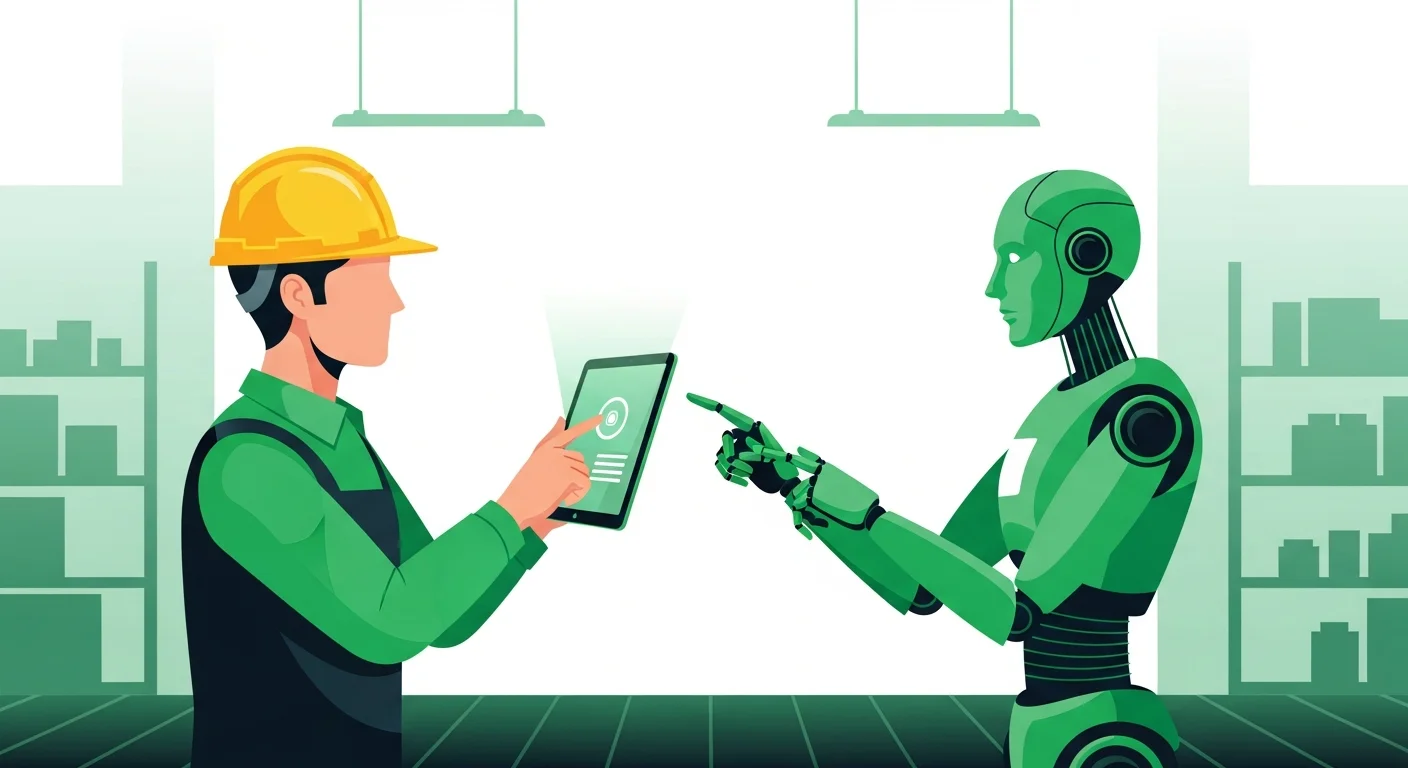
The manufacturing sector faces a paradox. Demand for automation has never been higher, yet the engineers needed to implement it have never been harder to find. Humanoid robots - general-purpose machines that can navigate human-designed workspaces and perform a wide range of physical tasks - are entering factories at an accelerating pace. They are the clearest example so far of physical AI: artificial intelligence that perceives, decides and acts in the physical world rather than on a screen. But the traditional deployment model assumes something most manufacturers simply do not have: a team of robotics engineers.
That assumption is changing. A new deployment model is making it possible for domain experts - the plant managers, process engineers, and operations leads who understand the work - to put humanoid robots on the floor without hiring a robotics team. Field Deployment Engineers train the robot on the tasks those experts define, and train their operators to work alongside it. This article explains how that works, what it requires, and what manufacturers should know before getting started.
---
The Robotics Talent Gap: Why Finding Engineers Is Nearly Impossible
The global shortage of robotics engineers is not a temporary hiring challenge. It is a structural constraint. Universities produce a fraction of the specialists the market demands, and those who graduate are overwhelmingly absorbed by technology companies, defence contractors, and research labs. The manufacturing sector - especially small and mid-sized enterprises - is left competing for a talent pool that barely exists.
According to industry workforce analyses, the gap between open robotics positions and qualified candidates has widened every year since 2022. In Western Europe, the situation is particularly acute: ageing workforces, declining enrolment in technical programmes, and intense cross-border competition for talent mean that a mid-sized manufacturer in Germany or the Netherlands may wait twelve months or more to fill a single robotics engineering role.
This talent gap does not just slow adoption. It creates a dependency. Manufacturers who do manage to hire a robotics engineer become operationally dependent on that individual. When they leave - and in a market this competitive, they often do - the entire automation programme stalls.
The conclusion is straightforward: if deploying humanoid robots requires robotics engineers, most manufacturers will never deploy them. The industry needs a different model.
---
The Old Way vs the New Way: Writing Code vs Training the Robot
Traditional robot programming is a specialised discipline. It involves writing motion plans in languages like Python or C++, configuring sensor integrations, tuning control loops, building state machines, and debugging behaviour in simulation before transferring to hardware. Each robot platform has its own SDK, its own conventions, and its own failure modes. Even experienced software engineers face a steep learning curve when moving into robotics.
This is the old way: write code, compile, simulate, test, deploy, debug, repeat. It works, but it demands expertise that most manufacturers cannot access.
The new way replaces in-house robotics work with a deployed service. Instead of writing a motion plan, a plant manager describes the job to a Field Deployment Engineer, who trains the robot on that task until it runs it autonomously. An AI Workflow Builder configures each workflow and integrates the humanoid into the specific use case, and every workflow is validated in simulation before it reaches the floor. The domain expert stays in control of what the robot does. The deployment team handles how it does it.
This is not a simplification of the old process. It is a fundamentally different division of labour. The person who understands the manufacturing process no longer needs to hire and retain a robotics engineer to get a machine onto the line. That expertise arrives with the deployment and stays with it.
---
How the AI Workflow Builder Configures a Robot Task
The AI Workflow Builder is a software layer that sits between the customer's use case and the robot hardware. Field Deployment Engineers use it to perform several functions that were previously the exclusive domain of an in-house engineering team:
Task capture. The work starts from the customer's own account of the job - "Pick up the component from the conveyor belt, inspect it visually, and place it in the appropriate bin based on quality grade" - together with egocentric recordings of operators performing it. The builder decomposes that into a structured sequence of actions the robot can execute.
Motion planning. For each action in the sequence, the platform generates motion plans that account for the robot's physical capabilities, the workspace geometry, obstacle avoidance, and efficiency constraints. This is the work that traditionally required a controls engineer with deep knowledge of kinematics and dynamics.
Sensor integration. Modern humanoid robots are equipped with cameras, force sensors, LiDAR, and other perception systems. The Workflow Builder configures how these sensors are used for each task - which camera feeds to process, what force thresholds to set, how to interpret visual data for quality inspection - without the manufacturer writing a line of integration code.
Validation and safety checking. Before any task reaches the physical robot, the platform runs it through simulation and safety validation. It checks for collisions, verifies that force limits are within safe ranges, ensures the task sequence is complete, and flags potential issues for human review.
Continuous learning. As the robot executes tasks, the platform collects performance data and uses it to refine how future workflows are configured. Over time, the system becomes better at handling the specific layout, part mix, and operational context of each facility. That data stays the customer's.
The result is a system where the robotics expertise sits with the platform and the deployment team, not on the factory's payroll. The customer provides the domain knowledge - what needs to happen on the factory floor. Motion provides the robotics knowledge - how to make it happen safely and efficiently.
---
From Described Task to Robot Action: The Deployment Pipeline
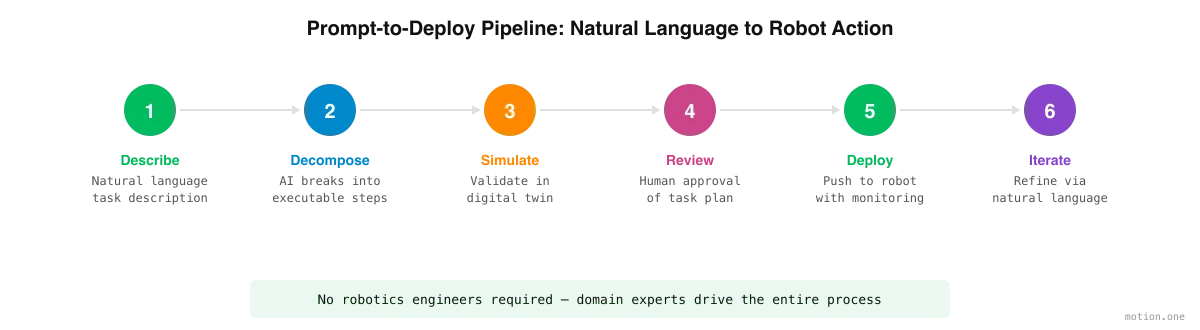
The process of going from a described task to a deployed robot task typically follows a consistent pipeline:
Step 1: Task capture. The operator describes the task and, where it helps, is recorded performing it. The description can be as high-level as "sort incoming parts by size" or as specific as "pick up items from position A, rotate 90 degrees, and place at position B with the label facing up." The Field Deployment Engineer works from both the description and the recording, going back to the operator whenever the job is ambiguous.
Step 2: Task decomposition. The Workflow Builder breaks the task into discrete, executable steps. For a sorting task, this might include: approach conveyor, identify part, measure dimensions, classify by size category, pick, navigate to correct bin, place. Each step is mapped to robot capabilities.
Step 3: Simulation. The full task sequence runs in a digital twin of the workspace. The operator can watch the simulated execution, identify issues, and refine the task description. This is where most errors are caught - before the physical robot moves at all.
Step 4: Human review and approval. The platform presents the validated task plan to the operator for approval. Critical parameters - speed limits, force thresholds, exclusion zones - are highlighted for explicit confirmation. Nothing deploys without human sign-off.
Step 5: Deployment. The approved task is pushed to the robot. Execution begins with heightened monitoring. The platform tracks performance in real time and can pause the robot automatically if anomalies are detected.
Step 6: Iteration. Based on real-world performance, the task gets refined. "Slow down during the placement step" or "add a pause after inspection for manual override" are the kinds of adjustments that previously required an in-house engineer to rewrite code. Now they are a request to the deployment team, applied in the Workflow Builder and re-validated in simulation before the change reaches the floor.
---
What "No Robotics Expertise Required" Actually Means in Practice
It is important to be precise about this claim. "No robotics expertise required" does not mean "no expertise required." Deploying humanoid robots effectively still demands deep knowledge - it is just a different kind of knowledge.
The people best positioned to deploy robots in a manufacturing environment are the people who already understand that environment: process engineers who know the workflow, quality managers who understand inspection criteria, operations leads who know where bottlenecks occur and where automation adds the most value.
What they do not need to know is how to write ROS nodes, tune PID controllers, or configure URDF models. They do not need to understand inverse kinematics or write computer vision pipelines. Motion's Field Deployment Engineers and the Workflow Builder handle all of that.
In practice, "no robotics expertise required" means:
- No programming. Tasks are described by the people who do them, then configured in the Workflow Builder by Field Deployment Engineers.
- No mechanical engineering. The platform handles motion planning and physical constraints.
- No computer science degree. Sensor integration, perception, and decision logic are managed by the platform and the deployment team.
- Domain expertise is essential. The operator must understand the manufacturing process, quality standards, safety requirements, and operational context. This knowledge cannot be outsourced - it is the input the whole deployment depends on.
The shift is from robotics expertise to process expertise. The people closest to the work become the people the robot is trained around, and the people who decide what it does next.
---
The Role of Simulation and Digital Twins
Simulation is not optional in this model - it is foundational. When the factory has no robotics engineer on staff, you need a mechanism to catch errors before they reach the physical world. That mechanism is the digital twin.
A digital twin is a virtual replica of the physical workspace - the factory floor, the conveyor systems, the storage areas, the robot itself. Workflows built for the robot are first executed in this virtual environment, where failures are costless and iteration is fast.
For manufacturers deploying without robotics engineers, the digital twin provides several critical functions:
Risk-free experimentation. Operators can try different task configurations, test edge cases, and explore "what if" scenarios without any risk to equipment, products, or personnel.
Visual validation. Non-technical operators can watch the simulated task and immediately see whether the robot is doing what they intended. This visual feedback loop replaces the code review that an in-house engineer would normally perform.
Performance benchmarking. The simulation provides cycle time estimates, identifies potential bottlenecks, and helps operators optimise task sequences before committing to physical deployment.
Training data generation. The simulation environment generates synthetic data that improves the AI's ability to handle variations in the real world - different part orientations, lighting conditions, or unexpected obstacles.
The quality of the digital twin directly affects the reliability of the deployment. Leading platforms invest heavily in physics-accurate simulation engines that model not just geometry but also material properties, friction, deformation, and sensor noise. The closer the twin matches reality, the fewer surprises arise during physical deployment.
---
The Learning Stack: VLAs, World Models and Reinforcement Learning
Why is any of this possible now, when it was not five years ago? Because the way robots learn has changed. Three ingredients, each a public research breakthrough of the last few years, make the deployment model work:
Vision-language-action models (VLAs). A VLA is a single neural network that takes in what the robot sees and a description of the task, and outputs the motor commands to do it. This is the technology behind the whole "show, don't program" shift: because the model connects perception, language and action directly, a robot can be trained from demonstrations of a task rather than programmed with hand-written motion code. It is the reason an operator's first-person recordings are useful training material at all.
World models. A world model is an AI system that has learned how a physical scene behaves - how objects move, fall, stack, and respond to contact. World models are what make digital twins more than pretty animations: the robot can rehearse a task through thousands of simulated variations, including situations that never occurred in the recordings, because the simulation predicts plausible physics rather than replaying fixed scripts.
Reinforcement learning. Demonstrations give the robot a starting behaviour; reinforcement learning sharpens it. In simulation, the robot attempts the task over and over, is scored against the criteria that matter - success rate, cycle time, safe force limits - and updates itself toward what scores well. This is how a behaviour goes from "roughly what the human showed" to reliable at production quality, and how it keeps improving from the assisted runs during deployment.
None of these techniques belongs to any one company - they are the current state of the art in robot learning. What matters for a manufacturer is that together they replace the thing that used to be the bottleneck: an engineer writing task-specific code. The robot learns the task; the engineers who visit your site are there to teach it, not to program it.
---
Teleoperation: The Bridge From Simulation to Autonomy
Simulation catches most errors, but no digital twin predicts everything a real production day throws at a robot. That gap is closed on the floor. During the deployment, engineers teleoperate the humanoid through the edge cases the simulation could not fully anticipate - the mislabelled part, the crooked pallet, the tote that arrives half-open.
Teleoperation does two jobs at once. It keeps the line moving while the robot is still learning, because a human is in the loop for exactly the situations the robot cannot yet handle on its own. And it generates the most valuable training data there is: every assisted run is a demonstration of the correct behaviour, folded back into the robot's skills. Over the course of a deployment the balance shifts - assisted runs become rarer, autonomous runs become the norm, until the robot stands on its own.
None of this requires anyone on the customer's staff to operate a robot. The teleoperation, like the rest of the robotics work, arrives with the deployment team and leaves behind a robot that no longer needs it.
---
Real-World Deployment: What the Process Looks Like Without Engineers
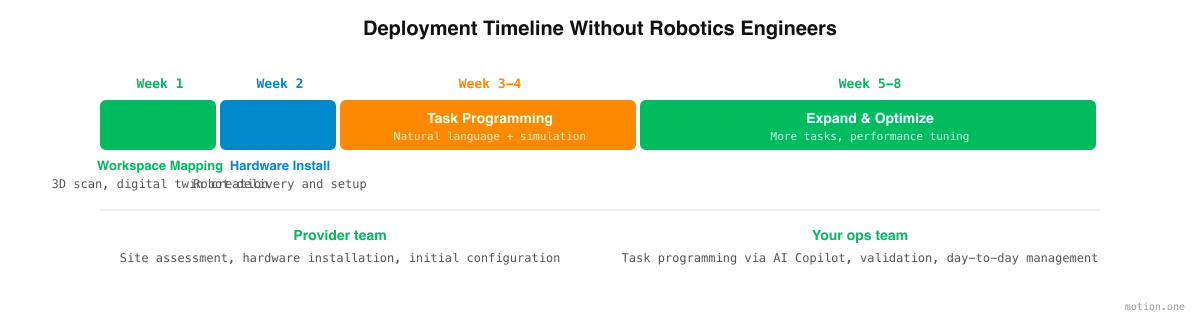
Here is what a typical integration mission looks like for a mid-sized manufacturer without a robotics engineer on staff:
Weeks 1-2: Site assessment and workspace mapping. The deployment team conducts a site assessment - on-site or remotely using 3D scanning. The physical workspace is digitised to create the digital twin, and the key workflows are documented and prioritised.
Weeks 3-4: Hardware installation and task capture. The humanoid robot is delivered and physically installed by the deployment team, similar to how industrial equipment vendors handle installation today. In parallel, operators describe their tasks and are recorded performing them - the raw material the training starts from. No ongoing engineering staff is needed.
Weeks 5-10: Training, simulation and assisted operation. Field Deployment Engineers train the robot on the customer's tasks, starting with the simplest and most repetitive. Every workflow is rehearsed in the digital twin, reviewed by the operations team, and refined before it reaches the floor. On the floor itself, engineers teleoperate the robot through the remaining edge cases, and every assisted run pushes the task closer to autonomy. The first tasks are typically pick-and-place, palletising, or basic material handling - high-volume, low-variability work that delivers immediate ROI.
Weeks 11-15: Autonomy handover and optimisation. Assisted runs taper off as the robot takes over. The team expands to more complex workflows - inspection tasks, kitting operations, machine tending - and operators are trained on each one as it goes live. Performance data from early tasks improves accuracy for subsequent ones.
Ongoing: Monitoring and iteration. The fleet platform tracks task performance, robot utilisation, error rates, and maintenance alerts. Operations staff flag changes as production requirements shift - a new product line, a modified workflow, a seasonal volume shift. Those adjustments are made in the Workflow Builder and re-validated in simulation, without the factory hiring an engineer.
Throughout the mission, the customer follows progress and gives every approval in a secure online portal, not in email threads. A typical integration mission runs 12 to 15 weeks from site assessment to autonomous operation, with a Field Deployment Engineer on-site throughout. Compare that to the traditional model, where hiring a robotics engineer alone can take three to six months - before any deployment work has started.
---
Safety and Compliance Without Specialised Staff
Safety is the most common concern manufacturers raise when considering deployment without robotics engineers. It is a legitimate concern - and one that modern AI platforms are designed to address directly.
Built-in safety frameworks. The platform enforces safety constraints at the system level, not the user level. Speed limits, force thresholds, exclusion zones, and emergency stop behaviours are configured according to industry standards and cannot be overridden by task-level instructions. No workflow configuration can push the robot faster than safe limits allow.
Regulatory compliance automation. Standards like ISO 10218 (industrial robot safety) and ISO/TS 15066 (collaborative robot safety) define specific requirements for force limiting, speed reduction, and safety-rated monitored stop. The platform encodes these requirements directly, ensuring that every task plan is compliant by default.
Risk assessment support. The platform can generate risk assessment documentation based on the configured tasks and workspace - the kind of documentation that regulatory bodies and workplace safety inspectors require. This does not replace a proper safety audit, but it provides a structured starting point that would traditionally require a safety engineer to produce.
Anomaly detection. During operation, the platform continuously monitors for deviations from expected behaviour. If the robot encounters unexpected resistance, if a sensor reading falls outside normal range, or if a human enters a restricted zone, the system responds automatically - slowing down, stopping, or alerting the operator - without anyone at the factory having to configure those responses.
Audit trails. Every task definition, simulation result, approval, and deployment event is logged. This creates a complete audit trail for regulatory compliance, incident investigation, and continuous improvement.
The key insight is that safety expertise, like robotics expertise, sits with the platform and the deployment team rather than being required of the operator. The operator's responsibility is to accurately describe the task and the operational context. The platform's responsibility is to ensure that task is executed safely.
---
Getting Started: What Manufacturers Need to Know
For manufacturers considering this path, here are the practical considerations:
Start with the right tasks. Not every manufacturing task is equally suited for initial humanoid robot deployment. Begin with tasks that are repetitive, physically demanding, and well-defined: material handling, palletising, basic inspection, machine tending. These tasks deliver the fastest ROI and provide the operational experience needed to tackle more complex work later.
Assess your workspace. Humanoid robots operate in human-designed environments, but they still need adequate space, appropriate lighting for vision systems, and stable surfaces. Most modern factories meet these requirements, but a pre-deployment assessment is essential.
Identify your domain experts. The people who will programme and manage the robots should be the people who understand the work best. This is typically a process engineer, a senior operator, or a production manager - someone who can clearly articulate what needs to happen and evaluate whether the result meets quality standards.
Agree success criteria up front. Decide before the deployment starts what success looks like: which tasks, what throughput, what quality bar. Written success criteria keep both sides honest and turn the decision at the end of a pilot into a measurement rather than a debate.
Plan for change management. Introducing robots changes workflows, and it changes how people feel about their work. Transparent communication about what the robot will do (repetitive, physically demanding tasks) and what people will do (supervision, quality assurance, higher-value work) is essential for successful adoption.
Evaluate providers on deployment support, not just technology. The software is only part of the equation. Evaluate providers on the completeness of their deployment support: site assessment, hardware installation, initial task programming assistance, training, and ongoing support. The best technology is worthless without a reliable path from purchase to production.
Think in terms of leasing, not buying. The economics of humanoid robot deployment are shifting. A 36-month operating lease with maintenance, fleet software, and insurance included - and a buyout option at the end - turns the robot into a predictable operational expense rather than a capital investment. This removes the upfront financial barrier and aligns costs with value delivery.
The window of advantage is open now. Manufacturers who deploy humanoid robots today - even without robotics engineers on staff - will build operational capabilities and institutional knowledge that compounds over time. Those who wait for the "perfect" conditions, the "right" hire, or the "mature" technology will find themselves permanently behind.
The robots are ready. The deployment model is ready. The question is whether your operation is ready to let the people who understand the work define what the machines do.
---