Scenario: Humanoid Robots in Logistics Palletising
A modelled scenario: four humanoid robots on mixed-case palletising and truck loading at a regional logistics operator, and the results a deployment of this shape can achieve.
Motion1 Inc. ·
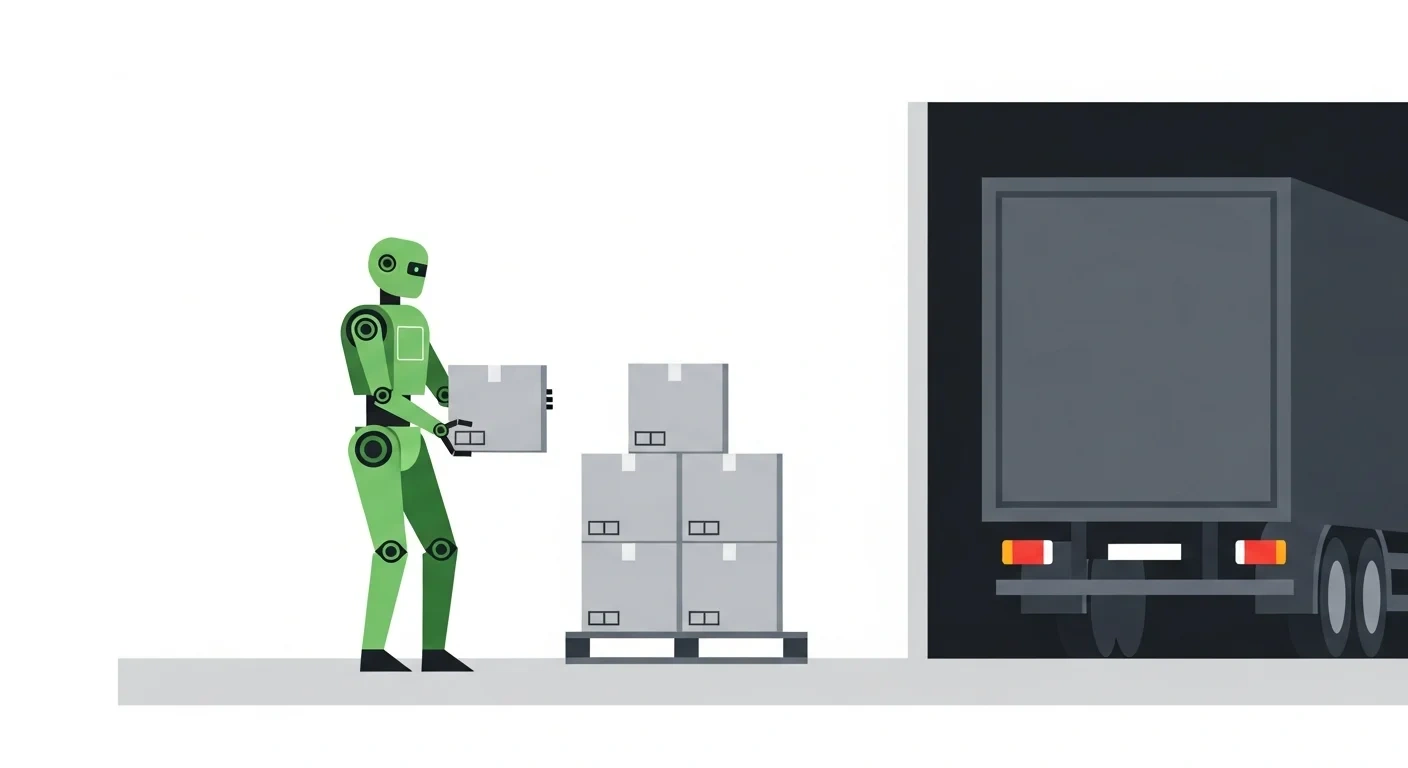
Logistics Operator - Palletising and Loading Dock Operations
A modelled scenario: this article describes a representative deployment, built from operational patterns typical of the sector, rather than a report on a named customer engagement. The figures are illustrative estimates of what a deployment of this shape can achieve.
The Challenge
A regional logistics operator managing three distribution centres faced chronic staffing difficulties in its palletising and loading dock operations. These roles involve repetitive heavy lifting - stacking cases onto pallets and loading pallets into trucks - and are among the hardest positions to fill in the logistics industry.
The operator had explored traditional palletising automation (robotic arms with fixed gantries) but found the capital cost prohibitive given the variety of product sizes and pallet configurations they handle. Their operations require flexibility: different clients ship different products in different case sizes, and pallet configurations change daily based on order composition.
The Solution
The operator deployed four humanoid robots across its largest distribution centre, focusing on two workflows:
- Mixed-case palletising. Robots build pallets from mixed product cases, following pallet-build plans generated by the warehouse management system. The robots handle cases ranging from 2 to 25 kilograms and can adjust stacking patterns dynamically based on case dimensions and weight distribution.
- Truck loading. Robots transport completed pallets from the staging area to the loading dock and position them in the truck according to the load plan. This requires navigating a dynamic environment with other workers, forklifts, and changing truck positions.
The fleet software proved particularly valuable in this deployment. Dock supervisors could adjust robot priorities in real time - for example, pulling a robot from palletising to support an urgent truck loading - straight from the fleet dashboard, without a workflow having to be rebuilt.
Deployment Timeline
- Month 1-3: Facility mapping, safety assessment, and infrastructure preparation. The loading dock area required minor modifications to accommodate robot pathways, including floor markings and low-profile guidance strips.
- Month 4-5: Two robots deployed on palletising operations. Initial focus was on the five highest-volume product lines to build reliable workflows before expanding.
- Month 6-7: Third and fourth robots deployed. Truck loading operations began with human supervision at the dock.
- Month 8-10: Full autonomous operation for palletising. Truck loading moved to supervised autonomy (one human dock coordinator overseeing robot operations).
Modelled Results (First 12 Months)
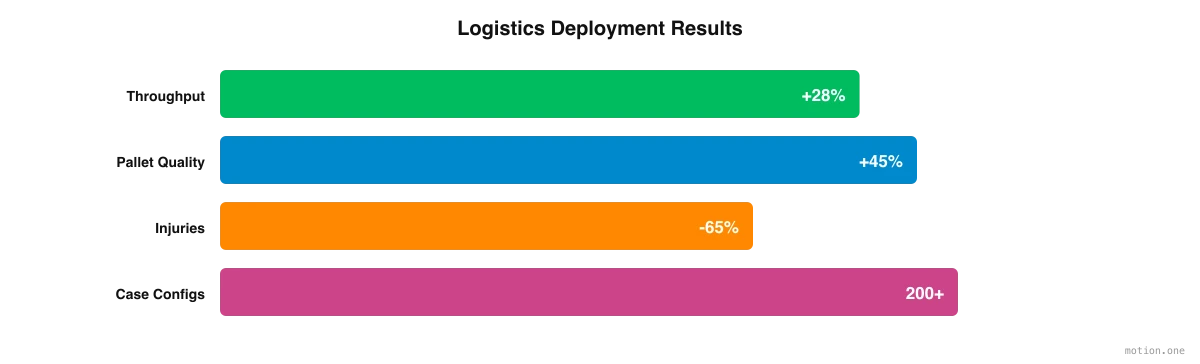
- Palletising throughput: 28% increase in pallets built per shift, driven by continuous operation without breaks and consistent cycle times.
- Pallet quality: Pallet stability issues (cases falling during transport) reduced by 45%, attributed to more consistent stacking patterns and weight distribution.
- Labour hours saved: Approximately 15,000 labour hours per year redirected from manual palletising and loading to inventory management and dispatch coordination.
- Injury reduction: Musculoskeletal injury reports in the dock area decreased by 65%. These injuries had previously accounted for the majority of workers' compensation claims at the facility.
- Flexibility: The robots successfully handled over 200 distinct case configurations during the period, demonstrating the flexibility advantage over fixed palletising systems.
- Shift coverage: The operator eliminated unfilled-shift incidents in the dock area entirely. Prior to deployment, an average of 12 shifts per month went partially or fully unstaffed.
What Made This Deployment Work
Looking back across the operator's first year with humanoid robots on the dock, several factors stand out:
Staffing was the primary driver. The decision to deploy humanoid robots came from difficulty hiring and retaining workers for physically demanding, repetitive roles. Cost reduction was a secondary benefit, not the primary motivation.
Phased deployment worked best. The operator started small - two robots, the five highest-volume product lines, human oversight at the dock - and expanded gradually over ten months. This approach allowed the team to build confidence, refine workflows, and address issues before scaling.
Workflow libraries accelerated scaling. Capturing pallet-build workflows in a central library meant the third and fourth robots inherited patterns already proven on the first two, rather than being configured from scratch. Over the year the fleet handled more than 200 distinct case configurations.
Deployment support lowered the adoption barrier. Dock supervisors are not robotics engineers, and never had to become them. Field Deployment Engineers trained the robots on the operator's own workflows, using recordings of the dock team at work, and trained that team to run alongside the machines. The operator cited this as a critical factor in adoption.
Safety was a process, not a milestone. In this scenario, safety is an ongoing activity - continuous risk assessment, regular protocol updates, iterative refinement of robot behaviour parameters - rather than treating initial safety certification as a "done" state.
Existing staff were redeployed, not replaced. Workers previously palletising and loading were reassigned to roles the operator had struggled to fill: inventory management and dispatch coordination. Net headcount at the facility did not decrease.
Key Takeaways
For operators considering humanoid robot deployment, this deployment offers several practical lessons:
- Start with roles that are hard to fill, not roles that are easy to automate. Palletising and loading were among the hardest positions in the business to staff. Before deployment, an average of 12 shifts a month in the dock area went partially or fully unstaffed.
- Invest in the software layer. The fleet management platform mattered as much as the hardware. Central workflow libraries and live priority changes are what made four robots on one dock manageable by a supervisor rather than an engineer.
- Plan for a longer ramp-up than the hardware suggests. The first three months went entirely to facility mapping, safety assessment, and dock modifications before a robot lifted a single case, and full autonomous palletising came only in month eight. Budget time and patience accordingly.
- Measure what matters. Throughput was the headline, but pallet stability, injury reports, and shift coverage mattered just as much. Musculoskeletal injury reports in the dock area fell by 65%, and unfilled-shift incidents went to zero.
- Engage your workforce early. Staff who had been palletising and loading moved into inventory management and dispatch coordination. Being explicit about that plan from the start, so the robots take the lifting and people take the coordination, is what keeps resistance low.
This operator's experience shows that humanoid robot deployment in logistics is practical, beneficial, and achievable with current technology. The key is treating it as a dock operations change rather than a technology purchase, with the mapping and safety work done up front and the workflow library doing the heavy lifting as the fleet grows.