How to deploy humanoid robots in manufacturing without robotics engineers
Deploy humanoid robots with no robotics engineers on staff: a Field Deployment Engineer trains the robot on your task, autonomous in 12 to 15 weeks.
Motion team ·
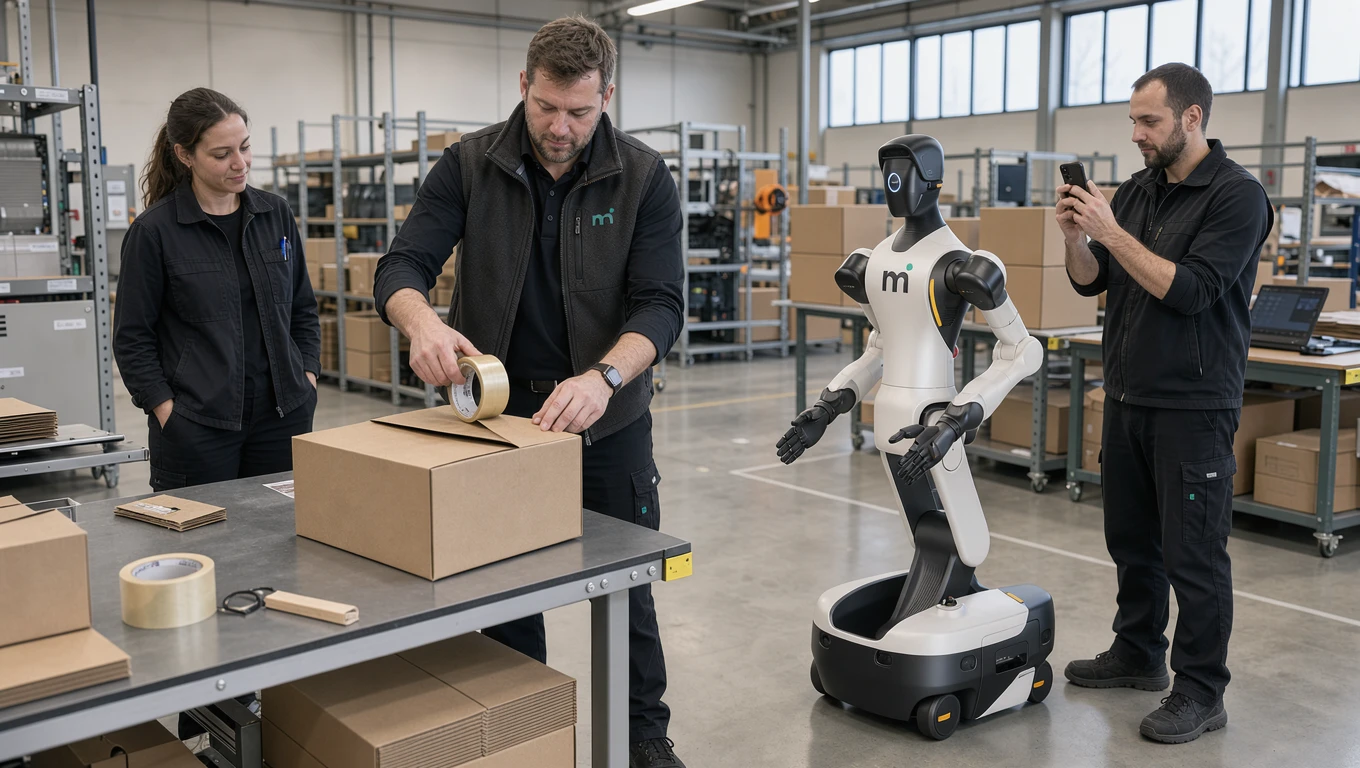
The fastest way to deploy a humanoid robot in a manufacturing facility without a large internal AI team is to buy deployment as a service. A Field Deployment Engineer records your operators doing the task, Motion operators teach the robot by teleoperation and simulation, and most deployments run on their own within 12 to 15 weeks.
Manufacturers want more automation than ever, and the engineers who implement it have never been harder to find. Humanoid robots are general-purpose machines that can move through human-designed workspaces and perform a wide range of physical tasks. They are the clearest example so far of physical AI: artificial intelligence that perceives, decides and acts in the physical world. The traditional deployment model, though, assumes something most manufacturers do not have: a team of robotics engineers.
The service model lets domain experts - the plant managers, process engineers and operations leads who understand the work - put humanoid robots on the floor without hiring a robotics team. Field Deployment Engineers train the robot on the tasks those experts define, and Motion keeps running and supporting the robot after it goes live. This article explains how that works, what it requires and what to know before getting started.
---
The robotics talent gap: why finding engineers is nearly impossible
The shortage of robotics engineers is structural. Universities produce a fraction of the specialists the market demands, and technology companies, defence contractors and research labs compete for the same graduates. Manufacturers, especially small and mid-sized enterprises, are left competing for a talent pool that barely exists.
In Germany, engineering and IT occupations still had 194 open positions per 100 unemployed specialists in the second quarter of 2025, and 284 in electrical engineering, according to the VDI/IW Ingenieurmonitor. Across Western Europe, ageing workforces, declining enrolment in technical programmes and cross-border competition for talent keep that pressure on.
The gap also creates a dependency. A manufacturer that does hire a robotics engineer becomes operationally dependent on that person, and when they leave, as they often do in a market this competitive, the whole automation programme stalls. If deploying humanoid robots requires robotics engineers on staff, most manufacturers will never deploy them.
---
Writing code vs training the robot
Traditional robot programming is a specialised discipline. Engineers write motion plans in languages like Python or C++, configure sensor integrations, tune control loops, build state machines and debug behaviour in simulation before transferring it to hardware. Each robot platform has its own SDK, conventions and failure modes, and even experienced software engineers face a steep learning curve when they move into robotics.
That cycle - write code, compile, simulate, test, deploy, debug, repeat - works, but it demands expertise most manufacturers cannot access.
The service model replaces in-house robotics work with a deployment team. A plant manager describes the job to a Field Deployment Engineer, who trains the robot on that task until it runs it autonomously. Our deployment software configures each workflow and integrates the humanoid into the specific use case, and every workflow is validated in simulation before it reaches the floor. The domain expert decides what the robot does, and the deployment team handles how it does it.
The person who understands the manufacturing process no longer needs to hire and retain a robotics engineer to get a machine onto the line, because that expertise arrives with the deployment and stays with it.
---
From described task to robot action
The deployment software sits between the customer's use case and the robot hardware. Field Deployment Engineers use it for work that used to belong to an in-house engineering team, and going from a described task to a deployed robot task usually follows the same steps.
Step 1: task capture. The work starts from the customer's own account of the job, as high-level as "sort incoming parts by size" or as specific as "pick up items from position A, rotate 90 degrees, and place at position B with the label facing up", together with first-person recordings of operators performing it. The Field Deployment Engineer works from both, and goes back to the operator whenever the job is ambiguous.
Step 2: task decomposition and planning. The software breaks the task into discrete, executable steps. For a sorting task these might be: approach conveyor, identify part, measure dimensions, classify by size category, pick, navigate to correct bin, place. For each step it plans motion around the robot's physical capabilities, the workspace geometry and obstacles, and sets how the robot's cameras and force sensors are used. The manufacturer writes no integration code.
Step 3: simulation. The full task sequence runs in a digital twin of the workspace, where the platform checks for collisions, verifies that force limits are within safe ranges and confirms the sequence is complete. The operator can watch the simulated execution, spot issues and refine the task description. Most errors are caught here, before the physical robot moves at all.
Step 4: human review and approval. The platform presents the validated task plan to the operator for approval, with critical parameters - speed limits, force thresholds, exclusion zones - highlighted for explicit confirmation. Nothing deploys without human sign-off.
Step 5: deployment. The approved task is pushed to the robot, which starts under heightened monitoring. The platform tracks performance in real time and can pause the robot automatically if it detects anomalies.
Step 6: iteration. Real-world performance drives refinement, and the performance data helps the system get better at each facility's layout, part mix and operational context. That data stays the customer's. Adjustments such as "slow down during the placement step" or "add a pause after inspection for manual override" used to need an in-house engineer to rewrite code. Now they are a request to the deployment team, who apply them in the deployment software and re-validate them in simulation before the change reaches the floor.
The robotics expertise sits with the platform and the deployment team instead of on the factory's payroll. The customer provides the domain knowledge: what needs to happen on the factory floor. Motion provides the robotics knowledge: how to make it happen safely and efficiently.
---
What "no robotics expertise required" means in practice
Deploying humanoid robots well still takes deep knowledge, only of a different kind from robotics.
The people best placed to deploy robots in a manufacturing environment are the ones who already understand it: process engineers who know the workflow, quality managers who understand inspection criteria, operations leads who know where bottlenecks occur and where automation adds the most value.
They do not need to know how to write ROS nodes, tune PID controllers or configure URDF models. They do not need to understand inverse kinematics or write computer vision pipelines. Motion's Field Deployment Engineers and our deployment software handle all of that.
In practice, it means:
- Nobody on your side programs. The people who do the tasks describe them, and Field Deployment Engineers configure them in our deployment software.
- Nobody needs mechanical engineering. The platform handles motion planning and physical constraints.
- Nobody needs a computer science degree. The platform and the deployment team manage sensor integration, perception and decision logic.
- Domain expertise is essential. The operator must understand the manufacturing process, quality standards, safety requirements and operational context. This knowledge cannot be outsourced, because the whole deployment depends on it.
The people closest to the work are the people the robot is trained around, and they decide what it does next.
---
The role of simulation and digital twins
This model depends on simulation. With no robotics engineer on staff, the factory needs a way to catch errors before they reach the physical world, and the digital twin provides it.
A digital twin is a virtual replica of the physical workspace: the factory floor, the conveyor systems, the storage areas and the robot itself. Workflows built for the robot run first in this virtual environment, where failures cost nothing and iteration is fast. The sim-to-real guide explains how skills trained there transfer to real hardware.
For manufacturers deploying without robotics engineers, the digital twin does several jobs:
- Operators can try different task configurations, test edge cases and explore "what if" scenarios with no risk to equipment, products or personnel.
- Non-technical operators can watch the simulated task and see straight away whether the robot is doing what they intended. Watching replaces the code review an in-house engineer would normally perform.
- The simulation gives cycle time estimates, shows potential bottlenecks and helps operators optimise task sequences before committing to physical deployment.
- The simulation environment generates synthetic data that improves the AI's handling of real-world variation: different part orientations, lighting conditions or unexpected obstacles.
The quality of the digital twin directly affects the reliability of the deployment. A physics-accurate simulation engine models material properties, friction, deformation and sensor noise as well as geometry, and the closer the twin matches reality, the fewer surprises arise during physical deployment.
---
The learning stack: VLAs, world models and reinforcement learning
Why is this possible now, when it was not five years ago? The way robots learn has changed. Three public research advances of the last few years make the deployment model work.
A vision-language-action model (VLA) is a single neural network that takes in what the robot sees and a description of the task, and outputs the motor commands to do it. It is the technology behind the "show, don't program" shift: because the model connects perception, language and action directly, a robot can be trained from demonstrations of a task instead of being programmed with hand-written motion code. That is why an operator's first-person recordings are useful training material at all.
A world model is a network that has learned how scenes change when things are pushed, dropped or stacked. Alongside the physics engine behind the digital twin, it generates variations the recordings never showed, so the robot can rehearse thousands of versions of a task before it touches a real part.
Reinforcement learning sharpens the starting behaviour that demonstrations give the robot. In simulation, the robot attempts the task over and over, is scored against the criteria that matter - success rate, cycle time, safe force limits - and updates itself toward what scores well. That takes a behaviour from roughly what the human showed to reliable at production quality, and it keeps improving from the assisted runs during deployment.
None of these techniques belongs to any one company; they are the current state of the art in robot learning. Together they remove what used to be the bottleneck, an engineer writing task-specific code. The robot learns the task, and the engineers who visit your site are there to teach it.
---
Teleoperation: the bridge from simulation to autonomy
Simulation catches most errors, but no digital twin predicts everything a real production day throws at a robot. During the deployment, a Motion operator in VR teleoperates the humanoid from its own view through the edge cases the simulation could not fully anticipate: the mislabelled part, the crooked pallet, the tote that arrives half-open.
Teleoperation does two jobs at once. It keeps the line moving while the robot is still learning, because a human is in the loop for exactly the situations the robot cannot yet handle on its own. And every assisted run is a demonstration of the correct behaviour, the most valuable training data there is, which is folded back into the robot's skills. Over a deployment, assisted runs become rarer and autonomous runs become the norm, until the robot works on its own. After that, operators step in remotely only when something unusual happens.
Nobody on the customer's staff has to operate a robot. Teleoperation, like the rest of the robotics work, comes with the deployment team.
---
Real-world deployment: what the process looks like without engineers
A typical deployment for a mid-sized manufacturer without a robotics engineer on staff runs 12 to 15 weeks from assessment to autonomous operation, with a Field Deployment Engineer on site:
| Weeks | What happens | What your team does | |---|---|---| | 1-2 | Assessment of the task and site, digital twin of the workspace, deployment plan with success criteria | Show the task, agree the targets | | 3-4 | Robot delivered and installed; your operators recorded doing the task with a headset camera | A few hours of recording per task | | 5-8 | Motion operators teach the robot by VR teleoperation; the skill is trained in simulation | Review the simulated runs | | 9-12 | Robot runs on the line; assisted runs taper off as it takes over | Daily feedback on edge cases | | 13-15 | Risk assessment sign-off, production testing, autonomous operation | Sign off against the agreed criteria |
The first tasks are usually pick-and-place, palletising or basic material handling: high-volume, low-variability work. After go-live, Motion keeps running the robot. Engineers monitor robot health and are on call for maintenance, your team follows the fleet in Motion's fleet manager, and when production changes (a new product line, a modified workflow, a seasonal volume shift) the deployment team makes the adjustment and re-validates it in simulation. The factory does not have to hire an engineer.
Throughout the deployment, the customer follows progress and gives every approval in a secure online portal. In the traditional model, hiring a robotics engineer can take months before any deployment work starts. For a week-by-week account, read your first humanoid deployment, week by week.
---
Safety and compliance without specialised staff
Safety is the concern manufacturers raise most often about deploying without robotics engineers. It is a legitimate one, and the deployment is designed to address it directly.
The platform enforces safety constraints at system level. Speed limits, force thresholds, exclusion zones and emergency stop behaviours are configured to industry standards, and task-level instructions cannot override them, so no workflow configuration can push the robot faster than safe limits allow.
ISO 10218-1 and ISO 10218-2 (2025 editions, which now include most of the former ISO/TS 15066 collaborative requirements) set requirements for force limiting, speed reduction and safety-rated monitored stop. The platform builds those limits into every task plan, and every Motion deployment includes a risk assessment for your site. The EU compliance guide and the Machinery Regulation explainer cover the rules in detail.
The platform can generate risk assessment documentation from the configured tasks and workspace, the kind of documentation regulatory bodies and workplace safety inspectors require. It does not replace a proper safety audit, but it gives a structured starting point that a safety engineer would traditionally have to produce.
During operation, the platform monitors continuously for deviations from expected behaviour. If the robot meets unexpected resistance, a sensor reading falls outside normal range or a human enters a restricted zone, the system responds automatically by slowing down, stopping or alerting the operator. Nobody at the factory has to configure those responses.
The platform logs every task definition, simulation result, approval and deployment event. That audit trail serves regulatory compliance, incident investigation and continuous improvement.
Safety expertise, like robotics expertise, sits with the platform and the deployment team, so the operator does not need it. The operator's job is to describe the task and its operational context accurately. The platform's job is to make sure the task is executed safely.
---
Getting started: what manufacturers need to know
Choosing the first task
Humanoids are not generalists yet. They do best on repetitive, well-defined work in a stable setting, so the first task should be the easiest one to win, not the most impressive one. A good first task usually:
- repeats the same motion many times a shift, with little variation in parts or packaging
- is physically demanding or hard to staff, so the robot fills a gap instead of competing with your best people
- happens in a space people already work in, with no line rebuild needed
- has a quality check your team already uses, so "done right" is easy to judge
Material handling, palletising, basic inspection and machine tending often fit. Start with one task and add the next once the first runs on its own. Pick the person who will own the project on your side, usually a process engineer, senior operator or production manager who can judge whether the result meets your quality bar.
What to measure
Measure the task as it runs today before week one, so there is a baseline to compare against. The deployment plan then sets success criteria from it: success rate, cycle time, output per shift, quality rejects, and how often a remote operator still has to step in. That last number is the clearest sign of progress, because it falls as the robot takes over.
Plan the shift pattern too. Most humanoids today run two to four hours per charge, according to TrendForce, so covering a full shift means scheduling charging or battery swaps, and sometimes a second unit.
What changes for the people on the floor
The usual worry is that the robot replaces the team. In practice the first tasks are the repetitive, physically demanding ones that are hardest to staff, and the people who did them move to work that needs judgement. Your operators are central to the deployment: they are recorded doing the task, they flag edge cases during the assisted runs, and they decide whether the result meets the quality bar. Nobody on your side has to operate or maintain the robot, because Motion runs it after go-live. Tell the team early what the robot will do, what it will not do and who to call, and involve the operators who know the task best from the first recording.
The factory readiness checklist covers the rest of the preparation before week one: floor space and lighting, power and network, safety zoning and how to brief your team.
On cost, one monthly fee covers the hardware lease, software, insurance and maintenance, with no upfront cost and a lease length that suits you. The leasing buyer's guide explains how that compares with buying.
If you have a task in mind, book a 30-minute call and we will tell you whether a humanoid fits it.