Scenario: Humanoid Robots in an Industrial Bakery
A modelled scenario: three humanoid robots on end-of-line distribution at a mid-size European bakery, from manual sorting to a stable two-shift operation.
Motion1 Inc. ·
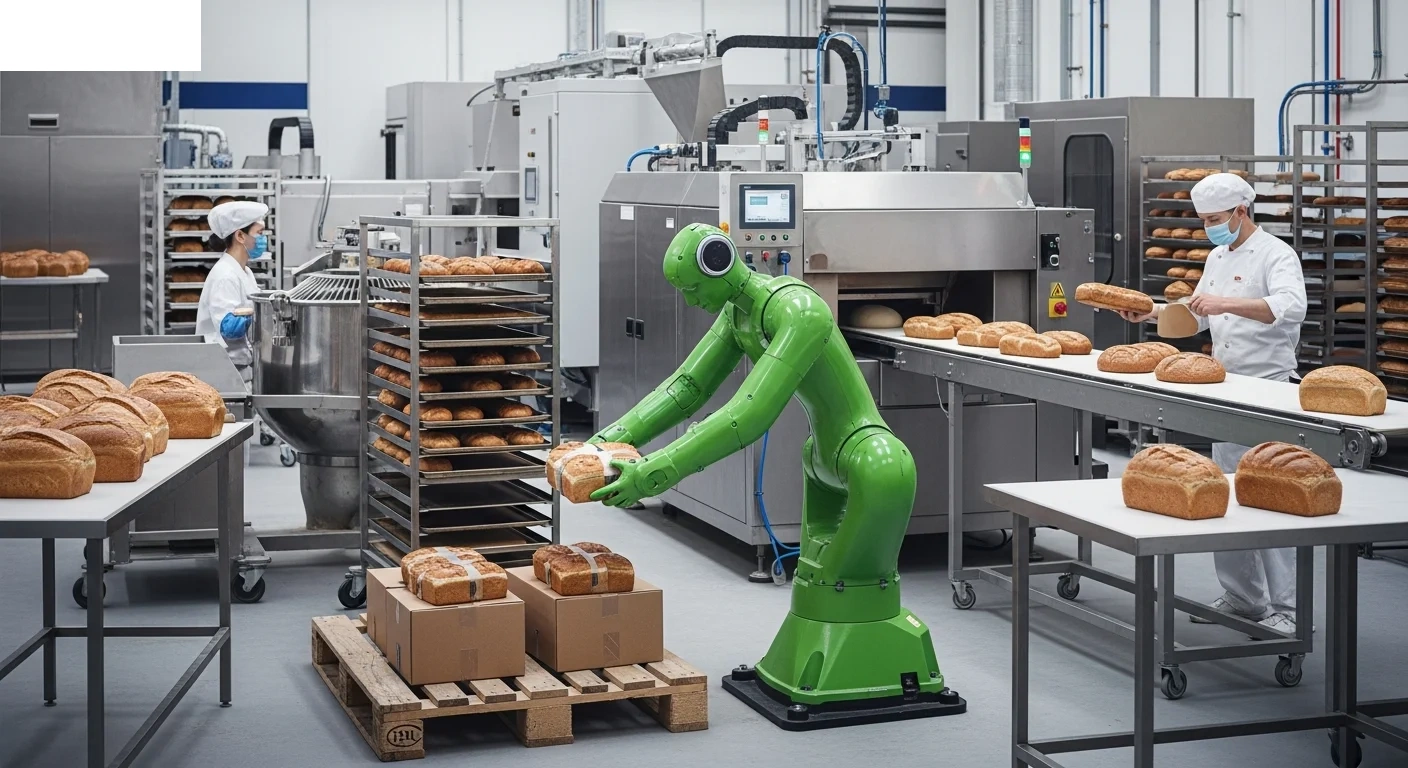
Industrial Bakery End-of-Line Distribution
A modelled scenario: this article describes a representative deployment, built from operational patterns typical of the sector, rather than a report on a named customer engagement. The figures are illustrative estimates of what a deployment of this shape can achieve.
The Challenge
A mid-size industrial bakery in Western Europe produces packaged baked goods for regional supermarket chains. The facility runs two production lines operating across two shifts, six days a week. The end-of-line process - sorting finished products from the conveyor, grouping them by order, and loading them onto pallets and rolling carts for distribution - was entirely manual.
This work is physically demanding. Workers spend eight-hour shifts lifting, bending, and carrying product cases weighing between 5 and 15 kilograms. Staff turnover in these roles exceeded 40% annually. During peak seasons (holidays, promotional periods), the bakery regularly struggled to fill shifts, leading to overtime costs and occasional order delays.
For operations leaders in this position, the goal is rarely to employ fewer people. It is to cover work that people can no longer be found to do reliably.
The Solution
The bakery deployed three humanoid robots to handle end-of-line distribution workflows. Field Deployment Engineers trained the robots on the bakery's own tasks and trained the line supervisors to run alongside them, with every workflow managed centrally through a fleet management platform.
The core workflows included:
- Order sorting. Robots pick finished product cases from the conveyor and sort them into order-specific staging areas based on barcode scanning.
- Pallet loading. Robots stack sorted cases onto pallets following predefined stacking patterns optimised for transport stability.
- Cart loading. For smaller orders, robots load rolling carts in delivery-route sequence.
Each robot was trained on these workflows on site, starting from recordings of the bakery's own operators doing the job, and the resulting workflows were stored in a shared library. When a new product line was introduced with different case dimensions, the workflow was updated once and propagated to all three units.
Deployment Timeline
- Month 1-2: Site assessment, risk assessment, workspace redesign. Safety zones were established around the end-of-line area with light curtain sensors and emergency stop stations.
- Month 3: First robot deployed on the primary production line. Operated alongside human workers during day shifts only, with human oversight.
- Month 4: Second and third robots deployed. Night shift operations began with reduced human oversight (one supervisor per shift for the robot area).
- Month 5-6: Full autonomous operation across both shifts. Human workers reassigned to quality control and dispatch coordination roles.
Modelled Results (First 12 Months)
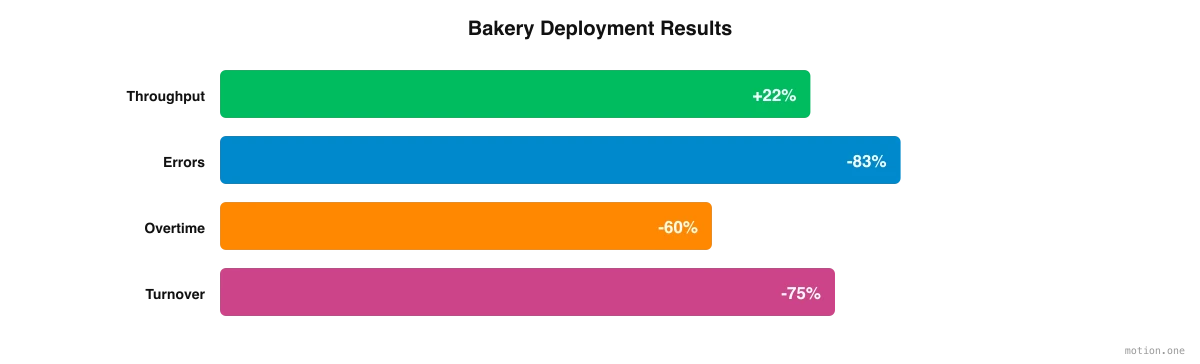
- Throughput increase: 22% improvement in end-of-line processing speed, primarily from eliminating break times and shift changeover gaps.
- Order accuracy: Sorting errors reduced from an average of 1.8% to 0.3%, driven by consistent barcode scanning and rule-based sorting logic.
- Labour hours saved: Approximately 11,000 labour hours per year redirected from manual handling to higher-value roles.
- Staff turnover: Turnover in the end-of-line area dropped from 40%+ to under 10% (remaining staff are in supervisory and quality roles).
- Overtime reduction: Peak-season overtime costs reduced by roughly 60%.
Key Takeaways
For manufacturers considering humanoid robot deployment, this bakery's experience offers several practical lessons:
- Start with roles that are hard to fill, not roles that are easy to automate. End-of-line handling was running at more than 40% annual turnover. The business case was staffing reliability first and cost second, exactly as the operations director put it.
- Invest in the software layer. The fleet management platform mattered as much as the hardware. Because workflows lived in a shared library, a new product line with different case dimensions was configured once and propagated to all three robots.
- Plan for a 3-6 month ramp-up. It took until month five for both shifts to run autonomously: site and risk assessment, workspace redesign, one robot on day shift, then the other two. Budget time and patience accordingly.
- Measure what matters. Throughput and labour hours saved are important, but order accuracy, overtime cost, and turnover carried as much weight here. The full value of the deployment extended well beyond processing speed.
- Engage your workforce early. The people who had been handling cases moved into quality control and dispatch coordination rather than out of the business. Communicating that plan before the first robot arrives is what separates acceptance from resistance.
This bakery's experience shows that humanoid robot deployment in end-of-line distribution is practical, beneficial, and achievable with current technology. The key is treating it as an operational change rather than a technology purchase, with a realistic ramp-up, workflows kept in one place, and a clear plan for where the existing team ends up.