Humanoid robot leasing: what a lease covers and what to check
How humanoid robot leasing works: what the monthly fee should cover, how a lease shows in your accounts, and what to check before you sign.
Motion team ·
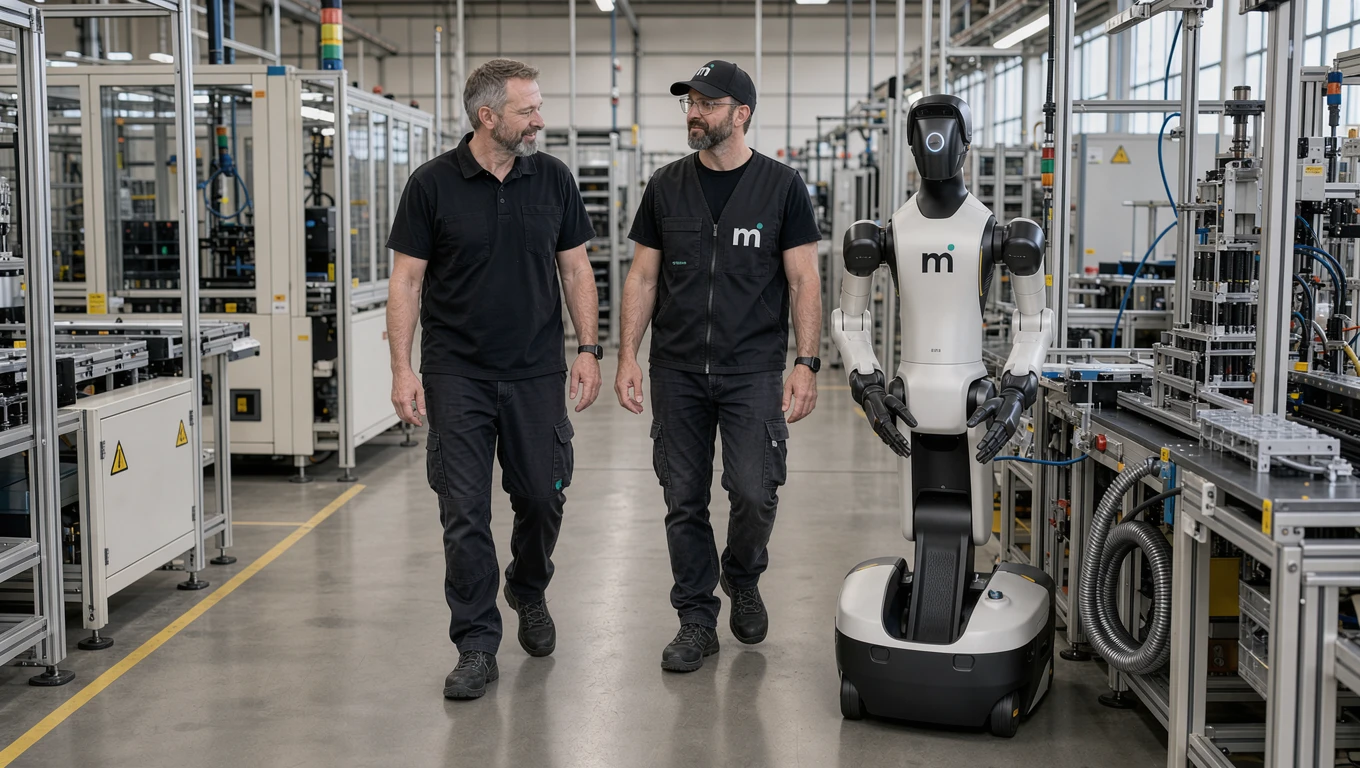
Humanoid robot leasing means paying a monthly fee to use a humanoid on your line instead of buying it. A full-service lease covers four things: the hardware lease, the software, insurance and maintenance. There is usually no upfront cost, and the lease length is agreed with you. With Motion, most deployments run on their own within 12 to 15 weeks.
General-purpose humanoid robots have moved out of R&D demos and controlled pilots. They are now commercially available, and a growing number of manufacturers and logistics operators are deploying them on real production floors.
Buying a humanoid robot outright is still a significant capital commitment, which is why leasing and service contracts are becoming a common way to bring this technology onto factory floors. This guide covers how humanoid leasing works, what a lease should include, how it shows in your accounts, and what to check in a provider.
---
Why leasing humanoid robots is now viable
Leasing a humanoid has become practical for three reasons.
The hardware has matured. Several robot makers have moved from prototypes to series production, though volumes are still small. Entry-level humanoids can now handle repetitive manipulation tasks - picking, packing, palletising, machine feeding - reliably enough to justify commercial deployment.
The software is less portable than it looks. Each maker runs its own control stack, so a provider that works across several makers lets you match the robot to the task without being tied to one. We cover this in how to avoid vendor lock-in.
The financial side is starting to form. Leasing companies, insurers and maintenance providers are starting to build residual value models and insurance products for humanoids, though the data behind them is still thin (see why humanoid robots are hard to finance).
You can now put a humanoid on your production floor, pay monthly, and have it working on its own within 12 to 15 weeks.
---
How humanoid robot leasing works
Humanoid leasing works much like commercial vehicle or industrial equipment leasing, with a few important differences.
The basic structure:
- You define the task or set of tasks you need automated
- A leasing provider assesses the task and recommends the right platform
- The robot is delivered, taught your task, and your site gets a risk assessment
- You pay a monthly fee for the duration of the lease (the length is agreed with you)
- The provider handles maintenance, software updates and repairs
- At the end of the lease, you can renew, move to a newer model, or return the unit
The main difference from traditional equipment leasing is the software layer. A humanoid can gain skills during the lease: the provider pushes skill updates and better perception models remotely.
A good provider also reports on throughput and uptime, so you can decide whether to scale up, adjust workflows or extend the lease.
---
What a full-service lease includes
Leasing agreements vary widely. A full-service humanoid lease should cover four services: hardware, software, maintenance and insurance.
Hardware - The humanoid unit itself, matched to your task requirements - End-of-arm tooling or grippers appropriate for your use case - Charging infrastructure and any required safety equipment
Software - A skill set trained for your specific workflows - Ongoing software updates and new skills - Remote monitoring and diagnostics - Integration with your existing MES, WMS or ERP systems where the task needs it
Maintenance and support - Preventive maintenance on a scheduled basis - Break-fix repairs with response times defined in the SLA - Remote troubleshooting as first-line support
Insurance and compliance - Coverage for the unit against damage, theft or malfunction - Liability coverage for workplace incidents involving the robot - CE marking under EU machinery rules (the Machinery Regulation (EU) 2023/1230 from 20 January 2027) and a risk assessment of the full deployment - Documentation for workplace safety audits
Insurance for a machine with little claims history is its own problem; we explain how insurers price it in insuring humanoid robots. For the safety rules themselves, see humanoid robot safety and EU compliance.
Training is part of the deployment: your operators learn to work next to the robot and to follow it day to day, and workers who share the space get safety training.
If a leasing provider cannot say clearly what is included in each of these categories, ask before you sign.
---
CapEx vs OpEx: lease, hire purchase or buy
Decision-makers most often ask whether they should buy or lease.
Here is how the two compare for a humanoid deployed in a manufacturing setting:
Purchasing - High upfront cost for the unit itself - Additional capital expenditure for integration, tooling and safety infrastructure - Ongoing costs for maintenance, software licences and insurance, which are often underestimated - A short useful life to depreciate over, and real technology risk: Goldman Sachs found that the manufacturing cost of a high-spec humanoid fell about 40% in a single year - You own an asset that may lose value faster than traditional industrial equipment
Leasing - No upfront capital expenditure with a full-service provider - A predictable monthly payment that covers the four services above - The option to move to newer hardware when the lease ends - Maintenance, insurance and software updates bundled into the monthly fee - Flexibility to scale up or down based on demand - Accounting treatment that depends on your framework (see below)
Buying is a capital expense (CapEx): the robot is an asset you depreciate. A monthly fee is mostly an operating expense (OpEx), though how much of it depends on your accounting rules. Between the two sits hire purchase, where you pay in instalments and own the robot at the end. An equipment lease and a Humanoid-as-a-Service (HaaS) contract both replace a purchase with monthly payments, but they differ in what the payment buys (see Humanoid-as-a-Service explained).
| | Buy | Hire purchase | Equipment lease | Humanoid-as-a-Service | |---|---|---|---|---| | Who owns the robot | You | You, once the last instalment is paid | The lessor | The provider | | Upfront cost | The full price | Spread over the instalments | Depends on the lessor | Usually none | | What is bundled | The hardware; maintenance, software and insurance are separate | The hardware; the rest is separate | The hardware; maintenance, software and insurance are often separate contracts | Hardware lease, software, insurance and maintenance in one fee, plus deployment and support | | On your balance sheet | Yes, as an asset you depreciate | Yes, from day one | An operating lease stays off the balance sheet under most national rules (Belgian, German or Dutch GAAP); under IFRS 16 it is a right-of-use asset | The lease part follows the same rules; the service part is an operating expense either way | | Who carries obsolescence and resale risk | You | You | The lessor | The provider |
Check the accounting treatment for your own company with your accountant.
---
Why plants choose a monthly fee
For small and mid-sized manufacturers, a monthly fee removes four barriers that commonly hold back a first humanoid project:
- Upfront capital: there is no large payment before the robot has done any work, so the project does not wait for a capital budget.
- Approval: a monthly service fee is often a lighter approval route than a capital purchase that has to go through the board.
- Technology risk: humanoid hardware is improving quickly, and a lease lets you move to newer hardware at renewal instead of writing off an old unit.
- Cost predictability: maintenance, repairs, software updates and insurance sit in one monthly number instead of bills you have to forecast.
---
Does leasing keep a humanoid off the balance sheet?
It depends on the accounting rules your company reports under. Under most national accounting rules (Belgian, German or Dutch GAAP), an operating lease stays off the balance sheet. Companies reporting under IFRS 16 record it as a right-of-use asset. The service part of a Humanoid-as-a-Service fee is an operating expense either way. Check with your accountant.
---
What to look for in a leasing provider
Some companies offering humanoid leasing lack the operational depth to deliver on their promises. Use these questions to evaluate providers.
Robot makers and fleet choice: does the provider work with several hardware makers? A single-maker provider limits your options. A good provider recommends the platform that suits your task, whatever it happens to stock.
Integration capability: can they connect the robot to your existing systems where the task needs it? Ask about interfaces to your warehouse management system, production line controllers and quality tools, and whether they have in-house integration engineers.
Service-level agreements: what uptime do they commit to, what happens when something breaks, and how fast do they respond? Get specifics. A promise to "fix it quickly" is not an SLA. Look for defined response times and penalty clauses for extended downtime.
Track record with similar operations: have they deployed in environments like yours? A provider that has only worked in logistics may struggle with the demands of precision manufacturing, and the reverse. Ask for references from comparable operations.
Geographic coverage: can they service your location? Humanoid leasing requires technicians who can be on site within a defined window.
Data: what visibility do you get into robot performance, who owns the operational data, and can you export it?
Financial stability: the provider needs to last for the length of your contract. Look at its funding, revenue model and customer base.
Total cost: ask the provider to model the cost of buying against the cost of the lease or subscription over three, five and seven years. A credible provider will say openly when ownership becomes cheaper.
Exit terms: what happens if you want to end the lease early? What is the process for returning equipment? Are there penalties? Understand the exit terms before you sign.
---
From contract to autonomy: 12 to 15 weeks
Deploying a humanoid robot takes setup work. Here is how a deployment runs with Motion:
- Assessment: you film the task on a phone and send it; Motion assesses how well a humanoid fits and which robot suits it best.
- Delivery: the robot is shipped, unpacked and driven to its place on the line.
- Recording: someone on your team does the task wearing a headset camera, and every hand joint is tracked and mapped onto the robot.
- Teaching: a Motion operator in VR teleoperates the robot from its own view, and every cycle becomes training data.
- Simulation: the skill is practised thousands of times on a digital replica of the line, with conditions varied every run.
- Deployment: the robot runs the task on its own, and operators step in remotely only when something unusual happens.
- Safety: every Motion deployment includes a risk assessment for your site.
- Day to day: your team follows the fleet from a tablet.
- Support: Motion engineers monitor robot health and are on call for maintenance.
Most deployments run on their own within 12 to 15 weeks. After that, Motion keeps running and supporting the robot for the length of the lease.
---
Frequently asked questions
Can I lease just one robot to start? Yes. Most leasing providers offer single-unit deployments so you can validate the technology in your environment before scaling. The recommended approach is to start with one robot on a well-defined task.
What happens if the robot breaks? Your lease agreement should include maintenance and repair coverage. The provider diagnoses the issue remotely first. If on-site repair is needed, a technician comes within the response time set in the SLA.
Do I need to hire a robotics engineer? No. The provider handles technical maintenance, software updates and troubleshooting. Your team gets operator training as part of the deployment, but you do not need in-house robotics expertise.
Can the robot work alongside my existing staff? Yes, after a risk assessment of the full deployment. The robot slows and stops when people come close, and the provider configures the safeguards your site needs.
What tasks can humanoid robots actually do today? In manufacturing and logistics, the most common deployments are picking, packing, palletising, machine feeding and line-side logistics. Tasks that require fine dexterity, complex decision-making, or operation in highly unstructured environments are still limited, though each software update widens the range.
Is my data secure? Ask your provider about data handling, storage location, and compliance with relevant regulations (GDPR for operations in the EU). Performance data should be encrypted in transit and at rest, and you should have full ownership of any operational data generated by the robot in your facility.
What is the minimum lease duration? Lease length is agreed with you. A good provider sets a term that matches the task and keeps the terms flexible.
---
Who should consider humanoid leasing
Humanoid robot leasing makes the most sense for:
- Mid-market manufacturers facing labour shortages who need to maintain or increase throughput without the capital commitment of traditional automation
- Logistics and warehouse operators handling high-volume, repetitive tasks where staffing is unpredictable or seasonal
- Operations leaders who want to evaluate humanoid robotics without committing to a purchase and a multi-year depreciation schedule
- Companies with variable or seasonal demand: a lease can add units for a peak and reduce them when volume drops, while a purchased robot stays on the books through the quiet months
- Manufacturers with several sites: a workflow trained at one site can usually move to another with some adaptation, so each later deployment builds on the first
- Any organisation that expects humanoid technology to keep improving quickly and does not want to be tied to today's hardware
If you run a production floor, a warehouse or a distribution centre and have been watching humanoid robotics from the sidelines, leasing lowers the barriers that have held most companies back: high upfront cost, technology risk, and the need for in-house robotics talent.
---
Next steps
If you are evaluating humanoid leasing for your operation, start with a single well-defined task, choose a provider that can show relevant deployment experience, and negotiate an agreement that stays flexible as the technology and your needs change.
If you have a task in mind, book a 30-minute call and we will tell you whether a humanoid fits it.