Robot Fleet Management Software: What Manufacturers Actually Need
Managing multiple humanoid robots requires purpose-built software. Here is what to look for in a fleet management platform and why it matters.
Motion1 Inc. ·
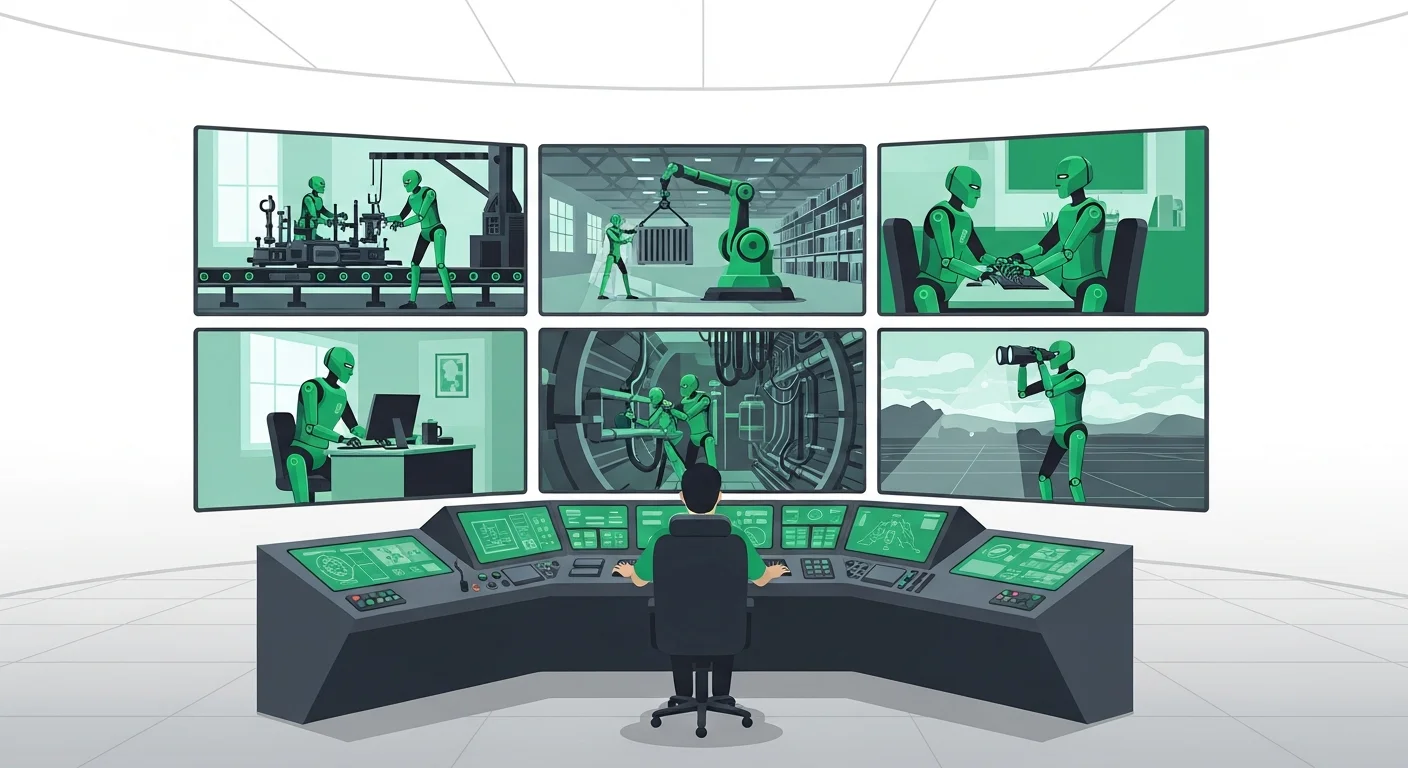
The era of single-robot deployments is ending. As humanoid robots become more capable and more affordable, manufacturers are moving from proof-of-concept trials to multi-unit fleets. And with that shift comes a new operational challenge: how do you manage five, ten, or fifty humanoid robots working across your facility?
This is where physical AI stops being a single-robot story. A skill learned on one unit is worth far more once every other unit can run it, and that only happens if something above the robots is keeping track.
The answer is fleet management software - purpose-built platforms designed to coordinate, monitor, and optimise multiple robots operating in real-world manufacturing environments. But not all fleet management tools are created equal. Many were designed for mobile robots or AGVs, not humanoids. And the difference matters.
This article breaks down what fleet management software actually needs to do for humanoid robot deployments, what capabilities to prioritise, and how to evaluate the platforms available today.
What Is Robot Fleet Management?
Robot fleet management is the centralised coordination of multiple robots operating within a shared environment. It encompasses task assignment, scheduling, real-time monitoring, diagnostics, software updates, and performance analytics - all from a single interface.
For traditional industrial robots (welding arms, pick-and-place units), fleet management has existed for decades in the form of PLC networks and SCADA systems. But humanoid robots introduce new complexity. They move through unstructured environments. They interact with human workers. They perform a wider variety of tasks. And increasingly, they learn and adapt on the job.
Fleet management software for humanoids must therefore go beyond simple device monitoring. It needs to handle task orchestration across diverse workflows, manage AI behaviour policies, and provide operators with clear visibility into what every robot is doing and why.
Why Fleet Software Matters at Scale
A single humanoid robot can often be managed manually. An operator watches it, intervenes when needed, and adjusts its behaviour through a local interface. This approach breaks down completely at scale.
Consider a manufacturer running six humanoid robots across two shifts. Without fleet management software, each robot operates as an island. There is no centralised view of task progress. There is no way to compare performance across units. Diagnosing issues means physically approaching each robot and checking its local logs. Updating behaviour policies means touching each unit individually.
The operational cost of this fragmented approach grows linearly with every robot added. Fleet management software flattens that curve. It gives a single operations team the ability to oversee dozens of units with the same effort it previously took to manage one.
There are three specific areas where fleet software delivers measurable value:
Uptime and utilisation. Fleet software tracks idle time, task completion rates, and error frequencies across all units. Operators can identify underperforming robots quickly and reassign tasks to keep throughput consistent.
Consistency and quality. When robots execute tasks from a shared workflow library, every unit performs the same operation the same way. This eliminates the variance that creeps in when robots are configured individually.
Operational efficiency. Centralised scheduling means robots are not waiting for instructions or duplicating work. Task queues are managed intelligently, and shift handovers happen automatically.
Core Capabilities to Look For
Not every fleet management platform offers the same feature set. Some are designed for warehouse AMRs and lack the sophistication needed for humanoid deployments. Here are the capabilities that matter most when evaluating fleet software for humanoid robots in manufacturing.
Task Assignment and Scheduling
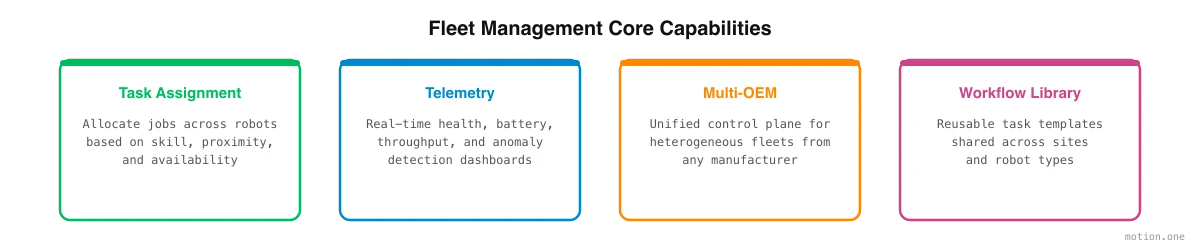
The most fundamental capability is the ability to assign tasks to specific robots or groups of robots, and to schedule those tasks across shifts and production cycles.
A strong task assignment system should support:
- Priority-based queuing. Some tasks are urgent. The system should allow operators to flag priority jobs and have them executed ahead of the regular queue.
- Skill-based routing. Not every humanoid is configured for every task. The system should know which robots are trained on which workflows and assign accordingly.
- Shift-aware scheduling. Manufacturing runs on shifts. Fleet software should understand shift boundaries, break times, and changeover windows - and schedule robot activity around them.
- Dynamic reallocation. When a robot goes offline or encounters an error, the system should automatically reassign its pending tasks to available units.
The best platforms also allow operators to define recurring schedules - daily, weekly, or tied to production orders - so that routine task assignment is fully automated.
Real-Time Telemetry and Monitoring
Operators need to know what is happening across their fleet at any given moment. Real-time telemetry provides this visibility.
Key data points include:
- Task status. What is each robot currently doing? What percentage of its assigned task is complete?
- System health. Battery levels, motor temperatures, sensor status, connectivity strength.
- Location. Where is each robot within the facility? Is it in its designated work zone?
- Alerts and anomalies. Automatic notifications when a robot encounters an error, deviates from expected behaviour, or requires human intervention.
The monitoring interface should be accessible from a central dashboard - ideally browser-based so operations managers can check fleet status from any device. Historical telemetry data should be stored and queryable, enabling trend analysis and predictive maintenance.
Multi-OEM Support
This is where many fleet management platforms fall short. Most are built to manage robots from a single manufacturer. But real-world deployments increasingly involve hardware from multiple OEMs.
A manufacturer might deploy entry-level humanoids for simple material handling tasks and more advanced units for precision assembly. These robots come from different vendors, run different firmware, and expose different APIs. Fleet management software that only supports one hardware platform forces manufacturers into vendor lock-in.
The ideal fleet management platform is hardware-agnostic. It communicates with robots through a standardised abstraction layer, translating high-level task instructions into hardware-specific commands. This allows operators to manage a mixed fleet from a single interface, compare performance across different hardware platforms, and swap out robots without rewriting their entire operational stack.
Workflow Libraries and Reuse
One of the most powerful features of modern fleet management software is the ability to capture, store, and reuse workflows.
A workflow is a structured sequence of actions that a robot performs to complete a task - picking up a component, inspecting it, placing it in a bin, moving to the next station. When a robot is trained on a new workflow, that knowledge should not live on a single unit. It should be stored in a central library and deployable to any compatible robot in the fleet.
Workflow libraries enable:
- Rapid onboarding of new robots. A new unit joins the fleet and immediately has access to every workflow the team has built.
- Consistency across units. Every robot executes the same workflow the same way, reducing quality variance.
- Iterative improvement. When an operator optimises a workflow, the improvement propagates to every robot using it.
- Knowledge preservation. Workflows survive hardware replacements. The institutional knowledge of how to perform a task lives in the software, not on any individual robot.
Analytics and Reporting
Fleet management is not just about real-time control. It is also about understanding long-term performance trends and making data-driven decisions about fleet composition, task allocation, and capacity planning.
Strong analytics capabilities include:
- Per-robot performance metrics. Task completion rates, error frequencies, cycle times, uptime percentages.
- Fleet-level dashboards. Aggregate metrics showing overall fleet utilisation, throughput, and efficiency.
- Comparative analysis. Side-by-side performance comparisons across robot models, shifts, or production lines.
- Export and integration. The ability to export data to existing BI tools or ERP systems for broader operational analysis.
How to Evaluate Fleet Management Platforms
With the capabilities outlined above, here is a practical framework for evaluating fleet management platforms:
1. Start with your hardware reality. What robots are you deploying today? What robots might you deploy in two years? If the answer involves more than one OEM, multi-OEM support is non-negotiable.
2. Assess your scale trajectory. If you are deploying three robots today but plan to reach twenty within eighteen months, you need a platform that scales gracefully. Ask vendors about their largest deployments and how performance holds up at scale.
3. Test the operator experience. Fleet management software is only useful if your operations team actually uses it. Request a demo or trial and have your floor operators - not just your IT team - evaluate the interface. Is it intuitive? Can they find information quickly? Can they intervene when something goes wrong?
4. Check integration depth. Fleet software should integrate with your existing systems - ERP, MES, quality management, maintenance scheduling. Ask about available APIs, webhooks, and pre-built integrations.
5. Evaluate the AI layer. The best fleet management platforms include AI-powered features like predictive maintenance, automatic task optimisation, and guided workflow configuration for operator interaction. These capabilities are not just nice-to-have - they are what separate modern platforms from glorified device dashboards.
6. Understand the deployment model. Is the platform cloud-based, on-premise, or hybrid? Manufacturing environments often have strict data residency and network security requirements. Make sure the deployment model fits your IT policies.
7. Ask about support and training. Fleet management is a critical operational system. Downtime or misconfiguration has direct production impact. Evaluate the vendor's support model - response times, escalation paths, and training resources for your team.
The Role of the AI Workflow Builder in Fleet Management
A growing trend in fleet management is tighter integration with the software that builds the workflows in the first place. Rather than requiring someone to configure every task, schedule, and policy by hand, an AI workflow builder assembles the workflow from the captured task, validates it in simulation, and turns it into robot-executable instructions the fleet can run.
For example, an operator assigns the end-of-line packing workflow to robots 3, 5, and 7 for the night shift. The platform validates that assignment against available resources and schedules, confirms each unit is trained on that workflow, and executes it. This dramatically lowers the skill barrier for fleet management and allows experienced operators to manage larger fleets with less cognitive overhead.
The same software plays a role in continuous improvement. It can analyse fleet performance data, identify bottlenecks, and suggest optimisations - effectively acting as a data analyst dedicated to your robot operations.
Looking Ahead
Fleet management software for humanoid robots is still a maturing category. Many of the platforms available today were built for simpler robotic systems and are being adapted - sometimes awkwardly - for humanoid use cases. The manufacturers who invest early in purpose-built fleet management will have a significant operational advantage as they scale their deployments.
The key is to think about fleet management not as an afterthought but as a foundational layer of your robotics strategy. The robots are the hardware. The fleet management software is what turns that hardware into a coordinated, efficient, and continuously improving workforce.