Humanoid Robots in Manufacturing: A Practical Guide for Operations Managers
Humanoid robots are entering factories - but deploying them still requires months of custom engineering. Here's how manufacturing SMEs can adopt humanoid automation without a robotics team.
Motion1 Inc. ·

The Humanoid Opportunity for Manufacturing
The humanoid robotics market is projected to reach €30 billion by 2030, and the pace of change over the past four years has been staggering. Over 100 original equipment manufacturers are now racing to ship capable hardware, and unit costs have dropped from well over €150,000 in 2022 to under €30,000 in 2026. For the first time, the economics of putting a humanoid robot on a factory floor make sense for companies far smaller than the automotive giants and logistics conglomerates that have traditionally driven industrial automation.
What changed is not only the hardware. It is physical AI: artificial intelligence that perceives and acts in the physical world rather than on a screen. A humanoid is the most recognisable container for it, but the value sits in the learned skills rather than in the limbs.
But there is a catch, and it is a significant one. Building the robot turns out to be the easy part. Deploying it into a real manufacturing environment - with its unique layouts, unpredictable edge cases, legacy equipment, and workforce that has spent decades perfecting manual processes - still requires months of custom engineering, specialised robotics talent that most companies simply cannot hire, and an expensive cycle of trial and error that can cost more than the robot itself.
This article is a practical guide for operations managers at small and mid-size manufacturers who are evaluating humanoid automation for the first time. It covers the current state of the market, the real barriers to deployment, and the emerging approaches that are making humanoid integration accessible to companies without dedicated robotics teams.
The Integration Bottleneck
According to a 2025 McKinsey survey, 61 percent of manufacturing executives say they lack the internal capabilities to execute robotics projects. This statistic captures a reality that anyone who has tried to deploy automation in a mid-size factory already knows: the technology exists, but the expertise to implement it does not.
The cost breakdown tells the story clearly. A humanoid robot can now be acquired for €16,000 to €30,000. But the integration and deployment work - programming the robot for specific tasks, building the simulation environment, testing on the factory floor, training operators, and handling the inevitable edge cases - typically costs €50,000 to €150,000 or more. Integration is routinely two to three times the hardware cost, and it is this gap, not the price of the robot, that has kept humanoid automation out of reach for most manufacturers.
The problem is compounded by a global shortage of qualified robotics engineers. There are fewer than 50,000 worldwide, and they are concentrated at large technology companies and research institutions. A 200-employee food manufacturer in Europe is not competing for this talent on equal footing with the major tech firms, and the reality is that most SMEs will never have an in-house robotics team.
What Changed in 2026
Three converging trends are fundamentally changing the accessibility of humanoid deployment for small and mid-size manufacturers.
The first is hardware commoditisation. Leading OEMs are now shipping production-ready humanoids at price points between €16,000 and €20,000. This is a dramatic shift from even two years ago, when the cheapest commercially available humanoid cost upwards of €50,000. As hardware becomes a commodity - following the same trajectory as smartphones, servers, and drones before it - the value shifts decisively to the software layer that makes the hardware useful.
The second trend is AI-driven integration. A new generation of deployment platforms uses large language models, computer vision, and physics simulation to replace the months of manual robotics engineering that traditional deployments require. Instead of hiring a team of robotics engineers to write custom code for every task and environment, an operations manager can describe what needs to be done in plain language. The platform decomposes the task, generates a simulation of the factory environment, trains the humanoid in that simulation, and produces a deployment-ready workflow. What used to take months now takes days.
The third trend is the emergence of leasing models that convert humanoid automation from a capital expenditure into a predictable monthly operating expense. Instead of committing €50,000 or more upfront - a sum that typically requires board approval, competitive bidding, and months of deliberation at an SME - manufacturers can lease humanoids on a monthly basis. The operations manager can approve the expense from the operating budget, no procurement cycle required. This removes the single biggest barrier for SME adoption: the upfront capital commitment.
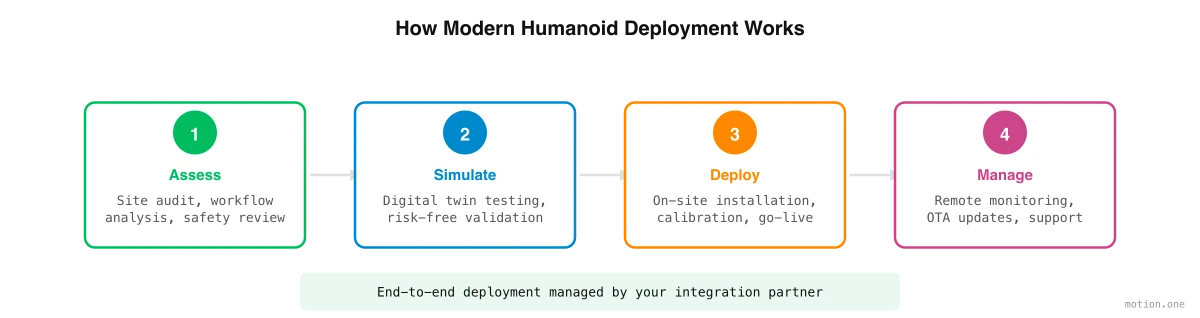
How Modern Humanoid Deployment Works
The modern deployment process has been streamlined into three phases, each designed to minimise the burden on the manufacturer while maximising the speed to productive operation.
The first phase is assessment. A Field Deployment Engineer visits the facility and conducts a thorough audit of the production line. Together with the operations team, they identify two or three high-impact tasks that are well-suited for humanoid automation - typically repetitive physical work like packaging, palletising, or material handling. The output is a deployment plan with clear milestones, success criteria, and a realistic timeline.
The second phase is integration. The FDE arrives on-site with the humanoid hardware and uses the AI Workflow Builder to configure workflows for the specific tasks identified in the assessment. Rather than writing control code from scratch, the FDE works from recordings of your own operators doing the job and turns them into simulation-ready workflows. The humanoid trains in a digital replica of the factory, practising thousands of iterations in hours rather than weeks. Once simulation accuracy targets are met, the trained policies are transferred to the real hardware and fine-tuned on the factory floor.
The third phase is handoff. The FDE trains two or three operators on the fleet management platform, which provides a dashboard for task assignment, performance monitoring, and troubleshooting. Documentation is delivered, including a deployment playbook and maintenance schedule. From this point forward, the manufacturer's own operations team manages the humanoid independently.
The entire process takes twelve to fifteen weeks from initial assessment to go-live. Compare this to the six to twelve months that traditional custom integration typically requires, and the appeal becomes obvious.
The ROI Case
The economics of humanoid leasing are compelling when you examine the fully loaded cost of a human worker. Most operations managers know their employees' gross wages, but the true cost per productive hour is significantly higher once you factor in annual leave, public holidays, sick leave, employer social charges (which add 30 to 40 percent on top of gross wages in Western Europe), training costs, and the productivity losses associated with shift changes, fatigue, and absenteeism.
A leased humanoid, by contrast, operates at a fixed monthly cost that includes hardware, maintenance, and fleet management software. It runs across shifts without overtime premiums, does not take holidays, and maintains consistent output quality throughout a twenty-four-hour operating day. For a manufacturer running two or more shifts, the utilisation advantage alone can deliver a payback period of eight to fourteen months.
The comparison becomes even more favourable over time. Human labour costs increase annually due to wage inflation and rising social charges. Humanoid leasing costs remain flat or decrease as hardware improves and software becomes more efficient. Over a seven-year horizon, the cumulative savings per humanoid-replaced position can be substantial.
Common Misconceptions
Several persistent misconceptions prevent manufacturing leaders from seriously evaluating humanoid automation.
The most common is the fear that humanoids will replace the existing workforce. In practice, humanoid robots fill positions that manufacturers cannot recruit for - the repetitive, physically demanding roles that have chronic vacancies and high turnover. They augment the existing team by handling the work that nobody wants to do, freeing human workers for higher-value tasks that require judgement, creativity, and interpersonal skills.
Another misconception is that the technology is not ready for real production environments. Humanoid hardware has matured to the point where it can reliably handle structured manufacturing tasks. The machines are not perfect generalists - they excel at repetitive, well-defined work in controlled environments - but for the specific tasks where labour shortages bite hardest, they are production-ready today.
Many manufacturers also assume they need to hire a robotics team before they can deploy humanoids. This is precisely the assumption that modern deployment platforms are designed to overturn. The operations manager describes the task. The AI handles the robotics engineering. The existing ops team manages the robot through a dashboard. No robotics expertise required.
Finally, there is the belief that humanoid automation is simply too expensive for an SME. Leasing models have eliminated this barrier entirely. The entire cost is converted into a monthly operating expense that the operations manager can approve like any other line item in the operating budget.
The First-Mover Advantage
Manufacturers who deploy humanoids early gain advantages that compound over time:
- Every deployment generates training data that makes subsequent deployments faster and more reliable
- The operations team builds institutional knowledge about human-robot collaboration that cannot be acquired overnight
- As hardware prices continue to drop and software capabilities improve, early adopters are positioned to benefit first
- Modern automation technology attracts younger workers to manufacturing
Perhaps most importantly, the workflows and operational data that accumulate over months and years of humanoid operation become a genuine competitive asset. A manufacturer that has been running humanoid automation for two years has optimised workflows, documented edge cases, and trained operators that a late adopter would need to build from scratch.
The manufacturers who wait will eventually adopt humanoid automation - the economics and labour demographics make it inevitable. But they will be starting from zero while their competitors have years of compounding operational advantage.