Scenario: Humanoid Robots in Electronics Quality Control
A modelled scenario: humanoid robots on roving quality inspection at a precision electronics assembler, closing the gaps between fixed inspection points.
Motion1 Inc. ·

Electronics Assembly - Component Inspection and Quality Control
A modelled scenario: this article describes a representative deployment, built from operational patterns typical of the sector, rather than a report on a named customer engagement. The figures are illustrative estimates of what a deployment of this shape can achieve.
The Challenge
A precision electronics assembler producing circuit boards and sensor modules for the automotive industry faced increasing quality demands from its customers. Defect rates needed to drop below 50 parts per million (PPM) to retain key contracts. The existing quality control process relied on human visual inspectors, supplemented by automated optical inspection (AOI) machines at specific points in the production line.
The problem was not the AOI machines - they performed well on the tasks they were designed for. The problem was the gaps between automated inspection points, where defects in component placement, solder quality, and mechanical assembly could go undetected until final testing. Human inspectors were effective but inconsistent, especially during long shifts. Fatigue-related inspection errors increased measurably after four hours of continuous work.
The Solution
The assembler deployed two humanoid robots equipped with high-resolution vision systems to perform roving quality inspections along the production line. Unlike fixed AOI machines, these robots could move between stations and inspect different aspects of the assembly process.
Key workflows included:
- Component placement verification. Robots inspect populated circuit boards against reference images, flagging misaligned, missing, or incorrectly oriented components.
- Solder joint inspection. Using macro vision capabilities, robots examine solder joints for bridges, cold joints, insufficient solder, and other common defects.
- Mechanical assembly checks. For assembled modules, robots verify screw torque indicators, connector seating, and label placement.
Inspection criteria were defined in the fleet management platform as configurable quality profiles. Different products could have different inspection parameters, and profiles were version-controlled to maintain traceability.
Deployment Timeline
- Month 1-2: Collaborative development of inspection profiles with the quality engineering team. Reference images and acceptance criteria were loaded into the fleet management platform.
- Month 3: First robot deployed on the primary SMT line. Operated in "shadow mode" alongside human inspectors for validation - flagging defects but not triggering production stops.
- Month 4: Shadow mode results validated. The robot's defect detection rate matched or exceeded human inspectors across all tested defect categories. Robot was authorised to trigger production holds for confirmed defects.
- Month 5: Second robot deployed on the mechanical assembly line.
Modelled Results (First 8 Months)
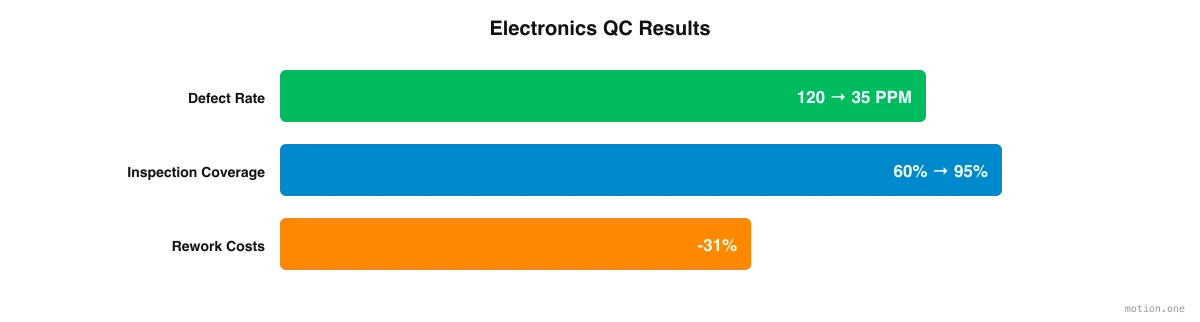
- Defect escape rate: Reduced from 120 PPM to 35 PPM, well below the 50 PPM target required by key customers.
- Inspection consistency: Inspection accuracy remained constant across all shifts, eliminating the fatigue-related decline observed with human inspectors.
- False positive rate: Initially 2.8%, reduced to 0.9% after two months of inspection profile refinement.
- Inspection coverage: Increased from approximately 60% of production (limited by human inspector availability) to 95% of production.
- Cost of quality: Rework costs decreased by 31% due to earlier defect detection. Defects caught at the component placement stage are significantly cheaper to fix than those found at final test.
- Customer audits: Two customer audits during the period specifically commended the robot-assisted inspection programme. One customer cited it as a factor in awarding an expanded contract.
Key Takeaways
For manufacturers considering humanoid robot deployment, this inspection programme offers several practical lessons:
- Start where consistency matters more than speed. The strongest case here was not a role nobody wanted to fill. It was a task where human accuracy declined measurably after four hours on shift. Fatigue-sensitive work is a natural first target.
- Invest in the software layer. The fleet management platform mattered as much as the hardware. Version-controlled inspection profiles let the quality team hold different acceptance criteria per product and keep full traceability as those criteria changed.
- Run in shadow mode before handing over authority. A full month of flagging defects without stopping production gave the quality team the evidence to let the robot trigger production holds. Budget time for that validation phase rather than skipping it.
- Measure what matters. Defect escape rate was the headline number, but false positive rate, inspection coverage, and the cost of rework told the fuller story. The value of the deployment extended well beyond the PPM figure in the customer contract.
- Bring the quality team in as authors, not spectators. Inspection profiles were developed jointly with the quality engineering team over the first two months, before a robot ever reached the line. The people who owned the acceptance criteria kept owning them.
This assembler's experience shows that humanoid robot deployment for quality inspection is practical, beneficial, and achievable with current technology. The key is treating it as a quality programme rather than a technology purchase, with the same rigour in validation, profile management, and record keeping that the rest of the quality system already gets.