Sim-to-Real: How AI Simulation Is Replacing Months of Robotics Engineering
Training humanoid robots in simulation before deploying them in real factories cuts integration time from months to days. Here's how sim-to-real transfer works and why it matters for manufacturers.
Motion1 Inc. ·
The Old Way: Trial and Error on the Factory Floor
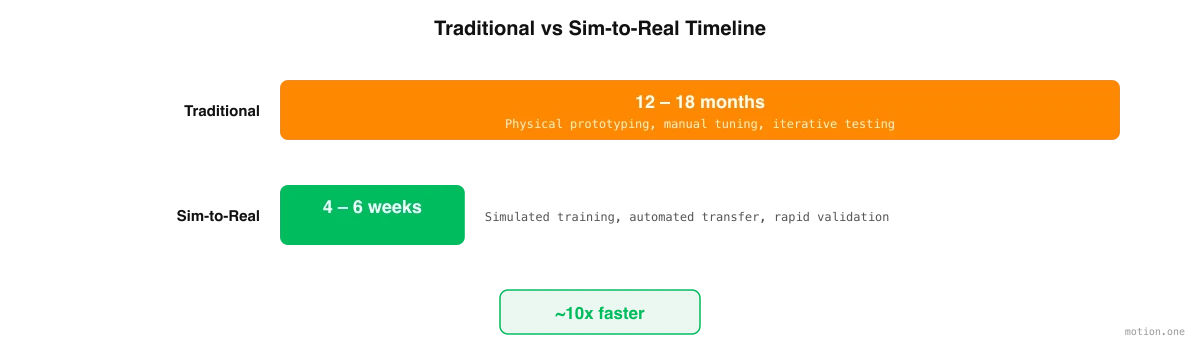
For as long as industrial robots have existed, deploying them has followed the same painful pattern. An engineer installs the robot, writes control code, tests it on the factory floor, discovers it does not work as expected, and iterates - sometimes for weeks, sometimes for months - until the robot achieves acceptable performance. Then the entire cycle repeats for the next task, the next product variant, the next production line.
Physical AI is the name now given to intelligence that has to work in the real world. It perceives, it decides, it moves, and it pays a physical price for every mistake. That price is exactly why the learning has to happen somewhere else first.
This process is slow because real-world testing is inherently slow. Each iteration cycle takes minutes to hours on the factory floor, where the robot must physically execute the task, the engineer must observe the result, diagnose the failure, modify the code, and try again. A single deployment might require fifty to a hundred of these cycles before the robot performs reliably. At €50,000 to €150,000 per deployment, with expensive engineering talent occupied for months, the economics are punishing.
Sim-to-real transfer - training a robot in a virtual simulation of the real environment and then deploying the trained policy to physical hardware - promises to compress this timeline from months to days. The idea is not new, but recent advances in AI, computer vision, and physics simulation have brought it from an academic curiosity to a practical deployment tool. Understanding how it works, where it excels, and where it still has limitations is essential for any manufacturer evaluating humanoid automation.
How Sim-to-Real Transfer Works
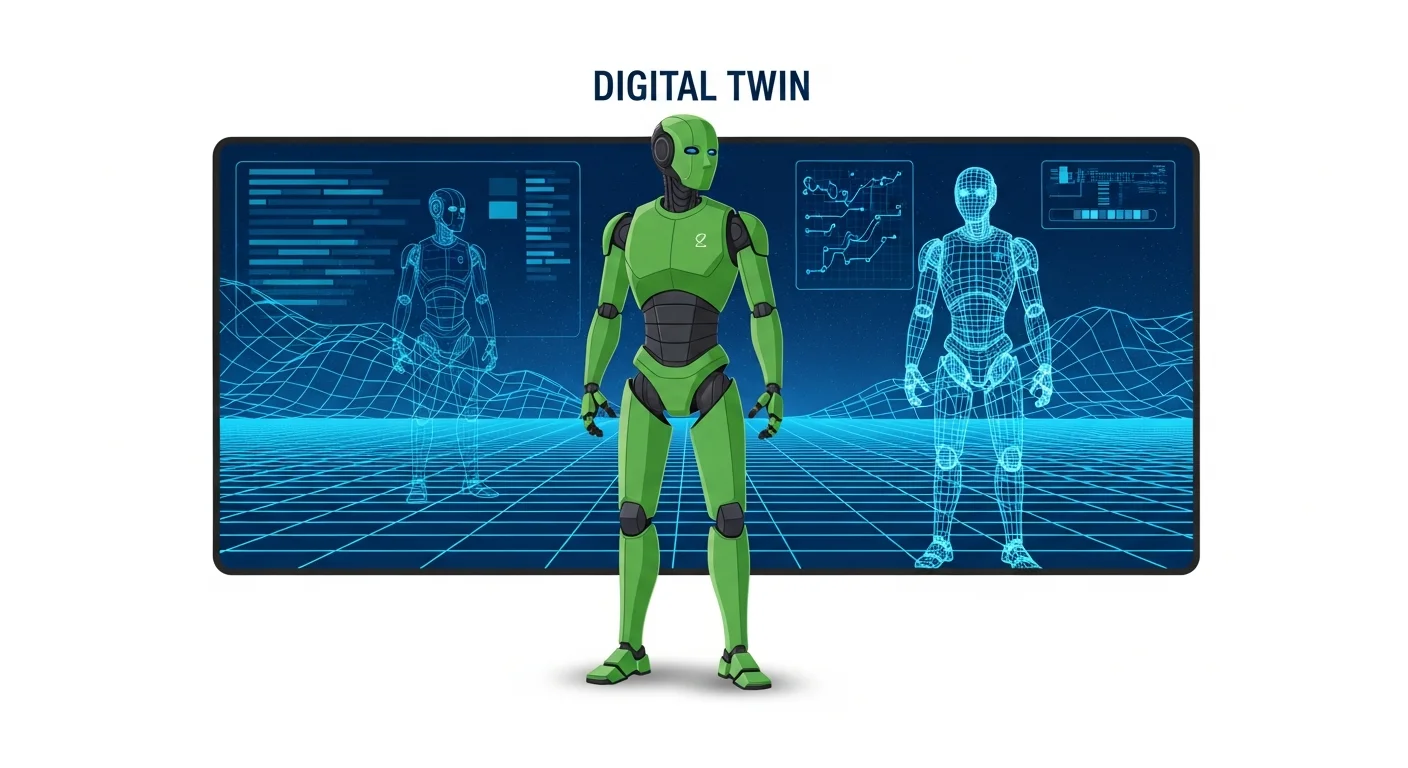
The sim-to-real pipeline begins with capturing the real environment. Photographs and videos of the factory - taken with ordinary smartphones or point-of-view cameras worn by workers - are processed into a three-dimensional simulation that replicates the geometry, lighting, and physics of the actual facility. This is not a generic warehouse or a stylised factory floor; it is a digital twin of your specific production environment, with your equipment, your products, and your layout.
Once the simulation environment exists, the process of training the humanoid begins. A task is captured from the operators who already perform it - for example, "pick products from the end of the conveyor, inspect for visible defects, and pack into boxes of six." An AI system decomposes that task into discrete manipulation steps and begins training the humanoid to execute each step within the simulation.
The training happens at a speed that would be impossible in the real world. In simulation, a humanoid can attempt a task thousands of times per hour, learning from each failure and refining its approach. In reality, each attempt takes minutes and risks damaging equipment or products. Simulation compresses months of real-world learning into hours of computation, and it does so at a fraction of the cost - GPU compute time versus highly paid engineering talent on the factory floor.
The trained policy is validated against accuracy targets before it ever touches real hardware. Typically, the threshold is ninety percent or higher task completion rate in simulation. Only when this target is met does the policy transfer to the physical robot, where a brief period of real-world fine-tuning addresses the remaining gap between simulation and reality.
Closing the Sim-to-Real Gap
The historical criticism of simulation-based robotics has been the sim-to-real gap - the observation that policies which perform flawlessly in simulation often fail in the real world. Simulation graphics do not perfectly match reality. Simulated physics are approximations. Real sensors introduce noise and latency that simulation does not capture. And the real world contains effects - airflow, vibration, temperature variation, surface irregularities - that simulations traditionally ignore.
Modern approaches address these gaps through several techniques that have matured significantly in the past two years.
Domain randomisation is perhaps the most important. During training, the simulation randomly varies textures, lighting conditions, object positions, surface friction, and other physical parameters. Rather than learning to perform the task in one perfect environment, the robot learns to handle variation. When it encounters the real world - which is, from the robot's perspective, simply another variant of the randomised training environments - it generalises rather than failing.
Progressive transfer provides an additional safety layer. Instead of a single jump from simulation to full production, policies are transferred through stages: high-fidelity simulation, then a simplified real-world test environment, then limited production runs, and finally full deployment. Each stage validates performance before the next begins, catching issues early when they are cheap to fix.
Continuous learning ensures that the simulation improves over time. Once deployed, the robot collects real-world data that feeds back into the simulation engine. The digital twin becomes more accurate with every shift of operation, and future policies trained in the updated simulation require less real-world fine-tuning. This creates a virtuous cycle: more deployments lead to better simulations, which lead to faster and more reliable future deployments.
Where Sim-to-Real Excels
Sim-to-real is particularly effective for manufacturing tasks that share certain characteristics. Repetitive tasks with consistent product geometry - packaging, palletising, sorting, material transfer - are ideal because the simulation can model the relevant objects with high fidelity and the task structure is predictable enough for reinforcement learning to converge quickly.
Tasks in controlled environments perform better than those in uncontrolled ones. A factory floor with consistent lighting, stable temperatures, and predictable equipment layouts is much easier to simulate accurately than an outdoor construction site or an agricultural field.
Tasks with clear success criteria - the box is sealed, the pallet is stacked, the product is inspected - train faster than tasks with subjective or ambiguous outcomes, because the reinforcement learning algorithm needs a well-defined reward signal to optimise against.
The Compounding Advantage
Every sim-to-real deployment generates data that improves the next one. The simulation models become more accurate as they incorporate real-world feedback. The task decomposition algorithms learn from past successes and failures. The policy training converges faster as the training data library grows.
This creates a data flywheel that is one of the most strategically important dynamics in humanoid robotics. The companies and manufacturers that begin sim-to-real deployment earliest accumulate the most data, build the most accurate simulations, and achieve the fastest deployment times. Late entrants face a compounding disadvantage: not only do they lack the data, but they are competing against organisations whose deployment infrastructure has been improving with every iteration for months or years.
For manufacturers, the practical implication is clear. The first sim-to-real deployment at your facility will be the slowest and most involved. The second will be significantly faster. By the fifth or sixth deployment, the process will be routine. The question is not whether sim-to-real will become the standard approach to humanoid deployment - the economics make that inevitable. The question is whether your facility will be generating data and building capability now, or starting from scratch later.