Why Humanoid Robot Integration Costs More Than the Hardware - and How to Fix It
Integration and deployment costs are 2–3× the price of the humanoid itself. The companies that eliminate this bottleneck will capture the most value in the $30B physical AI market.
Motion1 Inc. ·
The Real Price Tag of a Humanoid Robot
When a manufacturer evaluates humanoid automation for the first time, the conversation almost always starts with the sticker price of the robot. Entry-level humanoids now cost around €16,000. Higher-end models with greater payload capacity and dexterity sit closer to €50,000. These are reasonable numbers for a machine that can operate across shifts, does not take holidays, and delivers consistent output quality - and they represent a dramatic drop from the €150,000-plus price tags of just a few years ago.
But the sticker price is misleading, because it obscures the cost that actually determines whether a humanoid deployment succeeds or fails: integration.
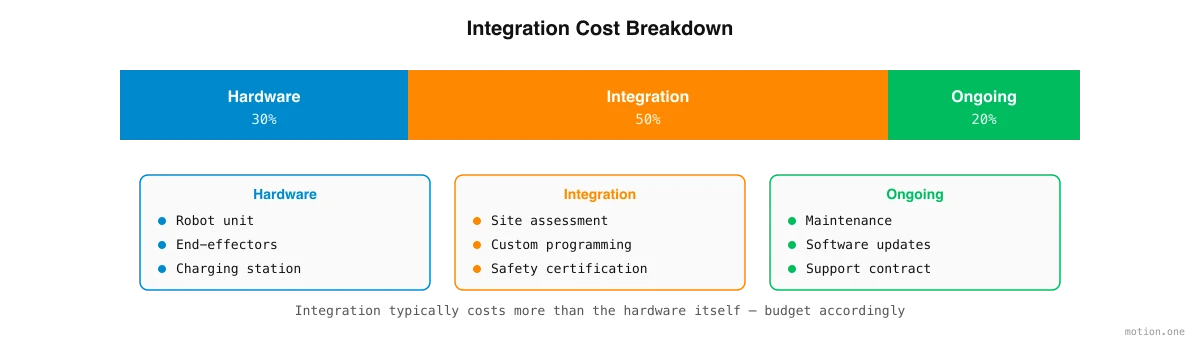
The integration and deployment work - programming the robot for your specific tasks, building a simulation of your specific environment, testing on your specific factory floor, handling your specific edge cases - routinely costs two to three times the price of the hardware itself. A €20,000 robot can easily require €60,000 to €100,000 in integration work before it does anything useful. This is the bottleneck that keeps humanoids in trade show demos instead of factory floors, and understanding why it is so expensive is the first step toward solving it.
Why Integration Is So Expensive
The cost of humanoid integration is driven by four structural factors that, taken together, explain why deploying a robot remains an order of magnitude harder than buying one.
The first factor is that every deployment is effectively custom. No two factories are alike. Each has its own layout, its own equipment, its own product mix, its own safety requirements, and its own collection of edge cases that have been accumulated over years of operation. A humanoid that packages bread in one facility cannot simply be moved to another facility and expected to work. The conveyor height is different. The box dimensions have changed. The lighting conditions affect the vision system. Every detail matters, and today, a team of robotics engineers must account for every detail manually.
The second factor is the absence of a standard integration layer. Every humanoid OEM has designed its own APIs, control schemes, sensor configurations, and software development kits. There is no universal middleware, no common programming language, no shared standard for how tasks are defined and executed. An engineer who has spent three months integrating one brand of humanoid must essentially start over when the manufacturer wants to try a different brand. This fragmentation multiplies cost at every stage.
The third factor is the expertise bottleneck. The people who understand factory operations - the operations managers, shift supervisors, and line workers who have spent years perfecting their processes - cannot program robots. The people who can program robots - the robotics engineers with advanced degrees in control systems and computer science - do not understand factory operations. Bridging this gap requires expensive consultants who serve as translators between two worlds that speak entirely different languages.
The fourth factor is the simulation gap. Training a robot in simulation and then deploying it in the real world - a process known as sim-to-real transfer - remains an imperfect science. Policies that achieve near-perfect accuracy in simulation often fail when confronted with the messy realities of a physical environment. Closing this gap requires iterative testing on the factory floor, where each cycle takes hours rather than the seconds it takes in simulation, and where failures have real consequences in the form of damaged products, safety incidents, and production downtime.
The Scaling Problem
The traditional integration model has a fundamental scaling problem that goes beyond cost: it requires scarce, expensive human expertise for every single deployment. There are fewer than 50,000 qualified robotics engineers globally. The projected demand for humanoid deployments will reach millions of units by 2030. The arithmetic simply does not work.
Even if you could hire enough engineers - and you cannot - the economics do not improve at scale. Custom engineering for every deployment means the cost per deployment stays roughly constant. There is no learning curve, no marginal cost reduction, no way to leverage the work done on deployment number one to make deployment number one hundred cheaper or faster. Every factory is a blank slate.
This is fundamentally different from how software scales. When a software company builds a product, the marginal cost of serving the next customer approaches zero. The integration model for humanoid robots is the opposite: the marginal cost of the next deployment is roughly the same as the first. This is why the industry needs a different approach.
The Software Platform Approach
The solution to the integration cost problem is not more engineers - it is better software. Specifically, it is software platforms that replace custom engineering with AI-driven automation, turning the deployment process from a bespoke consulting engagement into a repeatable, scalable product.
These platforms work by turning captured tasks into robot-executable workflows. Instead of anyone writing control code, the operations manager describes what needs to be done and the operators who do it today are recorded doing it. The platform decomposes the task into discrete steps, generates a 3D simulation of the factory environment from photographs and video, trains the humanoid in that simulation using reinforcement learning, and validates the policy before transferring it to real hardware.
The critical difference from the traditional model is that the platform gets better with every deployment. Training data accumulates. Simulation models become more accurate. Task decomposition algorithms learn from past successes and failures. The marginal cost of the hundredth deployment is dramatically lower than the first, and the thousandth deployment is lower still. This is the learning curve that custom engineering lacks, and it is what makes mass humanoid deployment possible.
What This Means for the Market
The €30 billion humanoid market projection assumes that humanoids will be deployed at scale across manufacturing, logistics, and services. But mass deployment is impossible if every installation costs €50,000 to €150,000 in integration work. The market projection only materialises if integration costs drop by ten to a hundred times.
That magnitude of cost reduction cannot come from incremental improvements in traditional consulting. It can only come from software automation that fundamentally changes the economics of deployment. The companies that build this software layer will capture a disproportionate share of the market's value, because every humanoid sold - regardless of manufacturer - needs integration software to become useful.
The deployment layer is, in many ways, the most strategically important part of the humanoid ecosystem. Over 100 companies build the hardware. The software that makes it useful is still wide open.
How to Evaluate Integration Solutions
For manufacturers evaluating different approaches to humanoid integration, five factors separate solutions that will scale from those that will not.
When comparing approaches, weight these factors:
- Time to first workflow - a solution that takes months is using traditional methods with a software veneer. A solution that delivers a working workflow in days is using genuine AI-driven automation.
- Expertise required from your team - If the solution requires your operations manager to learn robotics programming, or if it requires you to hire a robotics engineer, it has not solved the expertise bottleneck - it has merely relocated it.
- Reusability - Can workflows developed for one task be adapted for similar tasks? Can workflows transfer between different robot models or different factory sites? If every new task starts from scratch, you are paying for custom engineering regardless of what the vendor calls it.
- Ongoing cost structure - If every new task or every workflow modification requires another engagement, the total cost of ownership will be indistinguishable from traditional consulting. The right platform lets your team iterate independently after the initial deployment.
- Data ownership - The workflows your deployments generate, the training data your operations produce, and the simulation models built from your facility - these are valuable assets. Make sure they belong to you.