Insuring Humanoid Robots: Pricing Risk Without a History
Humanoid robots are hard to insure because there is almost no claims history to price them against. Here is why that gap exists, how a pricing model can learn from live deployments, and why coverage belongs with the lease.
Motion1 Inc. ·
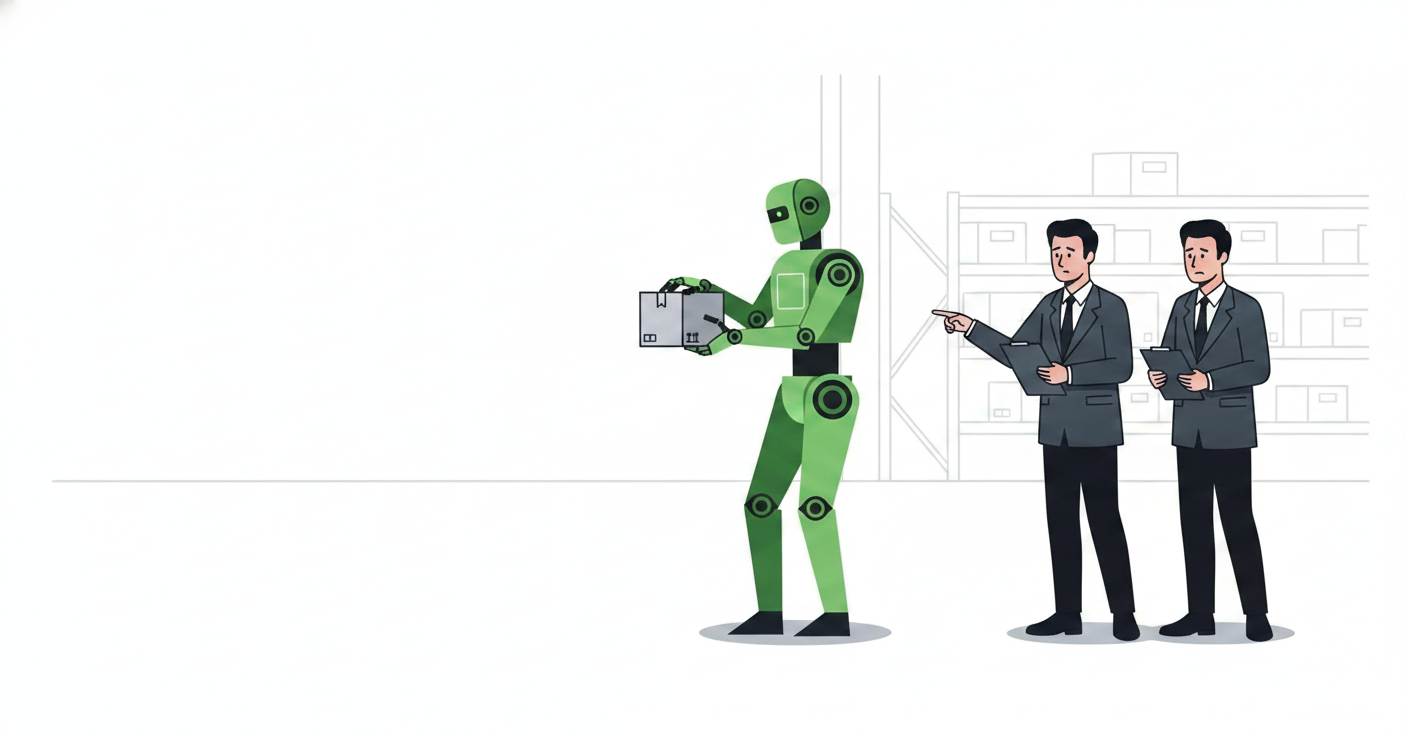
Insurance runs on history. An underwriter sets a premium by looking back at years of claims for a given asset, working out how often things go wrong, how badly, and what it costs to put right. For cars, factories and industrial machinery, that record is deep. For humanoid robots, it barely exists.
That absence is not a footnote. A robot that cannot be insured, is a robot that is hard to put on a production line or anywhere near people. Coverage is often the quiet precondition for deployment, and right now it is the part of the puzzle that lags furthest behind the hardware.
This piece looks at why humanoids are genuinely difficult to insure, what actually needs covering, and why the most practical answer is to attach coverage to the lease and let real-world use sharpen the pricing over time.
Why humanoids are hard to insure
No actuarial history
The core problem is the lack of standardized risk frameworks and actuarial data for robotics liabilities. Insurers are used to pricing from large pools of past claims. For humanoids, those pools are thin or empty. There is limited historical data on how often a unit fails, in what way, and what the resulting loss looks like.
Without that baseline, setting a premium becomes guesswork dressed up as a number. Price too high and the coverage prices itself out of reach. Price too low and the insurer carries exposure it cannot properly account for. Neither outcome helps a manufacturer trying to deploy.
A novel risk shape
Humanoids also do not map cleanly onto anything insurers already understand. They are tall, heavy and mobile, and they are designed to operate in shared spaces alongside people rather than behind a safety cage. On top of that, they combine complex physical hardware with AI software that makes its own decisions in real time.
That combination introduces risks with no clean precedent. A premium would ideally rest on data about component failure rates, software glitches and AI-driven incidents. Today that data is scarce, so the shape of the risk is understood far better in theory than in practice.
Who is at fault
Fault attribution is the part the industry has not solved. When a humanoid causes damage, the obvious question is what went wrong, and the honest answer is often unclear. Was it a hardware failure, a software bug, or a decision the AI made on its own?
That ambiguity matters for insurance because liability usually depends on cause. A wrist actuator that snaps is a different claim from a model that misjudged a situation, even if the visible damage looks identical. Until cause can be established reliably, pricing and settling claims stays harder than it is for conventional machinery.
What actually needs covering
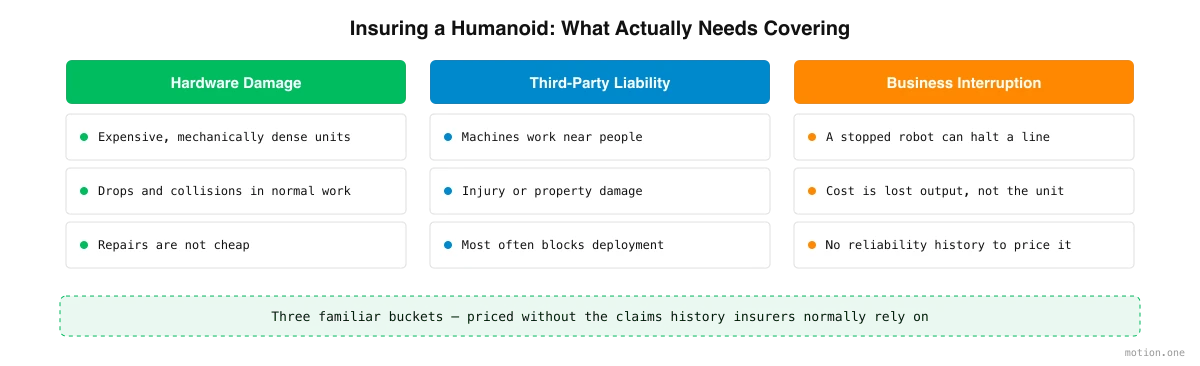
Strip away the novelty and the insurable exposures fall into three familiar buckets.
The first is hardware damage. Humanoids are expensive, mechanically dense machines. They can be dropped, collided with, or damaged in the course of normal work, and repairs are not cheap.
The second is third-party liability and personal safety. Because these machines work near people, an incident can mean injury to a worker or damage to someone else's property. This is usually the exposure that worries a buyer most, and the one that most often blocks deployment without coverage in place.
The third is business interruption. A humanoid that stops working can halt a line or a shift. The cost there is not the robot itself but the downtime it causes - lost output while the unit is repaired or replaced.
For context, industrial robot arms typically run at roughly 95 to 99 percent uptime, the product of decades of refinement. Humanoids have little to no published reliability data to compare against yet, and as an industry view rather than a measured fact, it will take real deployment time before their failure and downtime patterns are well understood. That uncertainty is exactly what makes the downtime exposure hard to price today.
These same financing and reliability gaps are why robots are hard to finance and insurance tend to surface as the same problem.
Pricing that learns: the data flywheel
If the obstacle is missing data, the solution is to generate it and to build pricing that improves as it arrives.
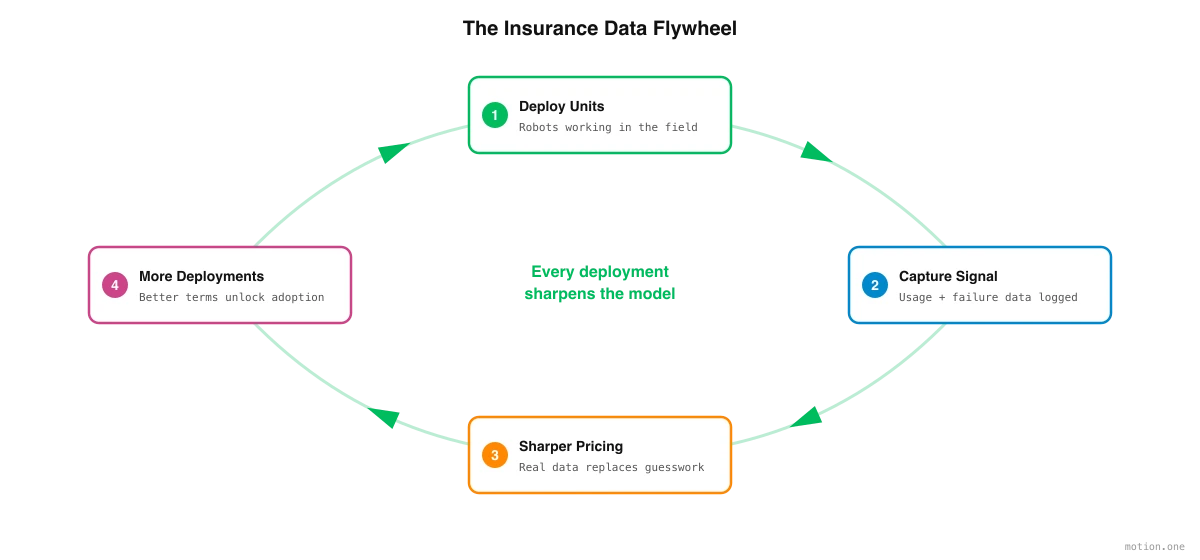
Every deployed humanoid produces a stream of useful signal: how many hours it runs, which components wear or fail, how often software faults occur, and how much downtime results. Each of these is a data point an underwriter never had before.
That creates a flywheel. Early pricing is necessarily conservative because the data is thin. As units go into the field and that history accumulates, the model gets sharper. Better pricing supports more deployments, more deployments produce more data, and the next round of pricing is more accurate still. The uncertainty that makes humanoids hard to insure today is the same uncertainty that shrinks with every machine put to work.
The key is to be set up to capture that signal from day one, so that real usage, failure and downtime data feeds back into pricing continuously rather than waiting years for an industry-wide dataset to form.
Why coverage belongs with the lease
This is where bundling matters. The market is already moving toward embedded, full-lifecycle coverage - protection that runs across production, sale, leasing and end use rather than being bolted on afterward as a separate product.
For a manufacturer, a standalone insurance search at deployment time is friction at the worst possible moment. The cleaner approach is to attach coverage to the lease, so it is priced and in place at the point the robot is put to work. One agreement covers the machine, its financing and its risk.
Bundling also closes the data loop. A provider that both leases and insures the unit sees usage, failure and downtime directly, and can feed that straight back into pricing. The lease becomes the channel through which every deployment refines the model - the embedded approach and the data flywheel reinforcing each other. This is part of the broader shift from capex to opex that makes humanoids practical to adopt at all.
Where this goes
Insuring humanoids will get easier, and the reason is simple: the data gap closes a little with every machine that goes to work. What looks today like an absence of history is really a history still being written. The job now is to structure leasing and coverage so that each deployment counts - so that the robots already in the field make the next ones easier to insure, and easier to put to work near the people they are built to help.