Hardware-Agnostic Robotics: Why Your Humanoid Platform Shouldn't Lock You In
Over 100 companies build humanoid robots. Choosing one shouldn't mean choosing all of them. Here's why hardware abstraction is the most important feature of your robotics software.
Motion1 Inc. ·
The Fragmentation Problem
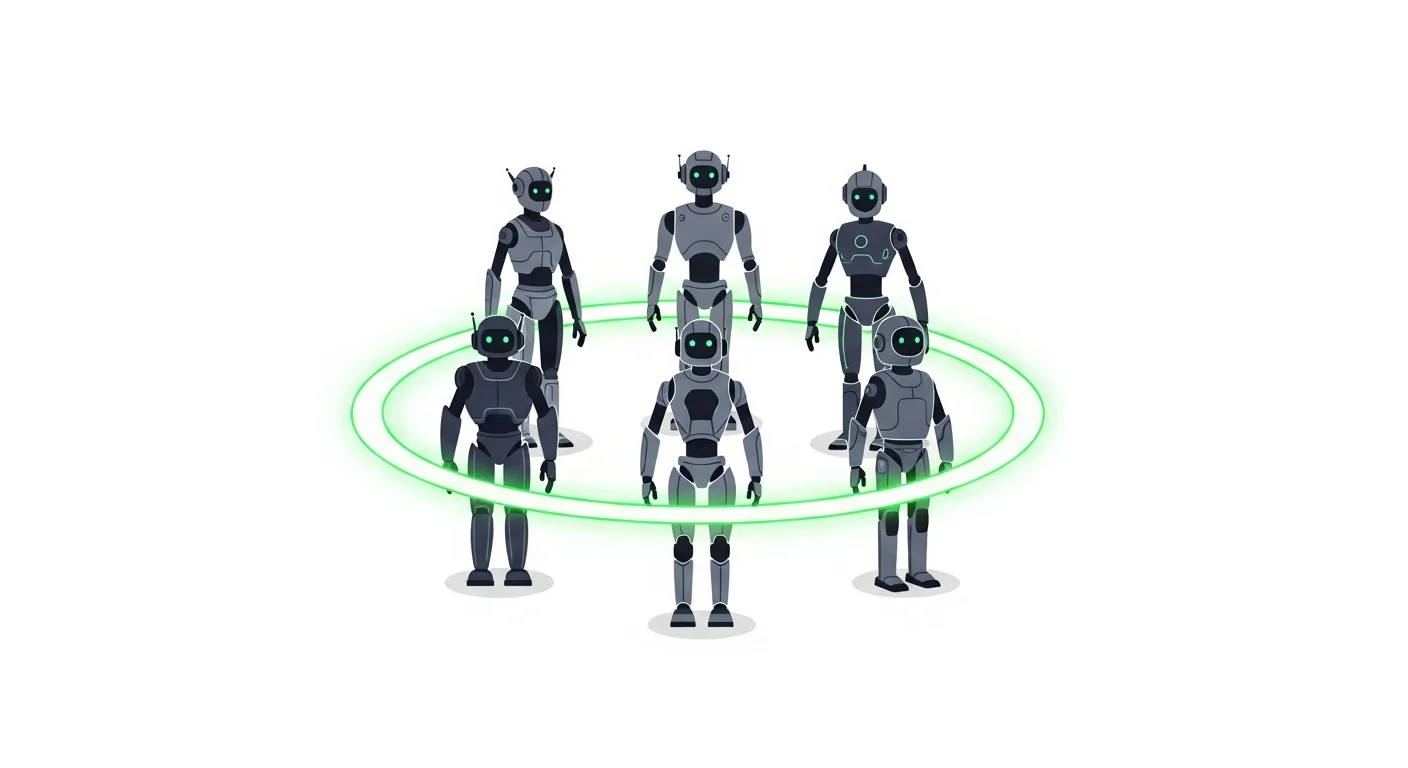
The humanoid robotics market is fragmenting at a speed that should concern every manufacturer considering automation. Over one hundred original equipment manufacturers are now shipping or preparing to ship humanoid robots, each with its own proprietary software ecosystem, control interfaces, programming tools, and maintenance requirements. For a manufacturer evaluating humanoid automation, this fragmentation creates a risk that is easy to overlook in the excitement of a first deployment: vendor lock-in.
There is a useful way to frame the problem. The robot is the body. Physical AI is the part that makes the body useful: the perception, the learned skills, the task model and the fleet logic. Bodies will keep changing and keep getting cheaper. The intelligence layer is the asset worth keeping, which is precisely why it should not belong to whoever sold you the hardware.
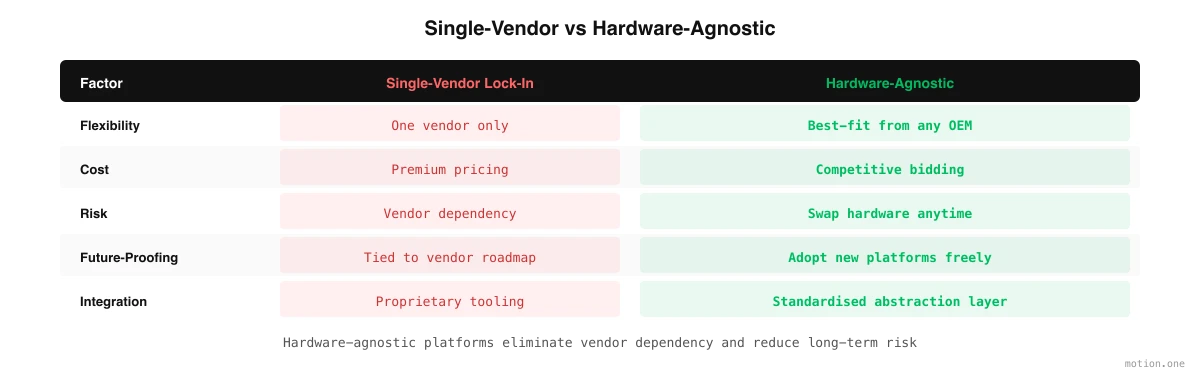
Vendor lock-in is a familiar problem in enterprise technology. Companies that adopted proprietary ERP systems, proprietary cloud platforms, or proprietary industrial control systems learned - often painfully - that switching costs compound over time. The longer you operate within a single vendor's ecosystem, the more your workflows, data, training, and institutional knowledge become entangled with that vendor's specific tools and interfaces. Eventually, switching becomes so expensive that it is effectively impossible, regardless of whether better or cheaper alternatives emerge.
Humanoid robotics is following the same trajectory. Every OEM is building a walled garden. If your deployment software is tied to one manufacturer, your workflows do not transfer. Your training data is not portable. Your operators' skills are vendor-specific. And when - not if - a better, cheaper humanoid ships from a competitor, you face a choice between starting over from scratch or remaining locked into inferior hardware.
What Hardware-Agnostic Actually Means
A hardware-agnostic robotics platform provides an abstraction layer between the task you want performed and the specific robot that performs it. You describe what needs to be done. The platform determines how to do it on whatever hardware you have.
This abstraction has several practical consequences that directly affect a manufacturer's operational flexibility and total cost of ownership.
The same workflow runs on different robots. A packaging workflow developed and validated on one humanoid model can be adapted to run on a different model from a different manufacturer. The task logic - what to pick, where to place, how to sequence - is preserved. Only the low-level motor commands change to account for differences in joint configuration, gripper design, and sensor placement.
Different robot brands can operate side by side in the same facility, managed through a single dashboard. A manufacturer might use lightweight, cost-efficient humanoids for material handling on one production line and heavier-duty models with greater payload capacity for palletising on another. Both are managed through the same fleet software, with the same interface, the same analytics, and the same operator training.
Upgrading hardware does not require retraining workflows. When a newer, better humanoid ships - and in this market, that happens every few months - the manufacturer can swap it into the fleet through the leasing model without rebuilding the workflows that have been developed and optimised over months of operation. The software adapts to the new hardware. The accumulated operational knowledge is preserved.
How the Abstraction Layer Works
The technical architecture that enables hardware agnosticism operates at four distinct levels, each with a different relationship to the underlying hardware.
At the top is the task layer, which is entirely hardware-independent. This is where the job itself is captured: what the operations manager needs done, and recordings of the operators who already do it. There is no reference to joint angles, motor torques, or sensor specifications - only the desired outcome, in human terms.
Below that is the behaviour layer, where the AI system decomposes the task into a sequence of actions and trains a generalised policy through simulation. This policy captures the intelligence of the workflow - the logic of what to do, when, and in what order - without encoding the specifics of how any particular robot's body moves.
The translation layer is where hardware specificity enters the picture. The generalised policy is mapped onto the specific kinematics of the target robot: its degrees of freedom, joint limits, velocity constraints, gripper type, and sensor configuration. This translation happens automatically and can be re-run for a different robot model without modifying the layers above.
At the bottom is the execution layer, where low-level motor commands are sent to the robot's actuators. This is the only layer that is truly hardware-dependent, and it is handled by the manufacturer's own firmware.
The critical insight is that the intelligence of the workflow - the task logic, the decision-making, the edge case handling - lives in the top two layers, which are hardware-independent. Only the bottom two layers touch the hardware. This separation is what makes workflows portable across different robot models.
The Strategic Implications for Manufacturers
Hardware agnosticism is not just a technical feature. It is a strategic choice that affects negotiating leverage, technology risk, supply chain resilience, and long-term cost of ownership.
Negotiating leverage is perhaps the most immediately tangible benefit. A manufacturer that can switch between OEMs has fundamentally different leverage in pricing, support, and contract negotiations than one that is locked into a single vendor. The ability to credibly threaten to switch - because your workflows and management infrastructure are portable - changes every conversation with every hardware supplier.
Technology risk is managed by maintaining optionality. The humanoid market is evolving at a pace where today's leading hardware may be obsolete within two years. A hardware-agnostic platform ensures that your investment in workflows, training data, operator skills, and fleet management infrastructure survives hardware transitions.
Supply chain resilience improves when you are not dependent on a single manufacturer's production capacity, component supply, or business continuity. If your sole hardware provider experiences production delays, component shortages, or financial difficulties, a hardware-agnostic setup lets you source alternatives without rebuilding your entire automation infrastructure.
The bottom line is this: in a market with over one hundred humanoid manufacturers, your software platform is a more important long-term decision than your hardware choice. The robots will keep getting better and cheaper. The software that connects them to your operations is the strategic asset. Choose a platform that gives you freedom to switch, mix, and upgrade - not one that ties your future to a single vendor's roadmap.