Humanoid Robot Leasing: The Complete Buyer's Guide for 2026
Everything you need to know about leasing humanoid robots for your factory - costs, contract terms, insurance, and how to choose the right platform in 2026.
Motion1 Inc. ·

The humanoid robotics industry has reached an inflection point. After years of R&D demos and controlled pilots, general-purpose humanoid robots are now commercially available - and a growing number of manufacturers and logistics operators are deploying them on real production floors.
But buying a humanoid robot outright remains a significant capital commitment. That's why leasing has emerged as the dominant go-to-market model for this technology in 2026. If you've been searching for how to lease humanoid robots, what it costs, or whether it makes sense for your operation, this guide covers everything you need to know.
---
Why Leasing Humanoid Robots Is Now Viable
Three things have changed in the past 18 months that make humanoid leasing practical for the first time:
Hardware maturity. Leading OEMs have moved from prototype to series production. Entry-level humanoids can now handle repetitive manipulation tasks - picking, packing, machine tending, light assembly - with reliability rates that justify commercial deployment. Mean time between failures has improved dramatically, and standardised form factors mean replacement units can be swapped in without reconfiguring an entire cell.
Software convergence. Most commercial humanoids now run on similar middleware stacks, with skill libraries that can be trained or configured for specific tasks. This means you're not locked into a single vendor's ecosystem forever. Leasing providers can offer multi-OEM fleets, matching the right hardware to the right task.
Financial infrastructure. Leasing companies, insurers, and maintenance providers have built the operational scaffolding needed to offer humanoids as a service. Residual value models exist. Insurance products are underwritten. Service-level agreements are standardised. The ecosystem is ready.
The result: you can now deploy a humanoid robot on your production floor within weeks, pay monthly, and return or upgrade it when your needs change.
---
How Humanoid Robot Leasing Works
Humanoid leasing follows a model similar to commercial vehicle or industrial equipment leasing, with a few important differences.
The basic structure:
- You define the task or set of tasks you need automated
- A leasing provider assesses your facility and recommends the right platform
- Hardware is delivered, installed, and configured for your specific workflow
- You pay a fixed monthly fee for the duration of the lease (typically 12-36 months)
- The provider handles maintenance, software updates, and hardware replacements
- At the end of the lease, you can renew, upgrade to a newer model, or return the unit
The key difference from traditional equipment leasing is the software layer. Humanoid robots improve over time. Skill updates, better perception models, and workflow optimisations are pushed remotely. This means the robot you're using in month 18 is meaningfully more capable than the one you received in month one - without any additional cost.
Most leasing agreements also include usage analytics and reporting, so you can track throughput, uptime, and ROI in real time. This data becomes invaluable for deciding whether to scale up, adjust workflows, or extend the lease.
---
What's Included in a Typical Lease
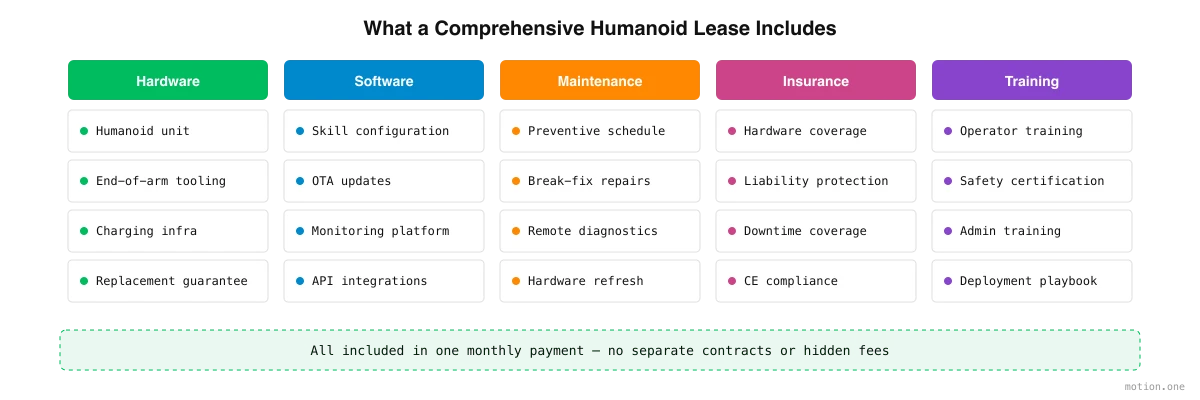
Not all leasing agreements are created equal. Here's what a comprehensive humanoid lease should include:
Hardware - The humanoid unit itself, matched to your task requirements - End-of-arm tooling or grippers appropriate for your use case - Charging infrastructure and any required safety equipment - A replacement unit guarantee (if your robot is down for extended maintenance, a substitute is provided)
Software - Pre-configured skill set for your specific workflows - Ongoing software updates and new skill deployments - Remote monitoring and diagnostics platform - Integration APIs for connecting to your existing MES, WMS, or ERP systems
Maintenance and Support - Preventive maintenance on a scheduled basis - Break-fix repairs with defined response times (typically 24-48 hours) - Remote troubleshooting as first-line support - Hardware refresh at defined intervals (e.g., every 18 months)
Insurance and Compliance - Comprehensive coverage for the unit against damage, theft, or malfunction - Liability coverage for workplace incidents involving the robot - CE marking or equivalent regulatory compliance for your jurisdiction - Documentation for workplace safety audits
Training - Operator training for your floor staff - Safety certification for workers who will interact with the robot - Administrator training for the monitoring and analytics platform
If a leasing provider can't clearly articulate what's included across all five of these categories, that's a red flag.
---
OPEX vs CAPEX: The Financial Case for Leasing
The most common question decision-makers ask is: "Should we buy or lease?"
Here's how the numbers typically compare for a mid-range humanoid deployed in a manufacturing setting:
Purchasing (CAPEX model) - High upfront cost for the unit itself - Additional capital expenditure for integration, tooling, and safety infrastructure - Ongoing costs for maintenance, software licenses, and insurance - often underestimated - Depreciation over 3-5 years, with significant technology risk (newer, better models will be available within 18 months) - You own an asset that may lose value faster than traditional industrial equipment
Leasing (OPEX model) - No upfront capital expenditure - Fixed, predictable monthly payment that includes everything listed above - Technology refresh built into the contract - you always have access to current-generation hardware - Maintenance, insurance, and software updates bundled into the monthly fee - Flexibility to scale up or down based on demand - Operating expense treatment for accounting purposes, keeping the balance sheet clean
The strategic advantage of leasing goes beyond cost. In a technology category that's evolving as rapidly as humanoid robotics, locking in a purchase today means committing to hardware that will be surpassed within two years. Leasing lets you ride the innovation curve rather than bet against it.
For most European SMEs and mid-market manufacturers, the OPEX model also aligns better with how they already procure services. Adding a predictable monthly line item is operationally simpler than justifying a six-figure capital purchase through a board approval process.
---
What to Look for in a Leasing Provider
Not every company offering humanoid leasing has the operational depth to deliver on its promises. Here's a practical checklist for evaluating providers:
OEM relationships and fleet diversity. Does the provider work with multiple hardware manufacturers? A single-OEM provider limits your options. The best leasing companies maintain relationships with several leading OEMs and can recommend the right platform for your specific task - not just the one they happen to stock.
Integration capability. Can they connect the robot to your existing systems? Humanoids don't operate in isolation. They need to communicate with your warehouse management system, your production line controllers, and your quality management tools. Ask about API availability, middleware support, and whether they have in-house integration engineers.
Service-level agreements. What's the guaranteed uptime? What happens when something breaks? How fast is the response? Get specifics. "We'll fix it quickly" is not an SLA. Look for defined response times, replacement unit commitments, and penalty clauses for extended downtime.
Track record with similar operations. Have they deployed in environments like yours? A leasing provider that's only worked in logistics may struggle with the demands of precision manufacturing, and vice versa. Ask for case studies or references from comparable operations.
Geographic coverage. Can they service your location? Humanoid leasing requires physical presence - technicians who can be on-site within a defined window. A provider with operations across Western Europe is more reliable than one operating from a single location.
Data and analytics. What visibility do you get into robot performance? The best providers offer real-time dashboards showing throughput, error rates, utilisation, and predictive maintenance alerts. This data is essential for optimising your deployment and building the business case for expansion.
Exit terms. What happens if you want to end the lease early? What's the process for returning equipment? Are there penalties? Understand the exit terms before you sign.
---
Integration and Deployment: What the Process Looks Like
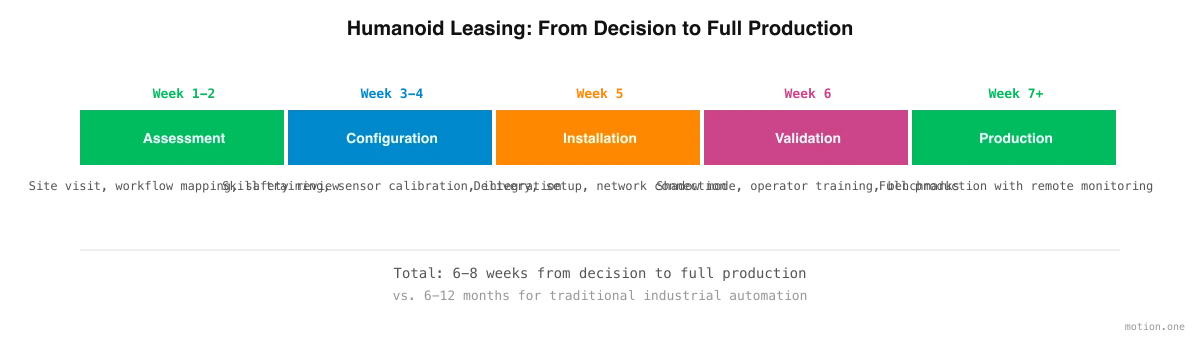
Deploying a humanoid robot is not plug-and-play, but it's also not the multi-year integration project that traditional industrial automation often requires. Here's what a typical deployment timeline looks like with a competent leasing provider:
Week 1-2: Assessment The provider visits your facility, maps the target workflow, identifies safety requirements, and recommends the right hardware platform. This phase includes measuring cycle times, understanding material flow, and evaluating the physical environment (floor surfaces, lighting, obstacles, temperature, humidity).
Week 3-4: Configuration The robot is configured for your specific tasks. This may involve training new skills, calibrating perception systems for your environment, and setting up integration points with your existing software systems. Much of this work happens off-site, in the provider's lab.
Week 5: Installation The unit is delivered and installed. Safety barriers or sensors are set up if required. The robot is connected to your network and production systems. Initial testing runs begin.
Week 6: Validation and Training The robot runs alongside your existing process in shadow mode or limited production. Your operators receive hands-on training. Safety procedures are reviewed and certified. Performance benchmarks are established.
Week 7 onward: Full Production The robot enters full production. The leasing provider monitors performance remotely and conducts a review at the 30-day mark to optimise settings and address any issues.
Total time from decision to full production: roughly 6-8 weeks. Compare that to 6-12 months for traditional industrial automation projects, and the advantage is clear.
---
Frequently Asked Questions
Can I lease just one robot to start? Yes. Most leasing providers offer single-unit deployments specifically so you can validate the technology in your environment before scaling. Starting with one robot on a well-defined task is the recommended approach.
What happens if the robot breaks? Your lease agreement should include maintenance and repair coverage. The provider diagnoses the issue remotely first. If on-site repair is needed, a technician is dispatched within the SLA window (typically 24-48 hours). For extended repairs, a replacement unit should be provided.
Do I need to hire a robotics engineer? No. That's one of the primary advantages of leasing. The provider handles technical maintenance, software updates, and troubleshooting. Your team needs basic operator training, which is included in the lease, but you don't need in-house robotics expertise.
Can the robot work alongside my existing staff? Yes. Current-generation humanoids are designed for collaborative environments. They include safety systems - force limiting, proximity detection, emergency stops - that allow them to operate in shared spaces. Your leasing provider will conduct a safety assessment and configure the appropriate safeguards for your facility.
What tasks can humanoid robots actually do today? In manufacturing and logistics, the most common deployments include: picking and packing, palletising, machine tending, quality inspection, material transport, and light assembly. Tasks that require fine dexterity, complex decision-making, or operation in highly unstructured environments are still limited - but the range of capable tasks is expanding with every software update.
Is my data secure? Ask your provider about data handling, storage location, and compliance with relevant regulations (GDPR for operations in the EU). Performance data should be encrypted in transit and at rest, and you should have full ownership of any operational data generated by the robot in your facility.
What's the minimum lease duration? Most providers offer 12-month minimum terms, with 24 and 36-month options that come at lower monthly rates. Some offer shorter pilot terms (3-6 months) at a premium, specifically designed for evaluation purposes.
---
Who Should Consider Humanoid Leasing
Humanoid robot leasing makes the most sense for:
- Mid-market manufacturers facing labour shortages who need to maintain or increase throughput without the capital commitment of traditional automation
- Logistics and warehouse operators handling high-volume, repetitive tasks where staffing is unpredictable or seasonal
- Operations leaders who want to evaluate humanoid robotics without committing to a purchase and a multi-year depreciation schedule
- Companies with variable demand who need the flexibility to scale automation up or down based on order volume
- Any organisation that recognises humanoid technology is improving rapidly and wants to stay on the leading edge without being locked into today's hardware
If you're running a production floor, a warehouse, or a distribution centre, and you've been watching the humanoid robotics space from the sidelines, leasing removes the barriers that have kept most companies from moving forward: high upfront cost, technology risk, and the need for in-house robotics talent.
---
Next Steps
The humanoid leasing market is maturing fast. Providers with real operational experience, multi-OEM fleets, and proven integration capabilities are separating from those still selling vaporware.
If you're evaluating humanoid leasing for your operation, start with a single well-defined task, choose a provider that can demonstrate relevant deployment experience, and negotiate an agreement that gives you flexibility as the technology - and your needs - evolve.
The companies that move now will build operational knowledge and workflow optimisation that compounds over time. The question is no longer whether humanoid robots will be part of manufacturing and logistics. It's whether you'll be leasing them this year or next.