Humanoid-as-a-Service (HaaS): how it works for a factory
Humanoid-as-a-Service (HaaS) explained: what the monthly fee covers, how it differs from buying a robot, and when the model pays off for a factory.
Motion team ·
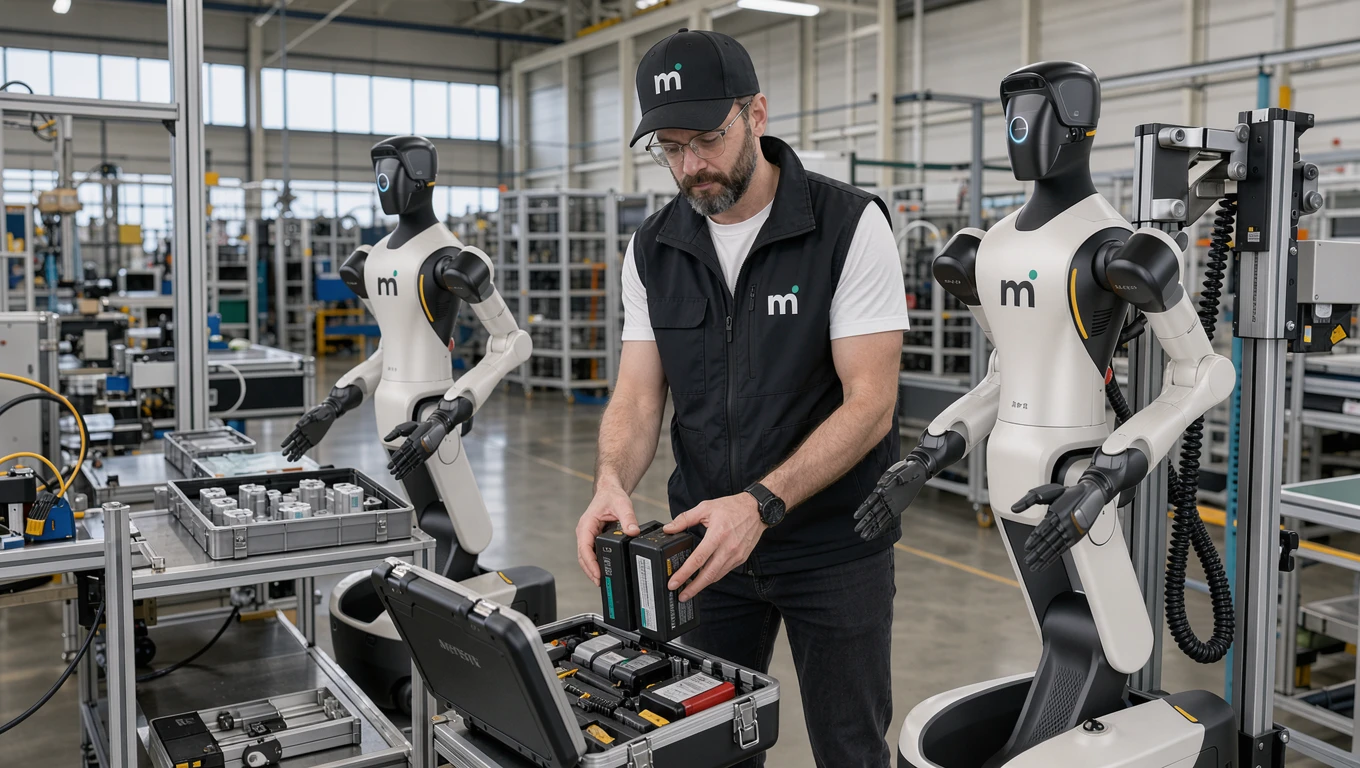
Humanoid-as-a-Service (HaaS) is a model where a provider owns, deploys and maintains humanoid robots at your site and you pay a recurring fee instead of buying them. It is the humanoid version of Robot-as-a-Service (RaaS). The fee usually bundles the hardware, software, maintenance and insurance, so there is little or no upfront cost.
For small and mid-sized manufacturers, HaaS removes the biggest barrier to automation, which is the upfront cost. It also changes how companies handle flexibility, risk and the pace at which they adopt new technology.
This article explains how HaaS works, how it compares to traditional procurement, what to look for in a provider, and why the model matters more now that humanoid robots are entering factories.
---
What is Humanoid-as-a-Service (HaaS)?
Under Humanoid-as-a-Service, a provider deploys, maintains and manages robotic systems at a customer's facility for a recurring fee, typically monthly or quarterly. The customer does not own the hardware. They pay for outcomes: units moved, hours operated, tasks completed, or simply access to a fleet of machines that the provider keeps in working order.
It resembles leasing, with much more included. A traditional equipment lease hands you the asset and leaves you to manage it. HaaS bundles the robot, the software, the integration, the maintenance, the upgrades and often the insurance into a single subscription. The provider keeps ownership and responsibility, and you keep the productivity gains. Motion's monthly fee covers four services: hardware lease, software, insurance and maintenance.
The model comes from enterprise software. Companies moved from buying servers and perpetual licences to subscribing to cloud infrastructure and SaaS applications, and manufacturers are now moving from buying robots to subscribing to robotic capabilities.
---
Why HaaS is gaining traction in manufacturing
Several forces make HaaS viable.
Capital is tight. A single industrial robotic cell (arm, end effector, safety enclosure, integration) can cost anywhere from tens of thousands to several hundred thousand euros depending on complexity. For a small manufacturer running thin margins, that is a bet-the-company investment. HaaS turns it into a predictable recurring fee, paid from revenue the robot helps generate.
Labour shortages are structural. In ManpowerGroup's 2026 survey, 72% of employers in manufacturing reported difficulty filling roles, and the gap widens as experienced operators retire. Manufacturers now automate to add capacity as much as to cut cost, and HaaS lets them add that capacity without the hiring timeline or the training overhead.
Technology moves faster than depreciation schedules. A robot bought today may be outclassed by a much more capable model within a few years. If you buy it, you are locked in. Some HaaS contracts build in hardware refreshes, so you get the current generation without writing off the previous one.
Integration has become simpler. Modern robotic platforms are more modular, more software-defined and easier to deploy than earlier ones. That is what makes the provider's economics work: they can deploy and redeploy units across customers without heavy setup costs each time.
---
How HaaS differs from traditional robot purchases
Here is how the two models compare on the points operations leaders care about most.
- Upfront cost: buying requires the full capital outlay or equipment financing. HaaS requires little or no upfront investment, often none at all.
- Ongoing cost: as an owner you pay for all maintenance, repair, software licensing and eventual replacement, and those costs are unpredictable. Under HaaS you pay a fixed recurring fee that covers maintenance and software updates, so the cost is predictable by design.
- Risk: when you buy a robot, you carry the risk of technological obsolescence, unexpected downtime and integration failures. Under HaaS the provider absorbs most of it, because their business depends on keeping your robot productive.
- Flexibility: purchased robots are fixed assets. Scaling up means another capital decision, and scaling down leaves idle equipment depreciating on your balance sheet. HaaS contracts can include scale-up and scale-down provisions, seasonal adjustments, or a change in fleet mix as production needs change.
- Accounting: a purchased robot is a depreciating asset, while the treatment of a HaaS fee depends on your accounting rules (the service part is an operating expense either way), as explained in our humanoid leasing guide.
In short, buying is a capital purchase and HaaS is a recurring fee for a running robot.
---
The HaaS model breakdown: what you pay for and what you get
HaaS offerings vary, but most bundle the same components into the recurring fee.
- Hardware: the physical robot, whether an industrial arm, a mobile platform or, more and more often, a humanoid. The provider owns it, insures it and is responsible for its physical condition.
- Software and AI: the control software, the task programming environment and any machine learning models that improve performance over time. The provider pushes updates, often remotely, so the robot gets better without work on your side.
- Deployment and integration: site assessment, installation, safety compliance and integration with your production systems (MES, ERP, conveyor infrastructure). Some providers include this in the subscription; others charge a one-time onboarding fee.
- Maintenance and support: preventive maintenance schedules, remote diagnostics, on-site repair when needed, and spare parts. The provider deals with downtime.
- Hardware refreshes: some providers offer upgraded hardware at set intervals, so you do not run a unit two or three generations behind.
- Analytics and reporting: most HaaS platforms report utilisation, throughput and maintenance alerts. This data often shows where to improve operations beyond the robot itself.
Pricing varies. Some providers charge per robot per month. Others charge per task completed or per unit produced, which is true pay-for-outcome pricing. Some combine a base subscription with variable pricing tied to actual utilisation, so cost tracks the value delivered.
---
HaaS for humanoid robots
Everything above applies to established industrial robots such as arms, AGVs and cobots. The case for HaaS gets stronger with humanoid robots.
Humanoid robots are general-purpose platforms designed to work in environments built for people. They can move around factory floors without changes to the infrastructure, use standard tools and fixtures, and switch between tasks that would otherwise each need a different specialised machine. That versatility is their main advantage, and it is also why they are expensive and change quickly.
The first generation of production-ready humanoids is reaching the market now. Robot makers are shipping units that can pick, pack, palletise and feed machines. The technology is advancing fast: Goldman Sachs found that the manufacturing cost of a high-spec humanoid fell about 40% in a single year, and next year's models will likely be more capable and cheaper than today's.
That pace makes outright purchase risky. A manufacturer who buys a humanoid today may find it limited compared with what is available in two years, with the capital already spent. Under HaaS the provider absorbs the depreciation risk and can offer newer hardware, so the manufacturer has current capabilities without the write-down. Lenders face the same problem from the other side, which we explain in why humanoid robots are hard to finance.
HaaS also deals with the integration uncertainty of a new category. Humanoid robots are not yet as well understood as six-axis arms: deployment patterns, the best tasks to assign them and maintenance cadences are all still being worked out. Under HaaS, the provider carries that learning curve. Its teams have deployed across multiple sites and built up operational knowledge that a single manufacturer would take years to gain alone.
For European SMEs in particular, humanoid HaaS gives access to the latest automation without the capital risk, the integration work or the worry of picking the wrong technology. The provider runs and supports the robot, and you run your production.
---
Key benefits: scalability, risk reduction, current hardware
The main advantages:
- Scalability on demand: add units for a seasonal surge and scale back when demand drops, so your robotic workforce becomes a variable resource.
- A much lower barrier to entry: companies that could never justify the capital expenditure for industrial automation can now get it, including the small and mid-sized manufacturers who need it most.
- Risk transfer: technology, maintenance and obsolescence risk shift to the provider, and you pay for what works.
- Current technology: where the contract includes hardware refreshes, you stay off ageing equipment, and software updates keep improving your robots without you managing the upgrade cycle.
- Predictable costs: no surprise repair bills and no emergency capital requests for replacements, just one line in the operating budget that stays the same month to month.
- A known deployment path: providers repeat the same deployment process across customers. With Motion, most deployments run on their own within 12 to 15 weeks.
- Focus: you manufacture products, and the HaaS provider manages the robots.
---
Challenges and considerations
HaaS has trade-offs, and an honest evaluation should weigh them.
Over a five-to-ten year horizon, subscription payments may exceed the purchase price of the same equipment. For companies with strong balance sheets and stable, long-term automation needs, ownership can be cheaper in the long run. HaaS is built for flexibility and risk reduction, and it will not always give the lowest lifetime cost.
You also depend on the provider. If they underperform, with slow maintenance response, poor software updates or unreliable hardware, your production suffers, so choosing the right provider matters.
HaaS platforms collect operational data from your facility. Find out who owns that data, how it is used and what protections are in place, and make sure the contract states it.
Highly specialised or proprietary processes may not fit a provider's standard offering. If your automation needs are deeply custom, HaaS may need significant adaptation, or may not suit you at all.
Minimum commitment periods, termination clauses, service level agreements and liability caps all vary. Read the contract carefully, because how flexible HaaS is for you depends on the terms you negotiate.
---
How to evaluate a HaaS provider
Check the provider's range of robots, deployment track record, SLAs, data access and financial stability, and ask it to compare the total cost against buying; the full checklist is in our humanoid leasing guide.
---
The future of HaaS in industry
HaaS is still early, and most industrial automation is still bought outright. We expect several trends to speed up adoption over the next three to five years.
Humanoid robots will drive it. As general-purpose humanoid platforms mature, we expect HaaS to become a common way to deploy them, because the technology changes too fast and does too many jobs for static ownership to make sense.
We expect more outcome-based pricing. Paying per unit produced or per task completed ties provider and customer incentives more closely and makes ROI easy to calculate.
Fleet data will add up. As providers come to manage larger fleets across many sites, the operational data they collect can train AI models that improve performance across the whole fleet, so each robot benefits from what the others learn. Owning a robot on its own gives you none of that network effect.
HaaS will tie into workforce planning. It should augment human workers instead of replacing them wholesale. The most advanced deployments will combine human expertise with robotic capacity and scale each according to demand.
The rules are already arriving. The Machinery Regulation (EU) 2023/1230 applies from 20 January 2027, and AI requirements for machinery are set to follow through delegated acts under that Regulation by 2 August 2028 (Regulation (EU) 2026/1744). The new Product Liability Directive (EU) 2024/2853 treats software as a product for products placed on the market after 9 December 2026. We cover what this means for a plant in the Machinery Regulation for robot users and in humanoid robot safety and EU compliance.
---
Getting started
If you are a manufacturer evaluating HaaS, start by identifying the right use case before you pick a provider. Look for tasks that are repetitive, physically demanding and hard to staff, and that can tolerate the learning curve of any new automation deployment. Picking, packing, palletising, machine feeding and line-side logistics are common starting points.
Then compare providers on deployment timelines, SLAs, hardware options and contract flexibility, and start on a contained scope before committing to a full rollout.
If you have a task in mind, book a 30-minute call and we will tell you whether a humanoid fits it and what the monthly fee would cover.