Scenario: humanoid robots in logistics palletising
A modelled scenario: four humanoids on mixed-case palletising at a logistics site. Inputs, assumptions, ramp-up and the ranges of results to expect.
Motion team ·
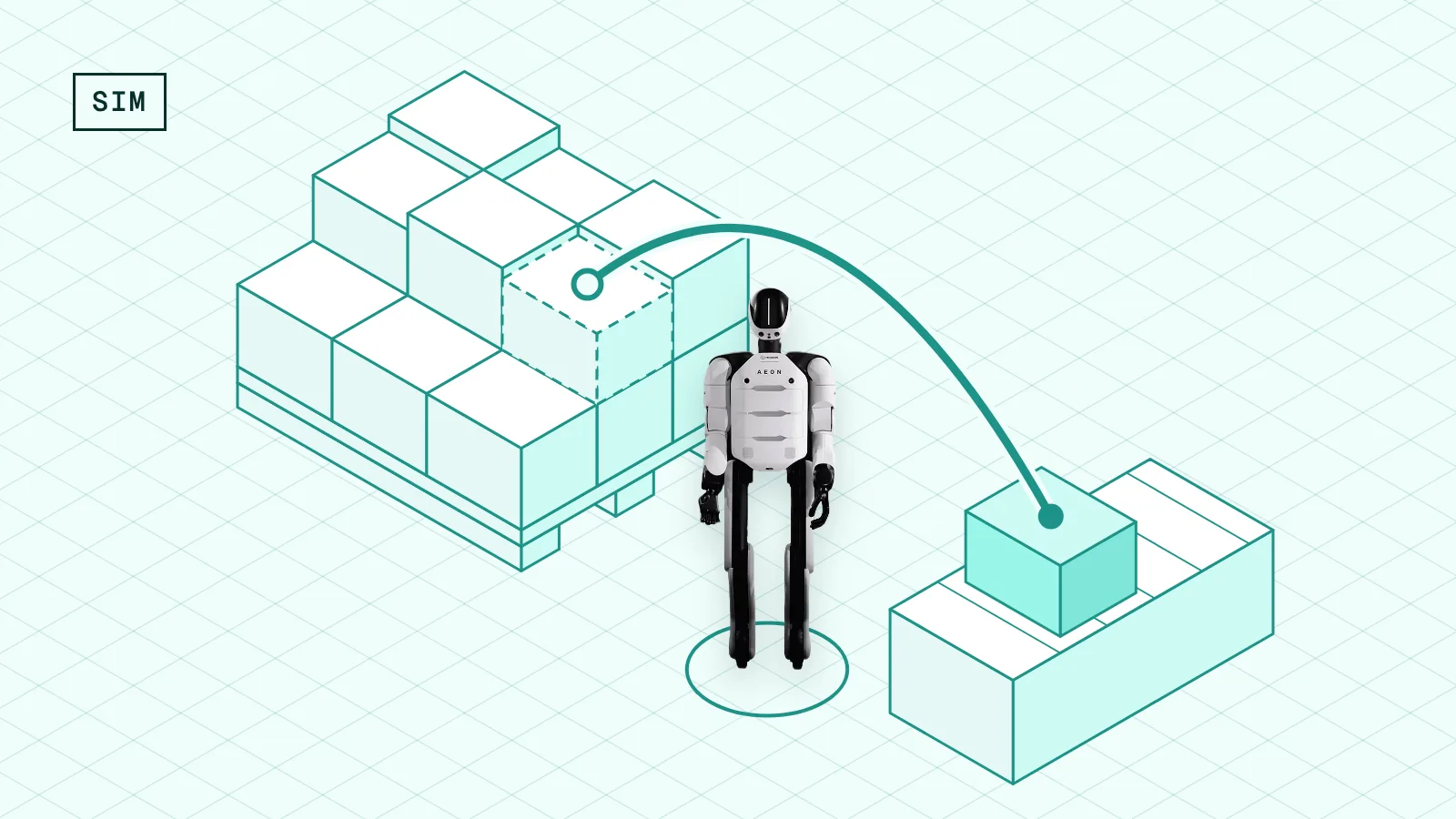
Logistics operator - palletising and loading dock operations
A modelled scenario: this article describes a representative deployment, built from operational patterns typical of the sector, rather than a report on a named customer engagement. It is not a write-up of a Motion pilot. The figures are illustrative estimates, and the robot capabilities assumed here match public 2026 humanoid specifications.
Can humanoid robots take over mixed-case palletising at a logistics site? In this model, yes, for cases up to about 15 kilograms. Four humanoids build mixed-case pallets while lift trucks move the finished ones. The first two robots palletise on their own within 12 to 15 weeks, and the main gain is covering shifts that used to go unstaffed.
The challenge
A regional logistics operator runs three distribution centres and has struggled for years to staff palletising and the loading dock. The work is repetitive heavy lifting, stacking cases onto pallets for outbound trucks, and these are among the hardest positions to fill in logistics. Manual handling is also where most injuries happen: musculoskeletal disorders are the most common work-related health problem in the EU.
The operator had looked at traditional palletising automation, robotic arms on fixed gantries, and found the capital cost too high for the range of product sizes and pallet configurations it handles. Different clients ship different products in different case sizes, and pallet configurations change daily with order composition.
The model's assumptions
| Input | Value in this scenario | |---|---| | Robots | Four humanoids in the largest distribution centre | | Shifts | Two eight-hour shifts, five days a week | | Case weights | 2 to 15 kilograms; heavier cases stay with people or a lift assist | | Case configurations | More than 200 over a year | | Robot pace | 60 to 80% of a person's pace per hour | | Battery | Packs swapped during the shift, a few hours per pack | | Staffing gap before deployment | About 12 dock shifts a month partially or fully unstaffed | | Pallet moves | Lift trucks, as before; humanoids do not carry loaded pallets |
The solution
The operator deploys four humanoid robots in its largest distribution centre on two workflows.
- Mixed-case palletising. The robots build pallets from mixed product cases, following pallet-build plans from the warehouse management system. They handle cases from 2 to 15 kilograms and adjust stacking patterns to case dimensions and weight distribution as they go.
- Pallet staging. Lift trucks move finished pallets to the dock, as they did before. A loaded pallet weighs hundreds of kilograms, which is a job for a lift truck, not a humanoid. The robots label, check and stage cases for the next build.
The fleet software matters most here. Dock supervisors can change robot priorities from the fleet dashboard, for example moving a robot onto an urgent order build, without anyone rebuilding a workflow. Our guide to fleet management software covers what that layer has to do.
Deployment timeline
- Weeks 1-4: robots delivered, facility mapped and safety assessment started. The dock team records the task, and operators run teleoperated sessions. The dock needs minor changes, such as floor markings for robot zones.
- Weeks 5-11: the skills are trained in simulation, then run under supervision on the five highest-volume product lines.
- Weeks 12-15: the first two robots palletise on their own, with operators stepping in remotely only for unusual cases.
- Months 4-6: robots three and four join, reusing the same skills, and the product range widens.
For what the site prepares before week one, see the factory readiness checklist.
Modelled results (first 12 months)
- Pallets built per week rise, mainly because shifts that used to go unstaffed are now covered. Per hour, the robots work at or below a person's pace.
- Pallet stability issues, meaning cases shifting or falling in transport, become less frequent, because stacking follows the same pattern every time.
- Roughly 9,000 to 13,000 labour hours a year move from manual palletising to inventory management and dispatch coordination. This follows from the assumptions above: four robots, two shifts, five days, at 60 to 80% of a person's pace.
- Musculoskeletal injury reports in the dock area fall, since the robots take the most repetitive lifts. In this model these injuries account for most of the site's occupational accident claims.
- The robots handle the full range of more than 200 case configurations, which a fixed palletising cell set up for a few formats would struggle with.
- Unstaffed dock shifts become rare.
What the model depends on
The results above hold only if a few conditions are true.
Staffing is the reason to deploy. The operator cannot hire and keep people for physically demanding, repetitive roles. If the dock were fully staffed, the case would rest on injury reduction and consistency alone, and it would be weaker, since the robots work no faster than people.
The case weights fit the robots. Cases above about 15 kilograms stay with people or a lift assist. A site whose volume is mostly heavy cases is a poor fit for today's humanoids.
The rollout is phased. Two robots and the five highest-volume product lines come first, then the other two robots and the wider range. That gives the team time to build confidence, refine the skills and fix problems before scaling.
Skills are shared across the fleet. Pallet-build skills learned on the first two robots carry over to the third and fourth, so nobody configures them from scratch.
Deployment support carries the work. Dock supervisors do not have to become robotics engineers. Field Deployment Engineers train the robots on the operator's own workflows, using recordings of the dock team at work, and train that team to work alongside the machines. Motion keeps running and supporting the robots after go-live.
Safety stays an ongoing activity. The team keeps assessing risk, updating protocols and refining the robots' behaviour after the initial certification.
Existing staff move into other roles. People who had been palletising go to inventory management and dispatch coordination, roles the operator also struggles to fill. In this scenario, net headcount stays the same. Saying so early matters on a site that is short of people already.
If you have a palletising task in mind, book a 30-minute call and we will tell you whether a humanoid fits it.