Labour shortages in European manufacturing: can humanoid robots fill the gap?
Europe's factories struggle to fill shop-floor jobs. What EU data shows, which tasks humanoid robots can take on today, and how to start with one pilot.
Motion team ·
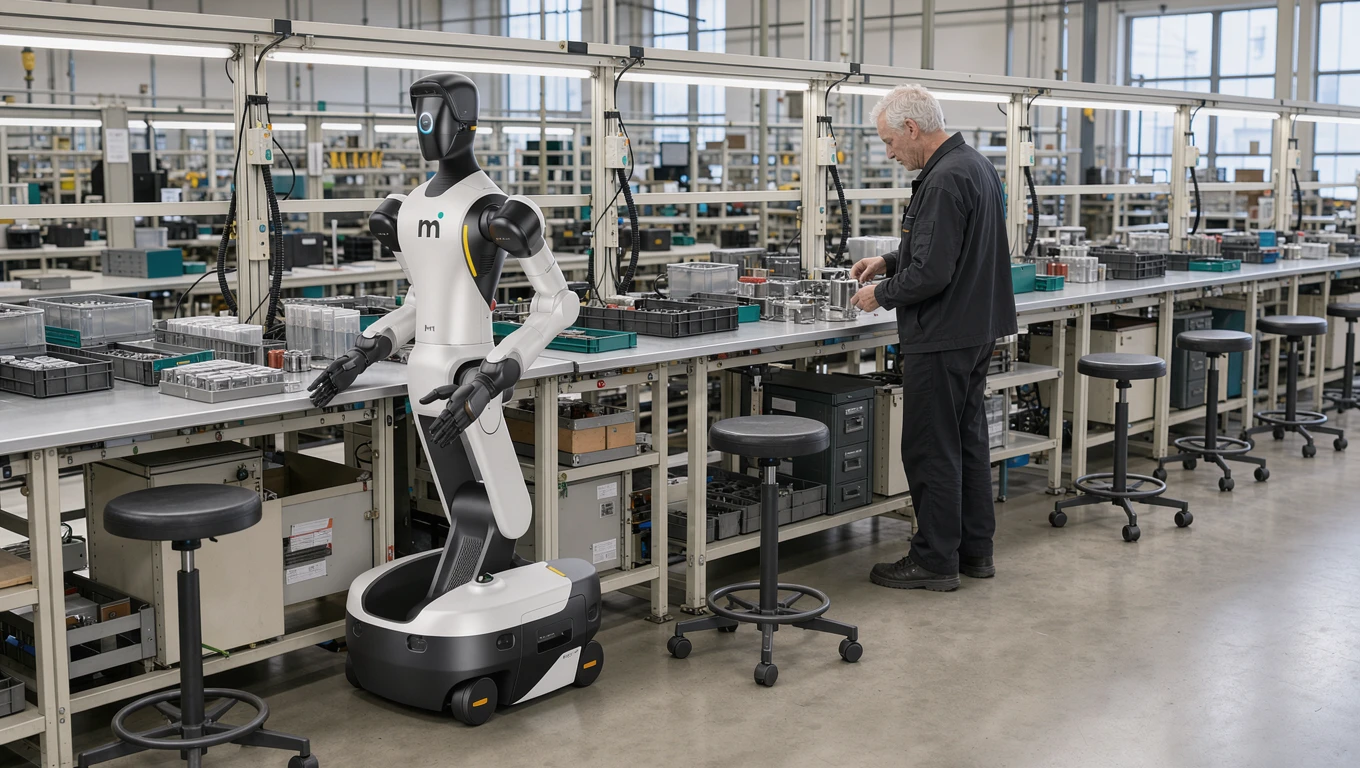
Partly. Humanoid robots can take on picking, packing, palletising, machine feeding and line-side logistics, the repetitive shop-floor tasks that are hardest to staff. They will not fix Europe's skills shortage on their own, but one robot on one hard-to-fill station can keep a line running. Most deployments run autonomously within 12 to 15 weeks.
What the data shows
European manufacturers have struggled to find the right people for years, and the causes are mostly demographic and skills-related, so higher recruitment budgets do not make them go away.
In a 2023 Eurobarometer survey (Flash Eurobarometer 529), almost four in five small and mid-size companies in the EU, across all sectors, said it was difficult to find workers with the right skills.
Headline vacancy rates have eased since their 2022 peak. In the third quarter of 2025 the EU job vacancy rate was 2.0 percent across the economy and 1.5 percent in manufacturing, with the highest national rate in the Netherlands at 4.1 percent (Eurostat). An average vacancy rate hides where the pain is: specific roles, shifts and regions where a station stays empty for months.
The workforce is also ageing. The share of employed people aged 55 to 64 has risen steadily across the EU (Eurostat), and many of them will retire within a decade.
Labour is expensive too. In 2025 the average hourly labour cost in the EU was EUR 34.9, and non-wage costs, mostly employer social contributions, made up 24.8 percent of total labour cost in the EU and 32.3 percent in France (Eurostat).
For operations managers at small and mid-size manufacturers, the shortage means running lines with unfilled positions, relying on overtime to cover gaps, watching quality slip as tired workers push through extended shifts, and turning down orders because the capacity cannot be staffed.
The cost of empty workstations
Labour shortages spread through the whole operation in ways that are often underestimated.
Reduced capacity is the most obvious impact. When positions go unfilled, lines run below their maximum throughput even when demand and equipment are there.
Overtime adds to the problem. Existing workers cover gaps at premium rates, which are set by national law and collective agreements. It is expensive in the short term and unsustainable in the long term, because chronic overtime leads to burnout, absenteeism and turnover, which make the shortage worse.
Quality suffers when workers are stretched thin. Fatigue raises the risk of errors and accidents (EU-OSHA). In regulated industries such as food and beverage, pharmaceuticals and automotive, quality issues can trigger recalls, regulatory action and damage to reputation.
Delivery reliability erodes as capacity becomes unpredictable. Customers who cannot rely on delivery dates look for other suppliers, and SME manufacturers competing against larger firms with deeper labour pools feel that first.
Why traditional automation has not solved the problem
Industrial robot arms have been in factories for decades, and they automate high-volume, high-precision, fixed-position tasks on dedicated lines very well. They have not solved the labour shortage, because the shortages sit in tasks that fixed arms handle poorly.
Robot arms do best in structured, predictable environments where the task is precisely defined and the workspace is built around them. They are less practical for tasks that need mobility between workstations, handling of objects with varying shapes and sizes, or work in spaces designed for people.
These are the tasks where labour shortages bite hardest and where humanoids can help today:
- End-of-line picking and packing, where products of varying sizes must be picked and packed.
- Palletising, where boxes and totes are stacked at the end of a line.
- Machine feeding, where parts are loaded into and taken out of a machine all shift long.
- Line-side logistics, where components are moved between stores and workstations across the floor.
Humanoids are built for spaces designed for people. They can reach the same shelves, walk the same aisles and use the same stations, so they usually need fewer work cells and infrastructure changes than fixed automation. Where a fixed arm does a job better, it is the better choice.
Making humanoids accessible to the manufacturers who need them most
The manufacturers most affected by labour shortages are often the least equipped to deploy robots the traditional way. A manufacturer with 50 to 500 employees does not have a robotics team. It cannot fund a custom integration project for every robot, and it cannot tie up a line for months while engineers iterate on the floor.
This is why how the robot is deployed matters as much as the robot. The deployment should not need robotics expertise inside the factory, so that the operations manager, the person who understands the work, can hand over the task without writing a programming brief. Training should happen largely in simulation and by remote operators, so the plant is not tied up for months. The cost should come as a monthly fee rather than a purchase, so it fits the existing operating budget. And after go-live the operations team should get a fleet view it can follow, with engineers who monitor the robots and are on call for maintenance.
That is how Motion works: one monthly fee covers the hardware lease, software, insurance and maintenance, with no upfront cost, and Motion runs and supports the robot after deployment. Deploying humanoids without robotics engineers explains the steps.
A phased path to adoption
Manufacturers do not need to change their whole operation at once. The safest adoption strategy is phased: start small and scale on results.
The first phase is a pilot of one or two humanoids on the hardest-to-fill positions. The goal is to validate the robot in your environment, measure the return, and build confidence in the operations team. This phase typically takes 12 to 15 weeks from assessment to autonomous operation. The factory readiness checklist covers what to prepare before week one.
The second phase extends to more positions in the same facility, reusing the skills, simulation models and site knowledge built during the pilot. Because that groundwork exists, the second and third humanoids should deploy faster than the first.
The third phase scales across shifts, lines and possibly other sites, with the same fleet view and support across all of them.
If you have a hard-to-fill station in mind, book a 30-minute call and we will tell you whether a humanoid fits it.