Humanoid-as-a-Service Explained: How HaaS Is Changing Manufacturing
Humanoid-as-a-Service turns robotics from a capital purchase into a monthly subscription - how the RaaS model works, what the fee covers, and when it pays off.
Motion1 Inc. ·
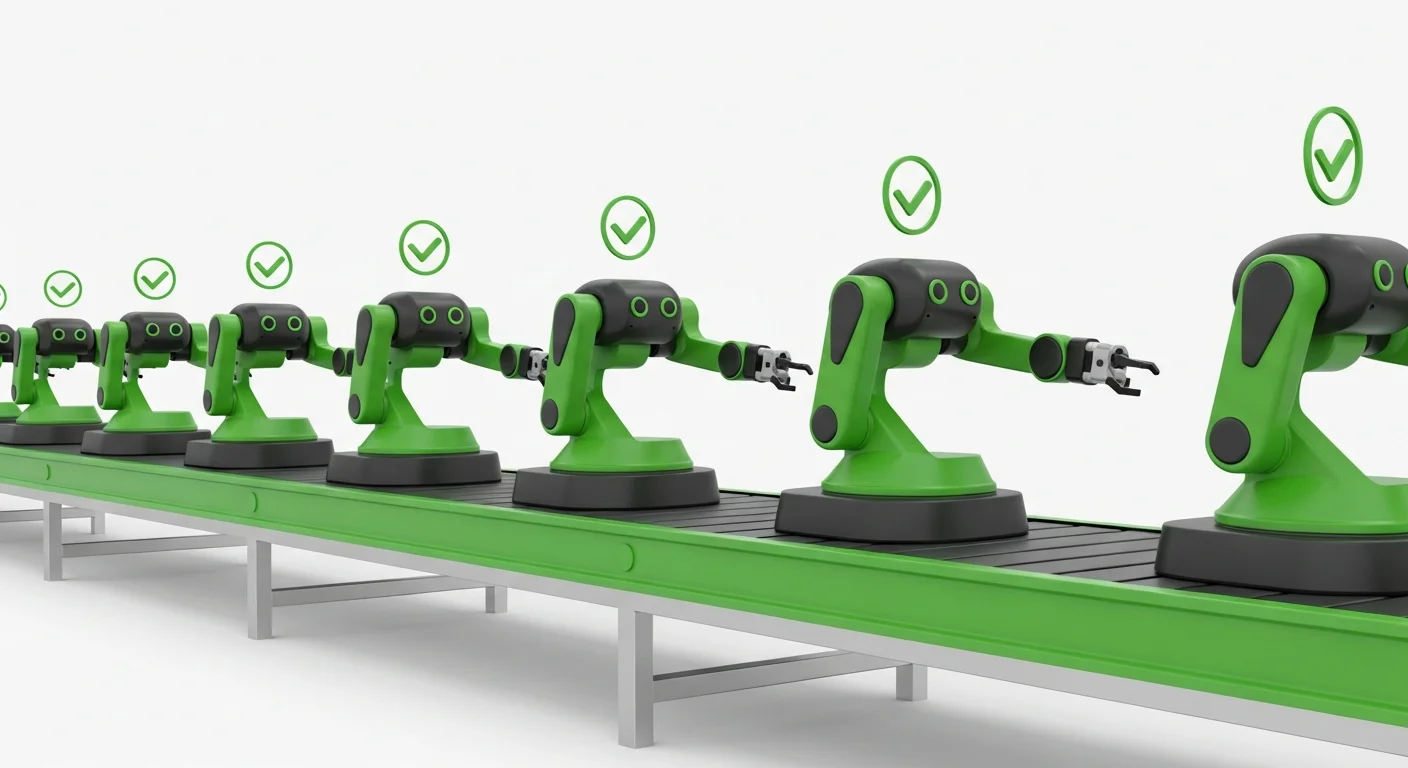
The factory floor is undergoing a quiet revolution. Instead of purchasing industrial robots outright - committing millions in capital expenditure before a single unit rolls off the line - manufacturers are increasingly subscribing to them. Welcome to Humanoid-as-a-Service, or HaaS: a model that treats robotics the way SaaS treats software, shifting the economics of automation from ownership to access.
For small and mid-sized manufacturers especially, HaaS removes the single biggest barrier to automation: the upfront cost. But the implications run deeper than financing. HaaS is reshaping how companies think about flexibility, risk, and the pace of technological adoption in an industry where standing still means falling behind.
This article breaks down exactly how HaaS works, how it compares to traditional procurement, what to look for in a provider, and why the model is particularly significant now that humanoid robots are entering the picture.
---
What Is Humanoid-as-a-Service (HaaS)?
Humanoid-as-a-Service is an operational model where a provider deploys, maintains, and manages robotic systems at a customer's facility in exchange for a recurring fee - typically monthly or quarterly. The customer does not own the hardware. Instead, they pay for outcomes: units moved, hours operated, tasks completed, or simply access to a fleet of machines kept in working order by the provider.
Think of it as leasing, but with significantly more included. A traditional equipment lease hands you the asset and leaves you to manage it. HaaS bundles the robot, the software, the integration, the maintenance, the upgrades, and often the insurance into a single subscription. The provider retains ownership and responsibility. You retain the productivity gains.
The model borrows directly from the playbook that transformed enterprise software. Just as companies moved from buying servers and perpetual licenses to subscribing to cloud infrastructure and SaaS applications, manufacturers are moving from buying robots to subscribing to robotic capabilities.
---
Why HaaS Is Gaining Traction in Manufacturing
Several forces are converging to make HaaS not just viable, but increasingly preferred.
Capital constraints are real. A single industrial robotic cell - arm, end effector, safety enclosure, integration - can cost anywhere from tens of thousands to several hundred thousand euros depending on complexity. For a small manufacturer running thin margins, that is a bet-the-company investment. HaaS converts that capital expenditure into a predictable operating expense, paid from revenue the robot helps generate.
Labour shortages are structural, not cyclical. Across Western Europe, North America, and parts of Asia, manufacturers cannot find enough skilled workers to fill production roles. The gap is widening as experienced operators retire and younger workers gravitate toward knowledge-economy jobs. Automation is no longer a cost-optimisation play - it is a capacity play. HaaS lets companies add capacity without the hiring timeline or the training overhead.
Technology is evolving faster than depreciation schedules. A robot purchased today may be outclassed by a significantly more capable model within three to five years. Under a purchase model, you are locked in. Under HaaS, hardware refreshes are typically built into the contract. You get access to the current generation without writing off the previous one.
Integration complexity has decreased. Modern robotic platforms are more modular, more software-defined, and easier to deploy than their predecessors. This makes the HaaS provider's economics work - they can deploy and redeploy units across customers without prohibitive setup costs each time.
---
How HaaS Differs from Traditional Robot Purchases
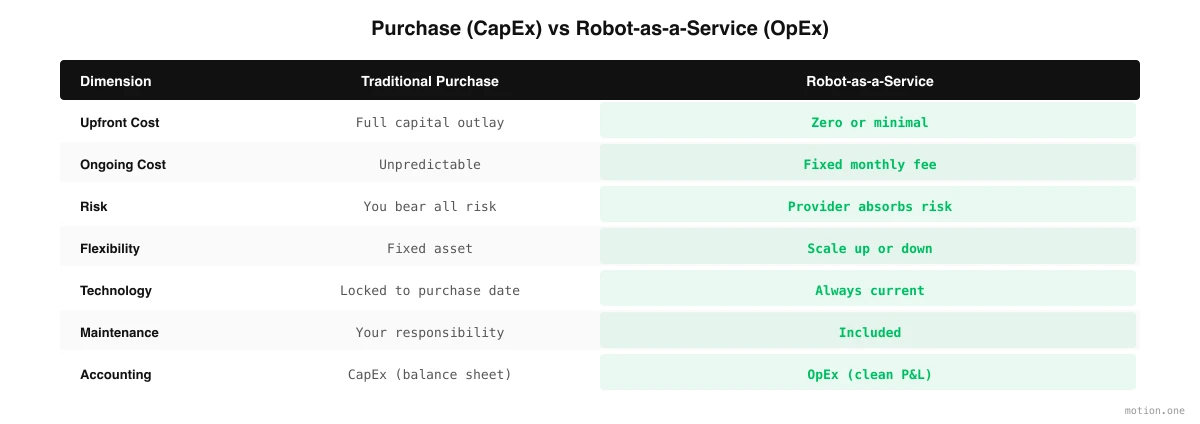
Understanding HaaS requires understanding what it replaces. Here is a direct comparison across the dimensions that matter most to operations leaders.
Upfront cost. Traditional purchase requires full capital outlay or equipment financing. HaaS requires zero or minimal upfront investment - typically just site preparation and a modest onboarding fee.
Ongoing cost. With ownership, you bear all maintenance, repair, software licensing, and eventual replacement costs. These are unpredictable. With HaaS, you pay a fixed recurring fee that covers maintenance, software updates, and often hardware swaps. The cost is predictable by design.
Risk allocation. When you buy a robot, you own the risk: technological obsolescence, unexpected downtime, integration failures. Under HaaS, the provider absorbs most of these risks. Their business model depends on keeping your robot productive - their incentives align with yours.
Flexibility. Purchased robots are fixed assets. Scaling up means another capital decision; scaling down means idle equipment depreciating on your balance sheet. HaaS contracts can include scale-up and scale-down provisions, seasonal adjustments, or even fleet recomposition based on changing production needs.
Accounting treatment. This is not trivial. A purchased robot sits on the balance sheet as a depreciating asset. HaaS payments are typically classified as operating expenses, which can improve return on assets and keep balance sheets cleaner - a meaningful consideration for companies seeking investment or managing debt covenants.
The shorthand: purchasing is the CAPEX model, HaaS is the OPEX model. But the difference is not just financial. It is operational, strategic, and increasingly cultural - reflecting a broader shift from asset ownership to capability access.
---
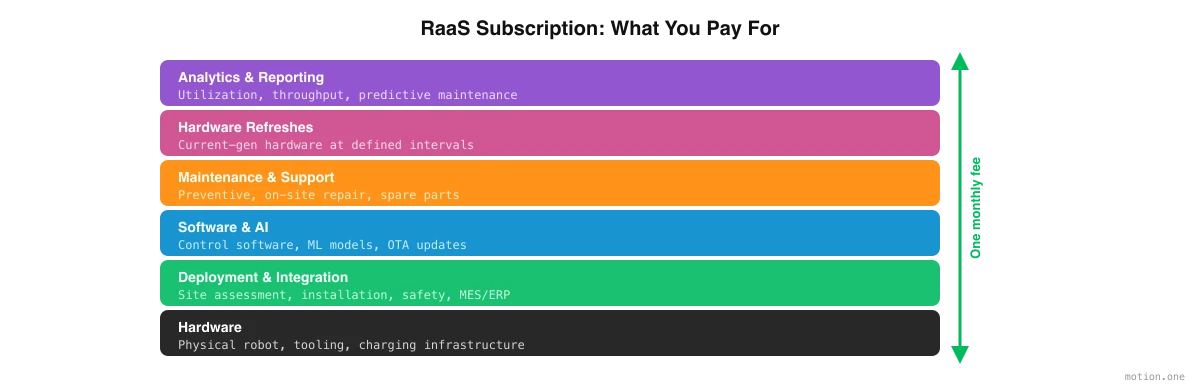
The HaaS Model Breakdown: What You Pay for and What You Get
Not all HaaS offerings are structured the same way, but most include a common set of components bundled into the recurring fee.
Hardware. The physical robot - whether a traditional industrial arm, a mobile platform, or increasingly a humanoid unit. The provider owns it, insures it, and is responsible for its physical condition.
Software and AI. The control software, task programming environment, and any machine learning models that improve performance over time. Updates are pushed by the provider, often remotely, meaning your robot gets smarter without you lifting a finger.
Deployment and integration. Initial site assessment, installation, safety compliance, and integration with your existing production systems (MES, ERP, conveyor infrastructure). Some providers include this in the subscription; others charge a one-time onboarding fee.
Maintenance and support. Preventive maintenance schedules, remote diagnostics, on-site repair when needed, and spare parts. Downtime is the provider's problem, not yours.
Hardware refreshes. Depending on the contract term, you may receive upgraded hardware at defined intervals - ensuring you are never running a unit that is two or three generations behind.
Analytics and reporting. Most HaaS platforms include dashboards showing utilisation rates, throughput, error rates, and predictive maintenance alerts. This data often reveals optimisation opportunities beyond the robot itself.
The pricing model varies. Some providers charge per robot per month. Others charge per task completed or per unit produced - a true pay-for-outcome model. The most sophisticated offerings blend a base subscription with variable pricing tied to actual utilisation, aligning cost directly with value delivered.
---
HaaS for Humanoid Robots: A New Frontier
Everything described above applies to established industrial robots - arms, AGVs, cobots. But the HaaS model becomes even more compelling when applied to humanoid robots.
Humanoid robots are general-purpose platforms designed to operate in environments built for human workers. They can navigate factory floors without infrastructure modifications, use standard tools and fixtures, and transition between tasks that would each require a different specialised machine. This versatility is their defining advantage - and it is also what makes them expensive and fast-evolving.
The first generation of production-ready humanoids is reaching the market now. Leading OEMs are shipping units capable of box manipulation, palletising, machine tending, and basic assembly tasks. But the technology is advancing rapidly. Models released twelve months from now will likely be significantly more capable, more reliable, and more cost-effective than today's units.
This pace of advancement makes outright purchase risky. A manufacturer who buys a humanoid today may find the unit limited compared to what is available in two years - but the capital is already spent. HaaS solves this problem structurally. The provider absorbs the depreciation risk and offers hardware refreshes, so the manufacturer always has access to current-generation capabilities without the write-down.
HaaS also addresses the integration uncertainty that comes with a new technology category. Humanoid robots are not yet a known quantity in the way that six-axis arms are. Deployment patterns, optimal task assignments, maintenance cadences - all of these are still being refined. Under a HaaS model, the provider carries the learning curve. Their teams have deployed across multiple sites and accumulated operational knowledge that any single manufacturer would take years to build independently.
For European SMEs in particular, humanoid HaaS offers something remarkable: access to cutting-edge automation without the capital risk, the integration burden, or the technology-selection anxiety. You subscribe to capability. The provider handles everything else.
---
Key Benefits: Scalability, Risk Reduction, Always-Current Hardware
To summarise the strategic advantages:
Scalability on demand. Need more capacity for a seasonal surge? Add units. Demand drops? Scale back. HaaS turns your robotic workforce into a variable resource, not a fixed one.
Dramatically lower barrier to entry. Companies that could never justify the capital expenditure for industrial automation can now access it. This democratises automation, bringing it to small and mid-sized manufacturers who need it most.
Risk transfer. Technology risk, maintenance risk, obsolescence risk - all shift to the provider. You pay for what works.
Always-current technology. Hardware refreshes mean you are not locked into aging equipment. Software updates mean your robots improve continuously. You stay current without managing the upgrade cycle.
Predictable costs. No surprise repair bills. No emergency capital requests for replacements. One line item in the operating budget, predictable month to month.
Faster deployment. Because the provider has standardised their deployment process across many customers, time-to-production is typically weeks, not months. You see value faster.
Focus on core competency. You manufacture products. The HaaS provider manages robots. Each party does what they do best.
---
Challenges and Considerations
HaaS is not without trade-offs. Honest evaluation requires acknowledging them.
Long-term cost. Over a five-to-ten year horizon, subscription payments may exceed the purchase price of the equivalent equipment. For companies with strong balance sheets and stable, long-term automation needs, ownership can be more economical in the long run. HaaS is optimised for flexibility and risk reduction, not necessarily for lowest lifetime cost.
Dependency on the provider. You are entering a relationship, not making a transaction. If the provider underperforms - slow maintenance response, poor software updates, unreliable hardware - your production suffers. Choosing the right provider is critical.
Data and IP considerations. HaaS platforms collect operational data from your facility. Understand who owns that data, how it is used, and what protections are in place. This should be explicit in the contract.
Customisation limits. Highly specialised or proprietary processes may not fit neatly into a provider's standard offering. If your automation needs are deeply custom, the HaaS model may require significant adaptation - or may not be the right fit.
Contract terms. Minimum commitment periods, termination clauses, service level agreements, and liability caps all vary. Read the contract carefully. The flexibility of HaaS depends entirely on the terms you negotiate.
---
How to Evaluate a HaaS Provider
If you are considering HaaS, here is a practical framework for evaluating providers.
Hardware breadth and currency. What robots do they offer? How recent is the hardware? Do they work with multiple OEMs, or are they locked into a single platform? Providers with a multi-platform approach can match the right robot to your specific task.
Deployment track record. How many sites have they deployed? In what industries? What is their average time from contract to production? Ask for references.
Service level agreements. What uptime do they guarantee? What is the response time for on-site repairs? What compensation do you receive if SLAs are missed? These are not formalities - they are the operational backbone of the relationship.
Software capabilities. How are tasks programmed? Can you reconfigure the robot yourself, or must you go through the provider? Is there a self-service interface for adjustments? How frequently is the software updated?
Scalability provisions. Can you add or remove units? What is the lead time? Are there penalties for scaling down? How do they handle seasonal fluctuations?
Data transparency. Do you have full access to operational data from your robots? Can you export it? Is it integrated with your existing systems?
Financial stability. Your provider needs to be around for the duration of your contract. Evaluate their funding, revenue model, and customer base. A provider that disappears mid-contract leaves you without both robots and recourse.
Total cost modelling. Ask the provider to model total cost of ownership versus total cost of subscription over three, five, and seven years. A credible provider will be transparent about when ownership becomes cheaper - and confident that the flexibility and risk benefits justify the premium.
---
The Future of HaaS in Industry
HaaS is still early. Most industrial automation is still purchased outright. But the trajectory is clear, and several trends will accelerate adoption over the next three to five years.
Humanoid robots will be the catalyst. As general-purpose humanoid platforms mature, the HaaS model will become the default deployment method - because the technology is evolving too fast and is too versatile for static ownership to make sense. Manufacturers will subscribe to humanoid capability the way they subscribe to cloud computing: as a utility.
Outcome-based pricing will dominate. The market is moving from "pay per robot per month" to "pay per unit produced" or "pay per task completed." This further aligns provider and customer incentives and makes ROI calculations trivially simple.
Fleet intelligence will compound. As HaaS providers manage thousands of robots across hundreds of sites, the operational data they collect will fuel AI models that optimise performance across the entire fleet. Every robot benefits from what every other robot learns. This network effect does not exist under the ownership model.
Integration with workforce planning will deepen. HaaS will not replace human workers wholesale - it will augment them. The most sophisticated deployments will blend human expertise with robotic capacity, scaling each independently based on demand. Workforce planning tools will treat HaaS robots as a resource pool alongside human teams.
Regulation will catch up. As HaaS becomes mainstream, expect clearer regulatory frameworks around liability, safety certification, data handling, and worker displacement. Providers who anticipate this - building compliance into their offering from day one - will have a structural advantage.
---
Getting Started
If you are a manufacturer evaluating HaaS, the first step is not choosing a provider - it is identifying the right use case. Look for tasks that are repetitive, physically demanding, difficult to staff, and tolerant of the learning curve that comes with any new automation deployment. Palletising, material transport, machine tending, and quality inspection are common starting points.
From there, engage two or three providers. Compare not just pricing, but deployment timelines, SLAs, hardware options, and contract flexibility. Run a pilot on a contained scope before committing to a full-scale rollout.
The companies that will lead manufacturing over the next decade are not necessarily those with the biggest capital budgets. They are the ones who adopt the most intelligent operating models. HaaS is one of them - and for many manufacturers, it may be the most important strategic decision they make this year.