Why Humanoid Robots Are Hard to Finance
Traditional equipment finance depends on predictable resale value and a deep used-asset market. Humanoid robots break both assumptions, which is why lenders hesitate and buyers stall - and why leasing and embedded finance are emerging as the fix.
Motion1 Inc. ·

There is a quiet gap between the humanoid robots being demonstrated today and the humanoid robots actually working on factory floors. The technology is closer than ever. The financing is not.
Many European manufacturers and SMEs that want to deploy a humanoid run into the same wall: a single unit or robotic cell can cost anywhere from roughly 150,000 euros to over 1,000,000 euros upfront, and the usual ways of paying for capital equipment do not fit cleanly. Banks and equipment lessors, the institutions that normally make expensive machines affordable, tend to hesitate. Understanding why they hesitate is the first step to understanding how the gap gets closed.
Why lenders can't underwrite a robot
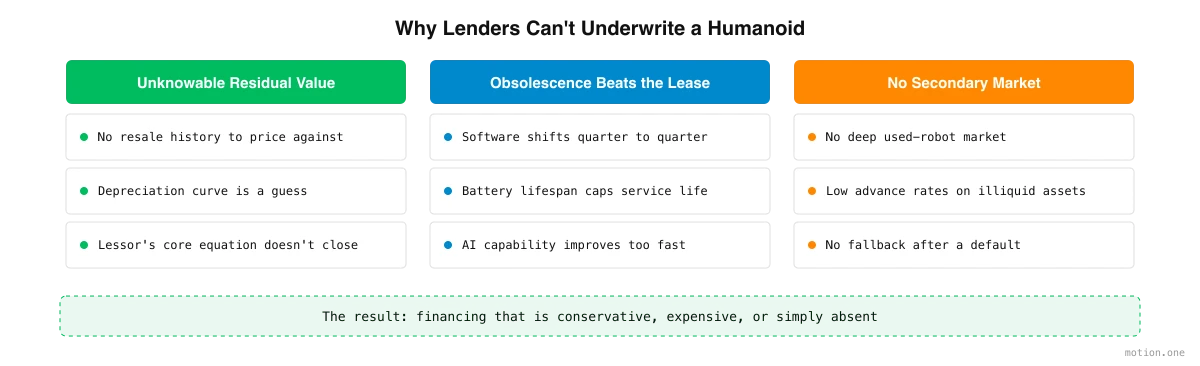
Equipment finance is an old, well-understood business. A lessor buys an asset, lets a company use it for a fixed term, and prices the lease around one central number: how much the asset will be worth when the term ends. That logic works beautifully for forklifts, trucks and machine tools. It works poorly for humanoid robots, for three connected reasons.
Residual value is the whole game and it's unknowable
A lessor prices a lease by taking the cost of the equipment and subtracting its expected residual value, what the asset can be sold for at the end of the term. The lower the expected residual, the higher the monthly cost to the customer, because the lessor has to recover more of the purchase price during the lease itself.
To set that residual, lenders evaluate depreciation curves, resale value at end of term, and whether the lease length lines up with the equipment's expected working life. For mature equipment categories, decades of data make those estimates routine. For humanoid robots, there is no such history. When the resale value is genuinely unknowable, the core equation a lessor relies on does not close, so they either decline the deal or price in a large margin of safety that makes it unattractive.
Obsolescence moves faster than the lease term
Automation and AI hardware run on much shorter innovation cycles than traditional machinery. A press brake bought today will be broadly competitive in ten years. A humanoid robot might be materially out-of-date well inside a standard lease term.
Several forces drive this. Software updates can change what a robot is capable of from one quarter to the next. Battery lifespan degrades and sets a ceiling on useful service life. And the underlying AI capability - how well the machine perceives, plans and manipulates - is improving so quickly that this year's flagship can feel ordinary in short order. Each of these makes the residual even harder to forecast, because the lessor is not just guessing at wear and tear, but at the pace of an entire field.
There is no secondary market to fall back on
Lenders manage risk partly through liquidity. New, standardized equipment that holds its value and is easy to resell commands a higher advance rate, or loan-to-value, because the lender can recover its money by selling the asset if a deal goes wrong. Specialty or illiquid equipment carries lower advance rates for the opposite reason.
Humanoid robots sit firmly in the illiquid bucket. There is no established, deep used-robot market a lender can lean on to value a unit or to offload one after a default. Without that fallback, the asset offers the lender little protection, so the financing on offer is conservative, expensive, or simply absent. The very feature that makes traditional equipment financeable - a liquid resale market - is exactly what humanoid robotics has not had time to build.
The capex wall for buyers
Stack these factors together and you get a hard outcome for the buyer. The robot is expensive upfront. Conventional financing is reluctant or costly because residual value is uncertain, obsolescence is fast, and there is nowhere to resell. So the buyer is pushed toward paying cash.
For a large enterprise, a six- or seven-figure capital outlay is a budgeting exercise. For a mid-sized manufacturer, it is often a non-starter. The money is tied up in a single asset whose future value is unclear, the technology might be superseded before the investment is recovered, and the flexibility to change course is gone. Faced with that, many capable adopters simply wait. The result is a market where the people who most need automation are the ones least able to finance it.
How leasing and embedded finance close the gap
The way through is to stop treating a humanoid robot like a truck the buyer must own, and start treating access to it as a service.
Robot-as-a-Service, or RaaS, emerged precisely to move the cost from capex to opex. Instead of a large upfront purchase, the buyer pays a recurring fee to use the robot. That single shift removes the capital barrier, lets a company match cost to the value the robot produces, and sidesteps the buyer's exposure to obsolescence and resale risk. It is the same instinct that reshaped software a decade ago, applied to physical machines. We have written more about that transition in leasing as the fix.
But moving cost off the buyer's balance sheet does not make the cost disappear. It moves onto the provider's balance sheet instead. Someone still has to fund the hardware, carry the residual-value risk, and absorb the uncertainty that made lenders nervous in the first place. This is the genuine challenge inside RaaS: providers can find themselves financing a growing fleet of expensive, fast-depreciating assets out of their own capital, which limits how fast they can grow.
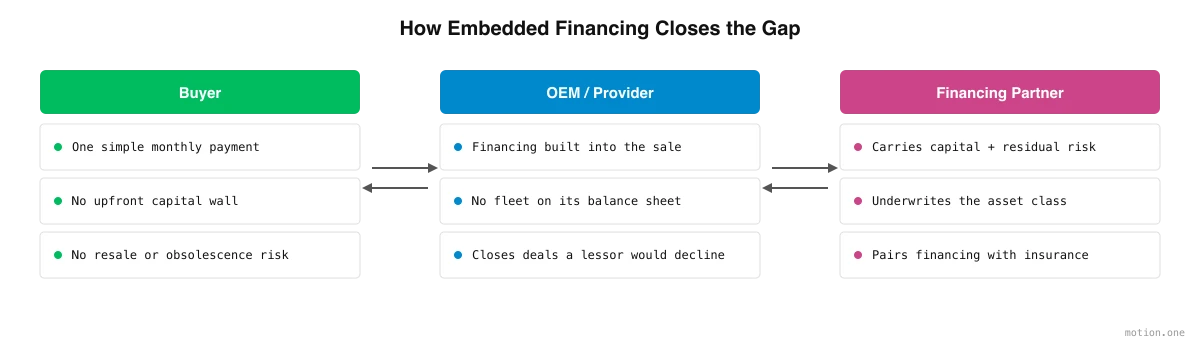
Embedded financing is what makes the model durable. Instead of bolting financing on after the sale, it is built into the point of sale: the buyer can lease or pay over time at the moment they commit, while a dedicated financing partner carries the capital and the risk. That partner is structured to do what a generalist lender cannot - underwrite the specific residual, obsolescence and liquidity profile of humanoid robots, and pair the financing with the right protection. Insurance is a natural companion here, because pricing risk on machines without a long track record is its own discipline, one we explore in insuring humanoids.
When financing and risk-bearing are handled by a partner built for the asset class, the buyer gets a simple monthly commitment, the provider is not forced to fund the entire fleet alone, and the deal that a traditional lessor would have declined becomes possible.
Where this goes
The hard part of humanoid robotics is no longer only engineering. It is increasingly financial: how to let a manufacturer adopt a six-figure machine without betting the business on a resale market that does not yet exist. The companies that solve the money problem will do as much to put robots to work as the companies building the robots. As leasing, RaaS and embedded finance mature, the upfront wall that keeps capable adopters on the sidelines should start to come down - and the gap between what humanoids can do and where they actually work should begin to close.