The First Humanoid Integration Mission: What to Expect in 12 Weeks
Deploying your first humanoid robot doesn't have to be a leap of faith. Here's a week-by-week breakdown of what a structured integration mission looks like - from site assessment to go-live.
Motion1 Inc. ·

What an Integration Mission Is
An integration mission is a structured engagement - typically twelve to fifteen weeks - in which a Field Deployment Engineer comes to your manufacturing facility, deploys humanoid robots into your operations, trains your team to manage them, and hands off a fully operational system. It is designed specifically for manufacturers who want humanoid automation but do not have robotics expertise in-house, which is to say, the vast majority of small and mid-size manufacturers in existence.
Most of those weeks go into the physical AI rather than into the robot. The hardware arrives ready. What has to be built is the part that knows your tasks, your layout and your exceptions.
The concept is straightforward: you provide the operational knowledge - what tasks need to be done, how your production flows, what your quality standards are - and the FDE provides the robotics expertise. The AI Workflow Builder bridges the two, turning your operational requirements into robot-executable workflows that are validated in simulation before they ever reach the floor.
What follows is a week-by-week account of what the process actually looks like, what is expected of your team at each stage, and what you should have in hand by the time the FDE walks out the door.
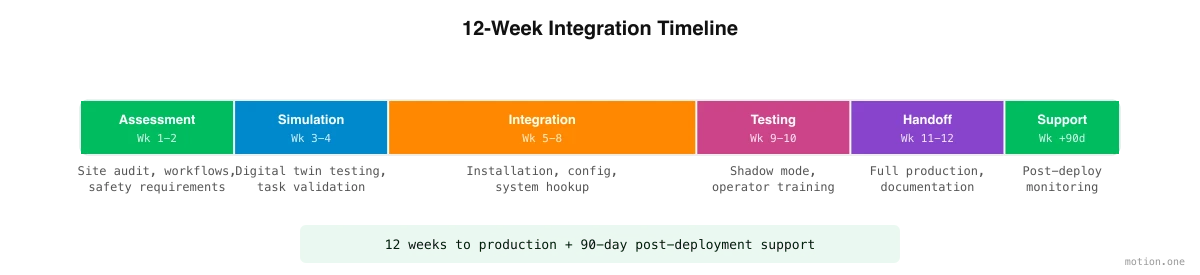
Weeks One and Two: Site Assessment and Planning
The mission begins with the FDE visiting your facility for a comprehensive production audit. This is not a cursory walkthrough or a sales presentation - it is a detailed, methodical examination of your operations designed to identify the tasks where humanoid automation will deliver the greatest impact with the lowest risk.
The FDE spends time on the factory floor with your operations manager and shift supervisors, observing production flows, measuring cycle times, documenting workstation layouts, and cataloguing the edge cases that your team handles instinctively but that a robot will need to be taught explicitly. Which tasks have the highest volume? Which have the most difficulty retaining workers? Where are the bottlenecks that constrain overall throughput?
From this assessment, the FDE and your operations team jointly select two or three target tasks for the initial deployment. These are typically repetitive physical tasks - packaging, palletising, material handling, sorting - that are well-suited to humanoid capabilities and where the business case for automation is clearest.
The output of this phase is a deployment plan that specifies exactly what will be automated, the success criteria for each task (measured in terms of completion rate, cycle time, and quality), the timeline for each phase of the mission, and the resources required from your team. This plan is your contract with reality - it sets expectations that both sides can be held accountable to.
Weeks Three and Four: Environment Capture and Simulation
With the deployment plan approved, the focus shifts to creating a digital twin of your facility. Your operators are asked to record themselves performing the target tasks, using point-of-view cameras that capture their exact perspective, hand movements, and decision-making in real time. This is not a performance - it is a working recording of normal operations, complete with the natural variation and edge case handling that makes expert knowledge so valuable.
Simultaneously, photographs and video of the target workstations are captured and processed into a three-dimensional simulation environment. This digital twin replicates the geometry of your facility, the physics of the objects your robots will handle, and the spatial relationships between equipment, conveyors, pallets, and storage areas.
Once the simulation is built, the humanoid begins training. Using reinforcement learning in simulation, it practises each target task thousands of times within the digital twin, refining its approach with every iteration. Your team can review simulation results to confirm that the robot's behaviour matches their expectations - and provide feedback that the FDE incorporates into refined training parameters.
Your involvement during this phase is modest: a few hours of demonstration per task from your most experienced operators, plus review sessions with the FDE. The heavy lifting - simulation construction, policy training, and validation - is handled by the AI platform.
Weeks Five Through Eight: Integration and Configuration
This is the phase where the humanoid physically arrives at your facility and the work moves from the virtual to the real.
The FDE installs the humanoid at the target workstation and begins the process of transferring trained policies from simulation to real hardware. This is not a simple copy-paste operation - it involves a progressive transfer process where the robot's behaviour is validated in stages of increasing complexity, from basic movements to full task execution under production conditions.
During this phase, the FDE uses the Workflow Builder to fine-tune workflows based on real-world conditions that the simulation may not have captured perfectly. Minor adjustments to gripper force, movement speed, visual recognition thresholds, and error handling routines are made iteratively, with each adjustment tested immediately on the factory floor.
If your operations require integration with existing systems - ERP, MES, warehouse management - this is handled during the integration phase. The fleet management platform provides standard interfaces for common enterprise systems.
Safety validation is conducted throughout this phase. The humanoid's behaviour is evaluated against your facility's safety requirements, and appropriate safeguards - speed limits, force limits, exclusion zones, emergency stop procedures - are configured and tested.
Your involvement increases during this phase. Daily check-ins with the FDE allow your operations team to provide feedback on workflow accuracy, flag edge cases that emerge during real-world testing, and begin building familiarity with the fleet management dashboard.
Weeks Nine and Ten: Production Testing
With the integration complete, the humanoid runs alongside your normal production for a sustained period of real-world validation. This is not a demo or a proof of concept - it is production testing under actual conditions, with actual products, at actual line speeds, across actual shifts.
Performance is measured against the success criteria defined in the deployment plan:
- Task completion rate - target: above ninety-five percent
- Cycle time - relative to human baseline
- Uptime - as a percentage of scheduled operating hours
- Quality metrics - specific to your operation
This phase exists to catch issues that only manifest under sustained production conditions - intermittent edge cases, gradual performance drift, interactions with shift changes and production schedule variations. Problems identified during production testing are resolved by the FDE before handoff, ensuring that what you receive at go-live is genuinely production-ready.
Weeks Eleven and Twelve: Training and Handoff
The final phase transfers operational ownership from the FDE to your team. Two or three operators complete training on the fleet management platform, covering task assignment, performance monitoring, troubleshooting procedures, and the process for adding or modifying workflows.
The FDE delivers a complete deployment playbook that documents everything your team needs to manage the humanoid independently: operating procedures, maintenance schedules, escalation paths for issues that require external support, and guidelines for expanding the deployment with additional units or tasks.
A final acceptance test validates that all success criteria from the deployment plan have been met. The FDE hands off, and your team takes over.
After Go-Live: The First Ninety Days
The handoff at week twelve is not the end of the story - it is the beginning of autonomous operation. The first ninety days follow a predictable pattern that is worth understanding in advance.
During the first thirty days, the focus is stabilisation. Your operators build confidence with daily management routines, and minor workflow adjustments are made based on production data. Remote support is available for any issues that arise, though most teams find they need it less than they expected.
Days thirty-one through sixty are typically characterised by optimisation. Cycle times improve as the humanoid accumulates operational data and the operations team becomes more proficient with the fleet management tools. Operators often begin experimenting with task modifications and exploring how to get more out of the system.
By days sixty-one through ninety, the ROI data is clear and documented, the operations team is self-sufficient, and the conversation typically shifts to planning additional deployments. The second humanoid deploys significantly faster than the first, because the simulation environments, trained policies, and team expertise already exist.
Is an Integration Mission Right for Your Facility
The integration mission model works best for manufacturers who have repetitive physical tasks that are hard to staff, an operations manager who can serve as the primary point of contact, facility access during working hours for the twelve-week period, and a budget that accommodates a monthly operating expense for humanoid automation.
It is not the right approach for manufacturers whose tasks are highly unpredictable with no repeatable patterns, who need results in under four weeks, whose facilities lack basic connectivity, or who do not have an internal champion willing to own the project through to completion.
For manufacturers who do fit the profile, the integration mission provides a structured, low-risk path from "we are interested in humanoid automation" to "we have a fully operational humanoid managed by our own team" - in twelve weeks, with no robotics expertise required.