Labour Shortages in European Manufacturing: Can Humanoid Robots Fill the Gap?
European manufacturers face a structural labour crisis. Humanoid robots offer a path to maintaining production capacity - but only if deployment becomes accessible to SMEs.
Motion1 Inc. ·
A Structural Crisis, Not a Cyclical One
European manufacturing is facing a workforce shortage that will not resolve itself. This is not a temporary dip caused by economic cycles or post-pandemic disruption. It is a structural, demographic reality driven by forces that have been building for decades and that no amount of recruitment spending can reverse.
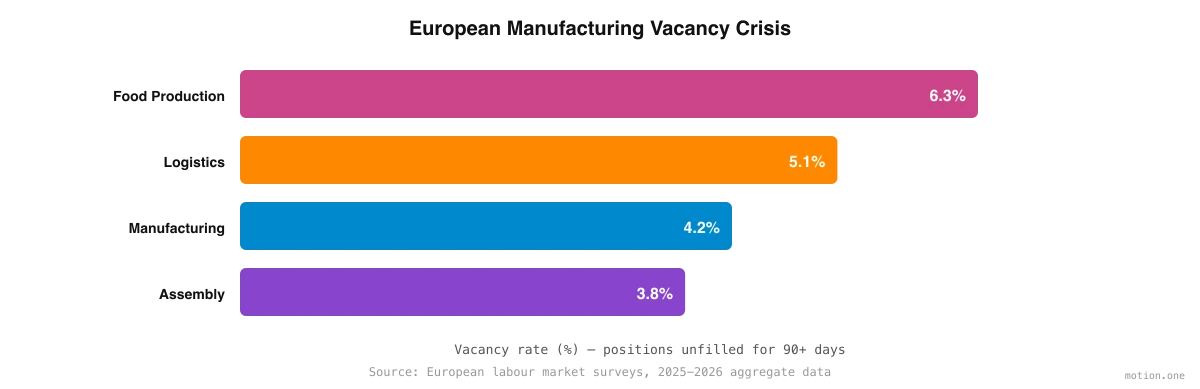
The numbers are stark. According to Eurostat, seventy-seven percent of EU manufacturers report difficulty finding workers with the right skills. Multiple EU countries have manufacturing vacancy rates above four percent - a level that indicates systemic shortage rather than normal labour market friction. The average age of the manufacturing workforce continues to climb, with fewer young people entering the trades each year. Labour costs in Western Europe are among the highest globally, with employer social charges adding thirty to forty percent on top of gross wages.
These are not problems that can be solved by raising wages, though wages are certainly rising. They are not problems that can be solved by automation awareness campaigns, though awareness is growing. They are demographic realities: the workers are aging out of the labour force, and there are not enough young workers choosing manufacturing careers to replace them. The pipeline is structurally insufficient.
For operations managers at small and mid-size manufacturers, this shortage is not an abstract macroeconomic trend. It is the daily reality of running production lines with unfilled positions, relying on overtime to cover gaps, watching quality deteriorate as fatigued workers push through extended shifts, and turning down orders because you cannot staff the capacity to fulfill them.
The Cost of Empty Workstations
Labour shortages do not merely reduce headcount. They cascade through the entire operation in ways that are often underestimated.
Reduced capacity is the most obvious impact. When positions go unfilled, production lines run below maximum throughput. A manufacturer operating at eighty percent capacity due to staffing shortages is leaving twenty percent of its revenue potential on the table - not because of insufficient demand or equipment limitations, but because there are not enough hands to do the work.
Overtime costs compound the problem. Existing workers cover gaps at premium rates, typically 150 to 200 percent of standard wages. This is expensive in the short term and unsustainable in the long term, as chronic overtime leads to burnout, increased absenteeism, and higher turnover - which further exacerbates the shortage.
Quality suffers when workers are stretched thin. Fatigued operators make more errors, miss more defects, and take more shortcuts. For manufacturers in regulated industries - food and beverage, pharmaceuticals, automotive - quality issues can trigger recalls, regulatory action, and reputational damage that far exceeds the cost of the labour shortage itself.
Delivery reliability erodes as production capacity becomes unpredictable. Customers who cannot depend on consistent delivery timelines will eventually find suppliers who can. For SME manufacturers competing against larger firms with deeper labour pools, this is an existential threat.
A single unfilled position on a production line can cost a manufacturer €50,000 to €100,000 annually in lost productivity - and most facilities have multiple unfilled positions at any given time.
Why Traditional Automation Has Not Solved the Problem
Industrial robotic arms have been in factories for decades, and they have been enormously successful at automating high-volume, high-precision, fixed-position tasks on dedicated production lines. But they have not solved the labour shortage problem, because the shortages are concentrated in exactly the tasks that traditional robotic arms cannot handle.
Robotic arms excel in structured, predictable environments where the task is precisely defined and the workspace is purpose-built. They are less effective - and often impractical - for tasks that require mobility between workstations, manipulation of diverse objects with varying shapes and sizes, operation in environments designed for humans rather than machines, and the kind of adaptive dexterity that routine manufacturing work often demands.
These are the tasks where labour shortages bite hardest:
- End-of-line packaging, where products of varying sizes must be picked, inspected, and packed.
- Material handling, where components must be moved between workstations across a factory floor.
- Light assembly, where parts must be oriented, inserted, and secured with human-like hand coordination.
- Quality inspection, where visual assessment and physical manipulation go hand in hand.
This is the gap that humanoid robots are designed to fill. Their human form factor means they can operate in spaces designed for human workers, use tools designed for human hands, navigate paths designed for human feet, and perform tasks designed for human dexterity. They do not require the purpose-built work cells and infrastructure modifications that traditional robotic arms demand.
Making Humanoids Accessible to the Manufacturers Who Need Them Most
The manufacturers most affected by labour shortages are, paradoxically, the ones least equipped to deploy humanoid robots using traditional methods. A fifty-to-five-hundred-employee manufacturer does not have a robotics team. It does not have €100,000 to spend on integration for each deployment. It does not have months to wait while engineers iterate on the factory floor.
This is why the accessibility of the deployment platform matters as much as the capability of the hardware. The deployment must remove the need for robotics expertise inside the factory, so that the operations manager - the person who understands the work - can simply hand over the task rather than write a programming brief. It must use AI-driven simulation to replace months of manual engineering with days of automated training. It must offer leasing rather than purchasing, so that the entire cost converts to a monthly operating expense that fits within the existing budget structure. And it must provide fleet management tools that the existing operations team can use independently, without ongoing support from external specialists.
When these conditions are met, humanoid automation becomes accessible to the manufacturers who need it most - the small and mid-size companies that form the backbone of European manufacturing and that are most vulnerable to the demographic forces driving the labour crisis.
A Phased Path to Adoption
Manufacturers considering humanoid automation do not need to transform their entire operation overnight. The most effective adoption strategy is phased, starting small and scaling based on demonstrated results.
The first phase is a pilot deployment of one or two humanoids on the highest-impact, hardest-to-fill positions. The goal is not to automate the entire factory but to validate the technology in your specific environment, measure real return on investment, and build confidence within the operations team. This phase typically takes twelve to fifteen weeks from assessment to go-live.
The second phase expands deployment to additional positions within the same facility, leveraging the workflows, simulation environments, and operational knowledge built during the pilot. Because the infrastructure already exists, the second and third humanoids deploy significantly faster than the first.
The third phase scales across shifts, production lines, and potentially multiple facilities. The fleet management platform ensures consistency, and the marginal cost of each additional unit continues to decrease as the data and workflow library grows.
This phased approach manages risk while building the organisational capability needed to scale humanoid automation effectively. The manufacturers who begin Phase 1 today will be scaling in Phase 3 while their competitors are still evaluating whether to start.