Motion OS: one platform to put humanoids to work on the factory floor
Motion OS replaces the patchwork of tools behind every humanoid deployment with one agentic platform: any robot, any model, live on your line in weeks.
Motion team ·
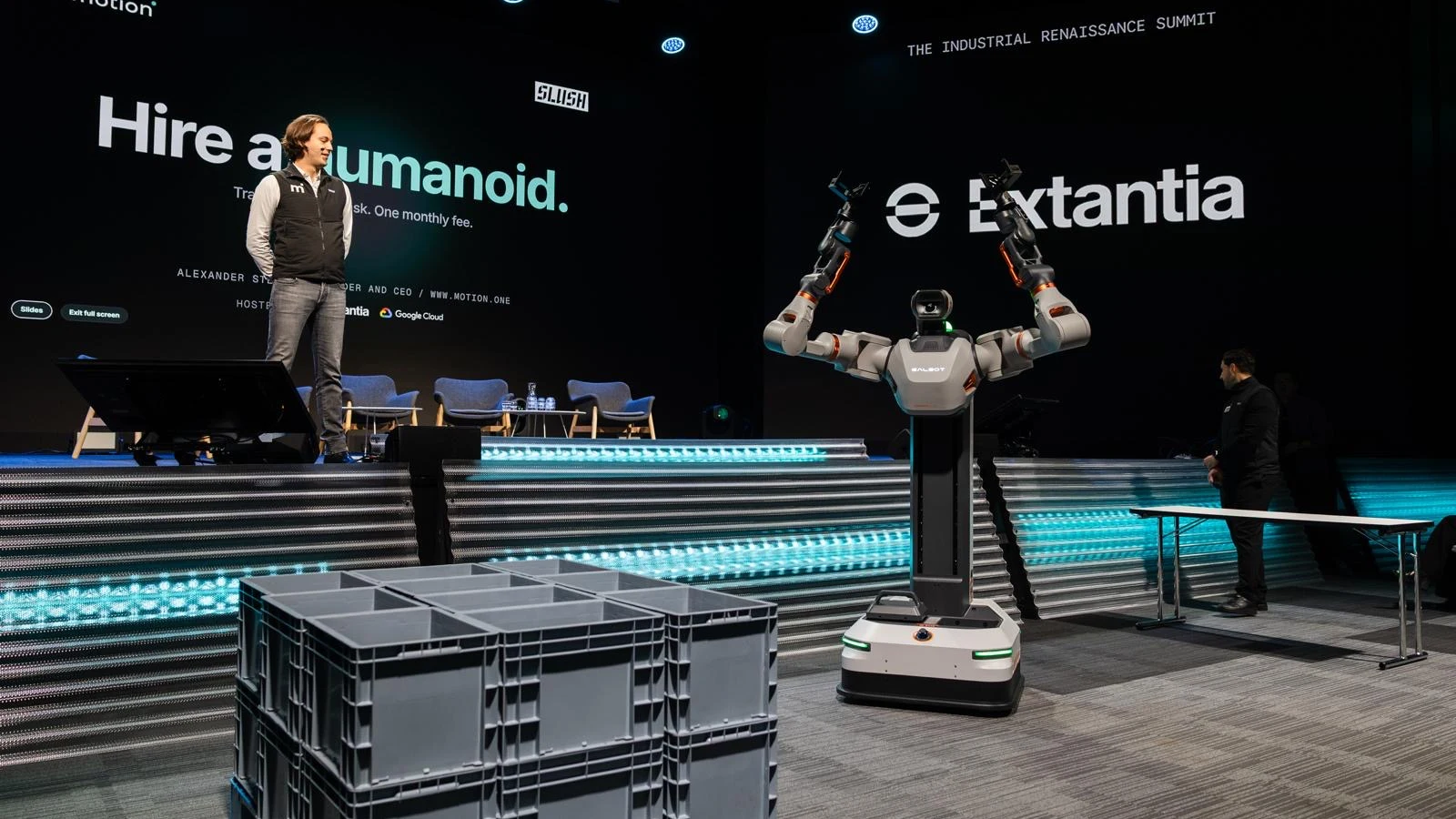
At Slush in Helsinki, we put a humanoid robot on stage and had it palletise grey crates while we talked. It is one of the robots we deploy for our customers, doing a task we run on real lines. The robot was the part people filmed. The part we came to announce sits behind it: Motion OS, the operating system we built to deploy physical AI inside the factory.
The problem: ten tools for one robot
Putting a humanoid to work on a production line takes far more than the robot. Today a single deployment needs a patchwork of tools and people:
- a way to film the task and judge whether a robot can do it
- simulation software to rebuild the station
- headsets and cameras to record how operators do the work
- teleoperation to collect robot data
- a training pipeline and a choice of AI model
- a safety file, a risk assessment and insurance
- connections to the plant's own systems
- maintenance, spare parts and someone to call when the robot stops
Each of those comes from a different vendor, runs on a different system and is stitched together by hand by an engineer on site. That is why a deployment takes months, and why most factories never get past a demo.
Demand is not the problem. More than 50 companies have already reached out to us with tasks they want automated: pick and place, case packing, palletising, machine tending. The question is how to deploy fast enough to meet it. Europe needs tens of thousands of new robots a year just to keep up with the people who are retiring, and nobody gets there one engineer and one robot at a time.
What Motion OS is
Motion OS is one agentic platform that takes a humanoid from a customer's first video to a robot working a real shift, and then keeps it running. Agents do the work at each step. Our engineers check and approve it.
It is modular and hardware-neutral by design:
- Any robot. We pick the right humanoid for each task from every major maker, and tie the customer to none.
- Any hand. Grippers and dexterous hands are chosen per object, not per brand.
- Any capture device. Headsets, cameras and 360 scans feed the same pipeline.
- Any model. We benchmark the models from the leading AI labs and use the best one for each task.
Robots will get cheaper and models will keep getting better. Motion OS is built to run on whatever is best next year, not to lock in what is best today.
How a deployment runs, in five phases
1. Qualify. A plant films the task on a phone and sends it. Motion OS breaks the task into steps and cycle times, finds every object the robot will touch, rebuilds each one in 3D with its weight and how to grip it, and scores the use case against our standard checks. The customer knows within days whether the task is a good fit.
2. Plan. The platform picks the robot and the hand for the task, and a short 360 walk-through of the station becomes a digital twin.
3. Teach. The plant's own operators wear headsets and record the job. Our engineers teleoperate the robot remotely, and the best runs become training data. Motion OS benchmarks the models, trains the chosen one on the customer's data, and lets the robot practise in the digital twin until it is reliable.
4. Go live. The robot runs on the real line, on a real shift. We set up quality checks, connect it to the plant's systems, prepare the safety file for sign-off and show the payback on the customer's own numbers.
5. Run. The plant sees every robot live: its task, its output and its health. When something goes wrong, an agent handles it in minutes: an engineer is sent, the part is ordered and the plant is informed. Repairs are guided step by step with AR glasses, and every robot is valued on its real wear.
On average, a deployment goes live in 4 to 8 weeks.
Why it gets better with every robot
Every deployment feeds the next one:
- Deployment data makes the models better at real factory work.
- Risk data from every shift makes the robots cheaper to insure.
- Wear and residual value data makes them cheaper to finance.
- Repair data teaches us to fix robots faster, and in time, to let robots help fix robots.
That is why we offer humanoids as a service: robot, training, safety, insurance and maintenance in one monthly fee, with no upfront cost. The more robots run on Motion OS, the better each of those parts gets.
Where we are going
Today we deploy robots ourselves, plant by plant, with Motion OS. Next, integrators will deploy on it too, while we finance and insure the robots. The goal is simple: put physical AI to work in Europe's factories at the pace the continent needs.
If you have a task you would like a humanoid to take on, book an assessment. Send us a video of the task, and we will tell you on the call whether it fits.