Humanoid Robot Safety and EU Compliance: A Practical Guide
Deploying humanoid robots in European manufacturing requires meeting strict safety and regulatory standards. Here is what you need to know.
Motion1 Inc. ·
Deploying humanoid robots in a manufacturing facility is no longer a futuristic concept. It is happening now, across European factories, warehouses, and production lines. But with deployment comes a critical question that every manufacturer must answer before a single robot starts operating: is this deployment safe and compliant?
The European Union has some of the most comprehensive regulatory frameworks in the world when it comes to industrial machinery, artificial intelligence, and workplace safety. For manufacturers deploying humanoid robots, these regulations are not optional considerations - they are legal requirements with real consequences for non-compliance.
This guide walks through the regulatory landscape, explains the key standards and directives that apply, and provides a practical checklist for achieving and maintaining compliance.
The Regulatory Landscape for Humanoid Robots
Humanoid robots occupy an unusual position in the regulatory framework. They are not traditional industrial robots bolted to the floor behind safety cages. They are mobile, autonomous, and designed to work alongside humans. This means they fall under multiple overlapping regulatory categories.
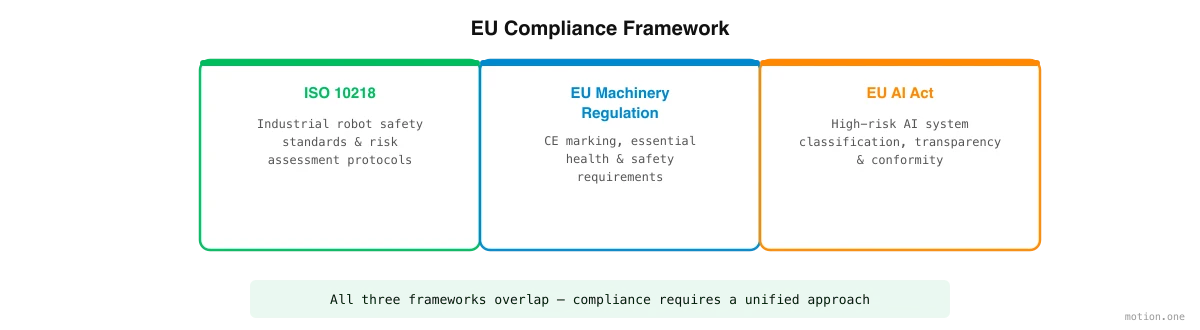
At a high level, three regulatory frameworks are most relevant:
- Industrial machinery safety standards (ISO 10218, ISO 15066)
- The EU Machinery Regulation 2023/1230 (replacing the older Machinery Directive 2006/42/EC)
- The EU AI Act (Regulation 2024/1689)
Each of these frameworks addresses different aspects of humanoid robot deployment. Together, they define the safety, documentation, and operational requirements that manufacturers must meet.
It is worth noting that the regulatory landscape is still evolving. Humanoid robots challenge existing categories, and regulators are actively working on guidance specific to humanoid and collaborative robot systems. Manufacturers should treat compliance as an ongoing process, not a one-time certification exercise.
ISO 10218 and Industrial Robot Safety
ISO 10218 is the foundational international standard for industrial robot safety. It comes in two parts:
- ISO 10218-1 covers the safety requirements for the robot itself - its design, construction, and built-in protective measures.
- ISO 10218-2 covers the safety of robot systems and their integration into manufacturing environments - including cell layout, safeguarding, and risk assessment.
For humanoid robots, ISO 10218 is relevant but not always sufficient on its own. The standard was originally designed for traditional industrial robots operating in caged environments. Humanoid robots that work alongside human operators fall into the category of collaborative robots (cobots), which are additionally governed by ISO/TS 15066.
ISO/TS 15066 defines four collaborative operation modes:
- Safety-rated monitored stop. The robot stops when a human enters the shared workspace.
- Hand guiding. A human physically guides the robot through movements.
- Speed and separation monitoring. The robot slows down or stops based on the proximity of humans.
- Power and force limiting. The robot is designed so that any contact with a human stays below pain and injury thresholds.
Most humanoid robot deployments in manufacturing rely on a combination of speed and separation monitoring and power and force limiting. The specific approach depends on the tasks being performed, the robot's payload capacity, and the layout of the workspace.
Manufacturers should work with their robot supplier and a qualified safety integrator to determine which collaborative modes apply to their deployment and to validate compliance through testing.
EU Machinery Regulation 2023/1230
The EU Machinery Regulation (2023/1230) is the successor to the long-standing Machinery Directive (2006/42/EC). It entered into force in 2023 and becomes fully applicable in January 2027, with a transition period during which manufacturers can comply with either the old directive or the new regulation.
The new regulation introduces several changes that are directly relevant to humanoid robot deployments:
Digital documentation. The regulation allows technical documentation and instructions to be provided in digital format, reducing the burden of paper-based compliance records. For robot fleets managed through software platforms, this aligns well with centralised documentation approaches.
Cybersecurity requirements. For the first time, the Machinery Regulation explicitly addresses cybersecurity. Humanoid robots connected to networks - which is essentially all of them - must be protected against unauthorised access, tampering, and data corruption. This includes secure software update mechanisms, access controls, and network security measures.
Substantial modification. The regulation clarifies when modifications to existing machinery trigger a new conformity assessment. For humanoid robots that receive frequent software updates (new workflows, updated AI models, changed safety parameters), understanding when an update constitutes a "substantial modification" is critical. Not every software update triggers a new assessment, but changes that affect the robot's safety functions or intended use likely do.
Self-learning systems. The regulation acknowledges that some machines incorporate AI and machine learning capabilities. For these systems, manufacturers must ensure that the machine remains safe throughout its learning process - not just at initial deployment. This has direct implications for humanoid robots that adapt their behaviour based on operational experience.
To comply with the EU Machinery Regulation, manufacturers deploying humanoid robots must:
- Conduct a thorough risk assessment covering all foreseeable hazards
- Apply essential health and safety requirements (EHSR) as defined in Annex III
- Prepare technical documentation (which can now be digital)
- Issue an EU declaration of conformity
- Affix the CE marking
The robot OEM is typically responsible for CE marking the robot itself. But the manufacturer deploying the robot is responsible for ensuring the overall system - robot, workspace, integration, and operational procedures - is safe and compliant.
EU AI Act Implications
The EU AI Act (Regulation 2024/1689) is the world's first comprehensive regulation of artificial intelligence. It entered into force in August 2024, with different provisions becoming applicable on a staggered timeline through 2027.
For humanoid robots, the AI Act is relevant because these robots are controlled by AI systems - from perception and navigation to task planning and human interaction. The AI Act classifies AI systems into risk categories, and the classification determines the regulatory requirements.
High-risk AI systems. AI systems used as safety components of products that are themselves subject to third-party conformity assessment (like machinery under the Machinery Regulation) are classified as high-risk. This means the AI systems controlling humanoid robots in manufacturing environments are very likely to be classified as high-risk under the AI Act.
High-risk AI systems must meet requirements including:
- Risk management. A continuous risk management process throughout the AI system's lifecycle.
- Data governance. Training, validation, and testing datasets must meet quality criteria.
- Technical documentation. Detailed documentation of the AI system's design, development, and intended purpose.
- Record-keeping. Automatic logging of events during operation to enable traceability.
- Transparency. Clear information to deployers about the AI system's capabilities, limitations, and intended use.
- Human oversight. The AI system must be designed to allow effective human oversight, including the ability to intervene and override.
- Accuracy, robustness, and cybersecurity. The AI system must achieve appropriate levels of accuracy and be resilient to errors, faults, and adversarial attacks.
For manufacturers deploying humanoid robots, the practical implication is that they need visibility into the AI systems running on their robots. This means working with their robot supplier and software provider to ensure that the necessary documentation, logging, and oversight mechanisms are in place.
Risk Assessment Per Deployment
One of the most important compliance activities is the deployment-specific risk assessment. This goes beyond the general risk assessment performed by the robot OEM. It evaluates the specific hazards present in your facility, with your workers, performing your tasks.
A thorough deployment-specific risk assessment should cover:
Physical hazards. What are the potential contact scenarios between the robot and human workers? What forces and speeds are involved? Are there pinch points, crush zones, or areas where a worker could be trapped?
Environmental hazards. What are the floor conditions? Are there slopes, obstacles, or wet surfaces? What is the lighting? Are there temperature extremes that could affect robot performance?
Task-specific hazards. What objects is the robot handling? Are they sharp, hot, heavy, or fragile? What happens if the robot drops an object? What are the consequences of a task executed incorrectly?
Interaction hazards. How do human workers interact with the robot? Are there shared pathways? Shared workstations? Handover points where a human receives an object from the robot?
Cybersecurity hazards. What happens if the robot's network connection is disrupted? What if an unauthorised user gains access to the fleet management system? What if a software update introduces a bug in safety-critical behaviour?
The risk assessment should result in a documented list of hazards, risk ratings, and mitigation measures. It should be reviewed whenever the deployment changes - new tasks, new workspace layouts, new robot models, or significant software updates.
Safety-by-Design in Robot Deployment Platforms
The software platform used to build workflows and manage humanoid robots plays a critical role in safety. A well-designed platform embeds safety at the architectural level, rather than treating it as an add-on.
Key safety-by-design principles for these platforms include:
Behaviour boundaries. The platform should enforce hard limits on robot behaviour - maximum speeds, force limits, permitted work zones - that cannot be overridden by task instructions or AI learning. These boundaries should be configurable per deployment and per robot model.
Validation before execution. When a new workflow is built or the platform generates task instructions, it should validate those instructions against safety rules before sending them to the robot. Tasks that violate safety constraints should be rejected with a clear explanation.
Audit trails. Every instruction sent to every robot should be logged, along with the source of the instruction (human operator, workflow builder, automated schedule) and the outcome. This creates the traceability required by both the Machinery Regulation and the AI Act.
Graceful degradation. When a robot encounters an unexpected situation, the platform should default to safe behaviour - stopping, retreating to a safe position, or requesting human intervention. The system should never "guess" its way through an ambiguous safety scenario.
Role-based access control. Not every user should be able to modify safety parameters. The platform should enforce role-based access controls that separate operational tasks (assigning workflows, scheduling) from safety configuration (speed limits, force thresholds, zone boundaries).
Practical Compliance Checklist
For manufacturers preparing to deploy humanoid robots in a European manufacturing environment, here is a practical checklist:
Before procurement:
- [ ] Confirm the robot has CE marking under the applicable directive or regulation
- [ ] Request the EU declaration of conformity and technical documentation from the OEM
- [ ] Verify which collaborative operation modes the robot supports (ISO/TS 15066)
- [ ] Understand the AI systems used and their risk classification under the EU AI Act
- [ ] Evaluate the fleet management platform's safety features (behaviour boundaries, audit trails, access controls)
Before deployment:
- [ ] Conduct a deployment-specific risk assessment covering physical, environmental, task-specific, interaction, and cybersecurity hazards
- [ ] Design the workspace layout with safety zones, emergency stops, and clear signage
- [ ] Configure robot behaviour limits (speed, force, work zones) appropriate to the deployment
- [ ] Establish operator training programmes covering normal operation, emergency procedures, and safety protocols
- [ ] Set up monitoring and logging systems for regulatory traceability
During operation:
- [ ] Monitor robot behaviour and fleet performance continuously
- [ ] Review and update the risk assessment when tasks, layouts, or software change
- [ ] Maintain incident logs and near-miss records
- [ ] Ensure software updates are evaluated for safety impact before deployment
- [ ] Conduct periodic safety audits with qualified personnel
Ongoing:
- [ ] Track regulatory developments - the EU AI Act provisions are still being phased in
- [ ] Engage with industry working groups on humanoid robot safety standards
- [ ] Review OEM security advisories and apply patches promptly
- [ ] Document all compliance activities for potential regulatory inspection
Moving Forward Safely
The regulatory requirements for humanoid robot deployment in Europe are demanding, but they are not insurmountable. They reflect a legitimate concern for worker safety and public trust in AI-powered systems.
Manufacturers who approach compliance proactively - building it into their deployment planning from day one - will find that the process actually improves their operations. A thorough risk assessment identifies real hazards. Proper documentation creates institutional knowledge. Audit trails enable continuous improvement.
The manufacturers who struggle with compliance are typically those who treat it as an afterthought - deploying first and trying to retrofit safety measures later. This approach is more expensive, more disruptive, and more likely to result in gaps.
The bottom line: humanoid robot deployment in Europe is absolutely achievable within the current regulatory framework. It simply requires planning, the right partners, and a commitment to safety as a first principle rather than an obligation.