The Rise of Humanoid Leasing: Why Manufacturers Are Choosing OpEx Over CapEx
Leasing humanoid robots eliminates the upfront capital barrier for SME manufacturers. Here's how the OpEx model works - and why it changes the economics of factory automation.
Motion1 Inc. ·
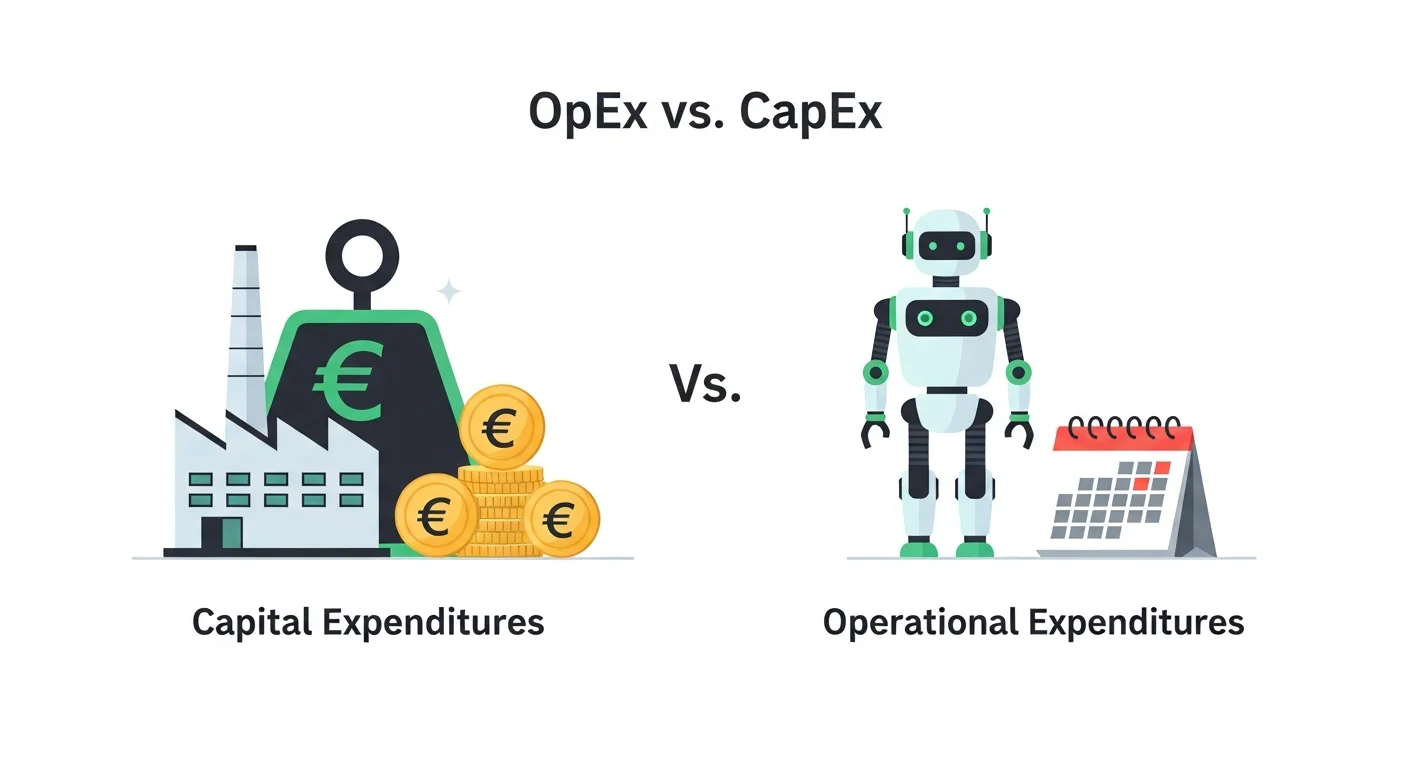
The End of the Capital Expenditure Model
For decades, the industrial robotics market has operated on a straightforward capital expenditure model. A manufacturer buys a robotic arm for €50,000 to €200,000, hires a systems integrator to install and program it, and amortises the total investment over seven to ten years. This model made sense when the technology was mature, the hardware changed slowly, and the return on investment was predictable over long time horizons.
Humanoid robots upend every one of these assumptions. The technology is evolving at a pace that makes ten-year amortisation schedules absurd - a humanoid purchased today will be outperformed by a model half its price within eighteen months. Unit costs are dropping twenty to thirty percent per year, meaning that the asset you paid full price for is depreciating faster than your accounting schedule can reflect. And the integration costs that accompany a purchase - €50,000 to €150,000 on top of the hardware - make the total upfront commitment prohibitive for the small and mid-size manufacturers who stand to benefit most from humanoid automation.
Leasing changes the equation entirely, and it is doing so in a way that is likely to reshape the entire go-to-market model for humanoid robotics.
How Humanoid Leasing Works
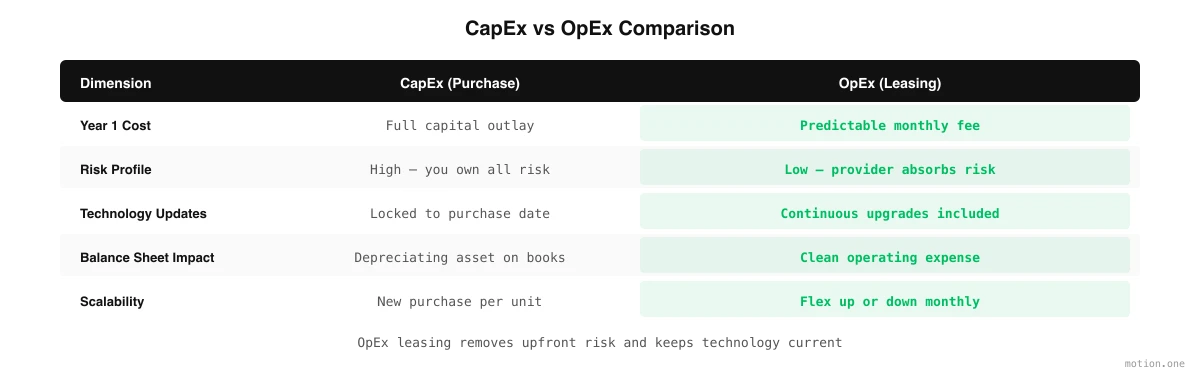
A humanoid lease is structured as an operating lease, which means the monthly payment is a pure operating expense. There is no asset on the balance sheet, no depreciation schedule to manage, and no residual value risk for the manufacturer. The distinction from a finance lease - which is treated as a purchase for accounting purposes - matters enormously for SMEs, where balance sheet cleanliness directly affects borrowing capacity and financial flexibility.
The lease bundles everything into a single monthly cost per unit. Hardware, maintenance, and fleet management software are all included. There is no separate maintenance contract, no spare parts inventory to manage, no surprise repair bills, and no software licensing fees layered on top. If the hardware fails, a replacement unit is shipped. If the software needs updating, patches are deployed automatically. The manufacturer pays one number per month and gets a fully functional humanoid with everything needed to operate it.
Terms are typically thirty-six months, which reflects the current pace of hardware evolution. At the end of the term, the manufacturer can return the units, renew at revised terms, or upgrade to newer hardware. This built-in upgrade path is one of the most compelling aspects of the leasing model - it means manufacturers are never locked into first-generation technology while the market evolves around them.
Why OpEx Wins for Small and Mid-Size Manufacturers
The shift from capital expenditure to operating expenditure is not merely an accounting preference. For SME manufacturers, it removes the four biggest barriers to humanoid adoption.
The first barrier is the upfront capital commitment. A 200-employee manufacturer typically does not have €100,000 or more available for a robotics experiment, even one with a compelling return on investment. Capital budgets are constrained, competing priorities are numerous, and the perceived risk of a new technology makes internal approval difficult. A monthly operating expense, by contrast, is a line item that the operations manager can approve from the existing operating budget. The person closest to the problem - and therefore best positioned to evaluate the solution - makes the decision.
The second barrier is the procurement cycle. Capital expenditure purchases at SMEs often require board approval, competitive bidding, multiple rounds of internal review, and months of deliberation. By the time approval comes through, the market conditions that motivated the original business case may have changed. Operating expenses bypass this cycle entirely. They are approved and managed at the operational level, where decisions can be made in days rather than months.
The third barrier is technology risk. Humanoid hardware is improving rapidly. Locking into a purchase today means committing to specific capabilities at a specific price point, with no ability to benefit from improvements that arrive six or twelve months later. Leasing externalises this risk. When better, cheaper hardware ships, the manufacturer can upgrade at the next renewal rather than writing off a stranded asset.
The fourth barrier is cost predictability. A purchased robot comes with ongoing costs that are difficult to forecast: maintenance, repairs, software updates, component replacements, and eventually end-of-life disposal. A lease converts all of these into a single predictable monthly number. For manufacturers operating on tight margins, this predictability has real value.
Fleet Software as Part of the Package
The fleet management software included in the lease is not an afterthought - it is a critical component of what makes the leasing model work for manufacturers without robotics expertise.
The software provides a dashboard that the operations team uses to manage the humanoid fleet:
- Task assignment - drag-and-drop interface, reassign workflows in real time as production priorities change
- Live telemetry - battery levels, joint positions, temperature, and performance metrics for every unit
- Analytics - utilisation rates, cycle times, and productivity comparisons across shifts and sites
- Multi-OEM support - manage different robot brands from a single interface
Critically, the software is hardware-agnostic. A manufacturer running humanoids from different OEMs manages them all through a single interface. This eliminates the need for multiple proprietary software systems and the training overhead that comes with each one. It also gives the manufacturer negotiating leverage with hardware suppliers, because switching from one brand to another does not require abandoning the management infrastructure.
Scaling the Fleet
One of the most powerful aspects of the leasing model is how naturally it supports scaling. Adding a second or third humanoid is straightforward: the new units arrive pre-configured with existing workflows and plug into the same fleet management dashboard. The deployment time for additional units is a fraction of what the first deployment required, because the simulation environments, trained policies, and operational procedures already exist.
Manufacturing often involves seasonal demand peaks, and leasing accommodates this reality. A manufacturer can scale up for high-volume periods and scale down when demand subsides - something that is impossible with purchased robots, which sit idle during off-peak periods but still depreciate on the balance sheet.
For manufacturers with multiple sites, the software platform ensures consistency. Workflows developed and optimised at one facility can be deployed at another with minimal adaptation. Best practices, performance benchmarks, and trained policies become portable assets that improve with every deployment.
The Broader Industry Shift
The transition from purchase to lease in humanoid robotics mirrors a pattern that has played out across the technology industry. Enterprise software moved from perpetual licenses to SaaS subscriptions. Data centres moved from owned infrastructure to cloud computing. Even traditional industrial equipment is increasingly offered on an as-a-service basis.
In each case, the shift was driven by the same fundamental insight: when technology evolves rapidly, ownership is a liability rather than an asset. The value lies in access to the latest capabilities, not in possessing a specific piece of hardware. Humanoid robotics is following the same trajectory, and the manufacturers who recognise this early will benefit from the flexibility, predictability, and lower barriers that the leasing model provides.
The manufacturers who move first will also have trained workflows, operational data, and team expertise that compound over time - advantages that are difficult to replicate regardless of how much capital a late entrant is willing to deploy.